
AI-native startups generate average revenue per employee of $2.5 million. Traditional companies average $200,000. That is not a percentage improvement. It is a twelve-and-a-half times multiplier, which is a different economic species altogether.
I have watched that slide land in boardrooms, and the response is always a gasp. But there are two distinct kinds of gasp, and which one a board produces tells you quite a lot about where that company will be in a few years.
The first gasp says: that is a crazy number, but it does not impact us, because of reasons one, two, and three. They convince themselves it is an AI bubble, or a startup bubble, or both. Not a real business. Not a seasoned business that has been through the trenches. And to be fair, some of those reasons sound quite sensible in the room.
The second gasp says: what can we do to get that?
Both reactions exist in the same quarterly board pack, sometimes in the same meeting. The first is a managed-decline strategy wearing the face of cautious realism. The second is the start of a transformation plan, which may succeed and may not, but has at least noticed the competitive environment.
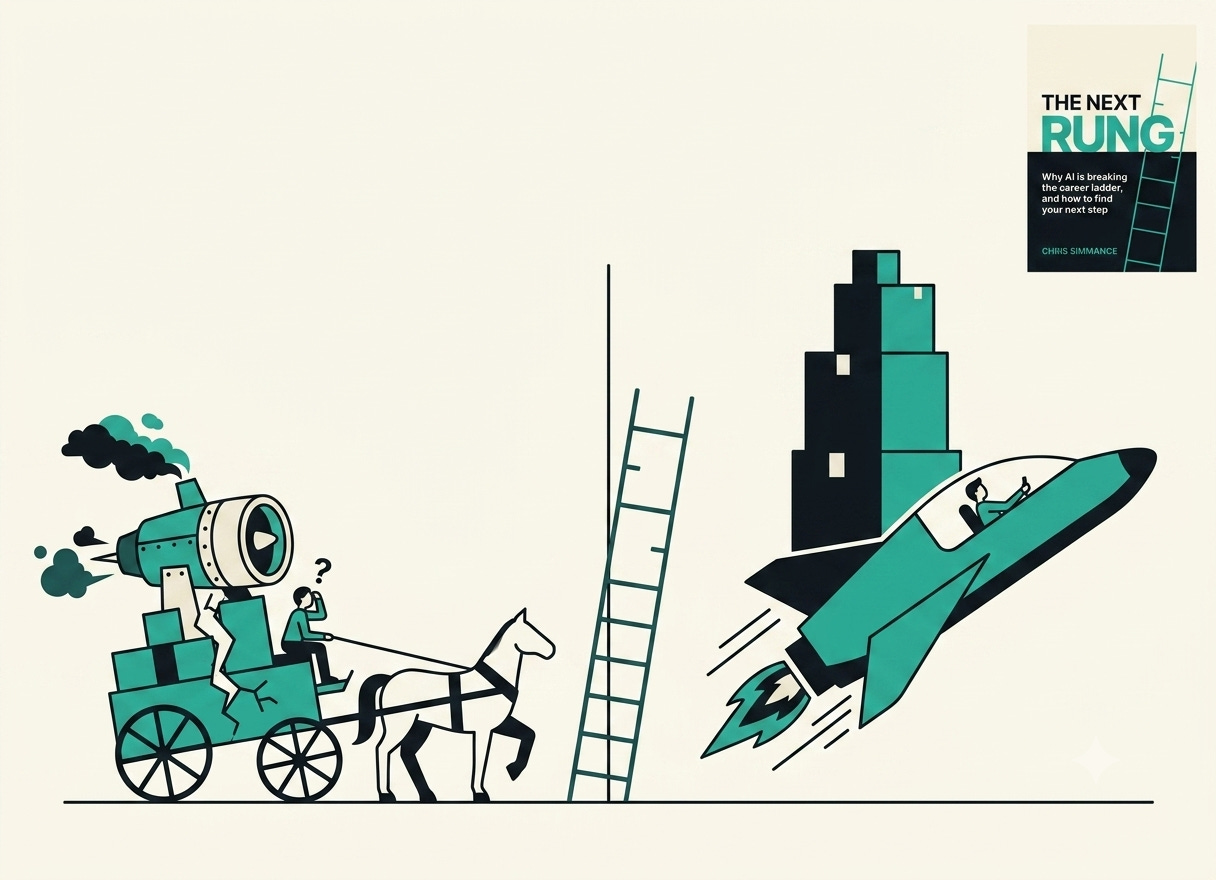
McKinsey’s own framing is blunt. Only 6 per cent of companies are achieving what it calls “transformative” AI impact, and the difference is not how much AI they use. It is whether they have rebuilt their operations around it, or simply bolted it onto what already exists. Bolting AI onto a legacy structure is like putting a jet engine on a horse cart. You get noise and expense, and the cart falls apart.
The thing I keep coming back to, from the advisory side, is that most people inside these firms are on rails. The decisions are not really ones they take. They wake up, they go to work, they do the work in front of them, and they see the failures of other businesses as evidence of their own excellence rather than as a pattern. Which means that in many cases nobody sees it coming. They walk into it.
Chapter 6 of the book follows that walk in detail: how the mandate gets private backing long before it is announced, the sentence that starts the cascade in every boardroom (“we can’t afford not to”), the sequence in which the professional sectors go, and what it means for the professional class when the economic viability of a role stops being a function of how good you are at it. Manufacturing workers have always known that plant closures do not care how good you are at the job. Professionals never had to know it. That is the part of the chapter I found hardest to write, and I suspect it is the part most readers will find hardest to read.
This is from Chapter 6 of The Next Rung, my book on what AI displacement actually looks like from inside. It’s open for pre-order now: