
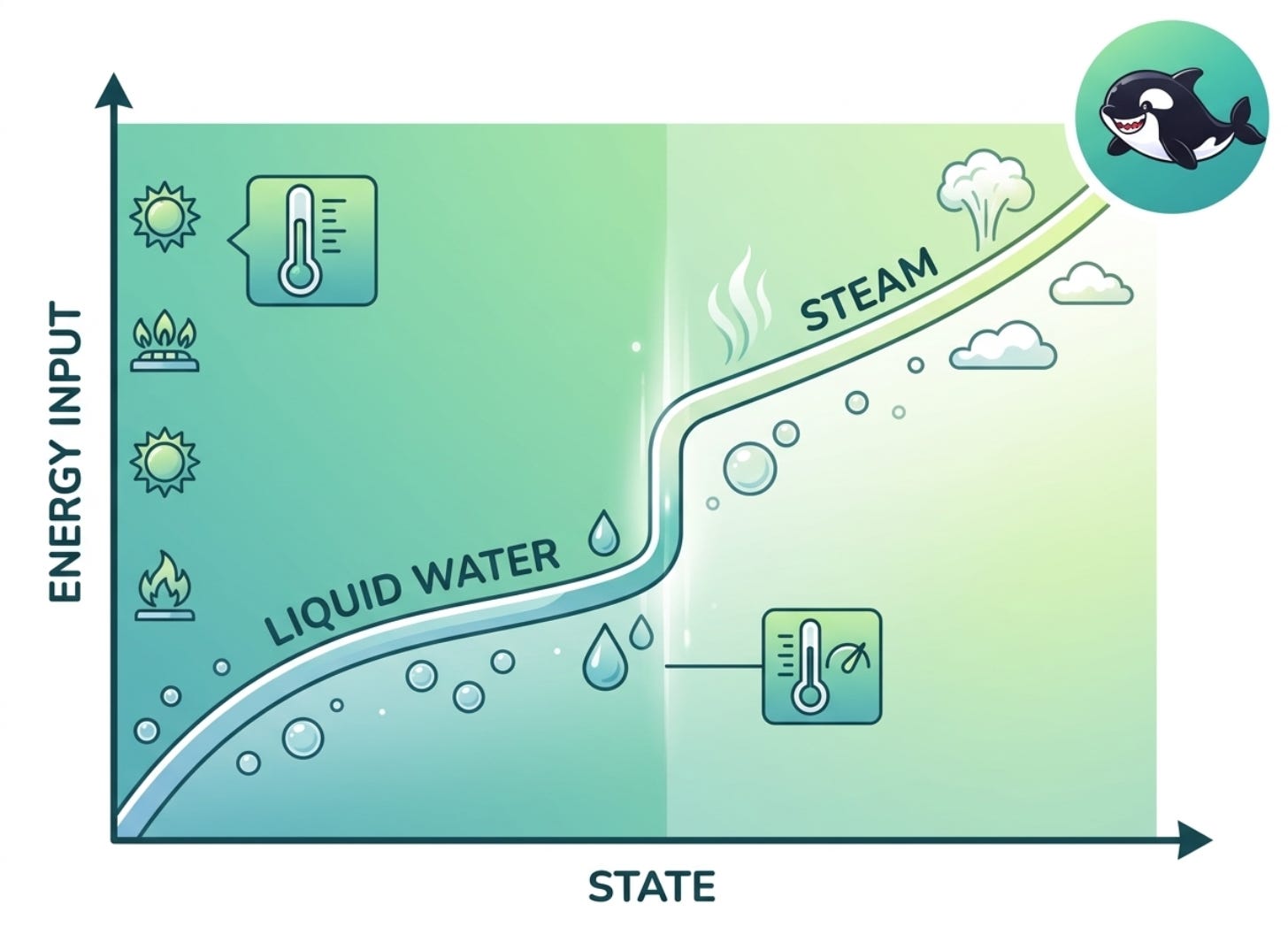
There’s a concept in nuclear physics called critical mass. It’s the minimum amount of fissile material needed to sustain a chain reaction. Below that threshold, individual atoms split but the energy dissipates. Nothing much happens. Above it, each reaction triggers others, and the thing becomes self-sustaining.
Enterprise AI adoption crosses that line somewhere around 2028.
This is Chapter 7 from Part Two. It’s the chapter where the gradual pressure of Part One becomes unmistakable. Where hiring freezes and contractor squeeze-outs give way to explicit redundancy programmes that cite AI as the reason. Where the denial stops being possible.
The mechanism matters because it explains why individual skill or excellence becomes insufficient protection. Your job isn’t disappearing because you’re bad at it. It’s disappearing because your employer is losing the competitive race against companies that have already rebuilt their operations around AI.
Here’s the frame: by 2028, 88 percent of organisations are using AI in at least one business function. That sounds like the revolution has already happened. The number that actually mattered was different. Thirty-one percent of use cases had reached full production in 2025, and that number was doubling annually. Full production means the AI isn’t being tested. It’s doing the work. Decisions are flowing through it. People who used to do those tasks are now doing something else, or nothing at all.
Run the maths. If 31 percent of use cases hit production in 2025 and the doubling rate held, 60 percent were in production by 2027. By 2028, the question wasn’t whether your company used AI. It was whether your company had been redesigned around it.
The productivity gap became impossible to ignore. Top AI-native startups were generating average revenue per employee of $2.5 million. Traditional companies averaged $200,000. That’s not a competitive advantage. That’s a structural difference so large it operates on different economics entirely.
The Next Rung is a book on how AI is quietly dismantling the middle of knowledge work, and what you can do about it before the market decides for you: pre-order it before it publishes in January.
The decision that killed companies was choosing between two bad strategies. Adding AI to a legacy structure is like putting a jet engine on a horse cart. You get noise and expense and the cart falls apart. The companies that pulled ahead were the ones that built new carts. But rebuilding from scratch required capital, will, and organisational design changes that most mid-market firms couldn’t execute while maintaining business-as-usual.
So they tried to manage decline instead. Cutting costs. Consolidating departments. Reducing headcount by attrition. These measures saved money in the quarterly numbers. They didn’t change the underlying economics. Every quarter the gap widened. Every quarter the catch-up cost increased. After a certain point, catching up became impossible.
This pattern, technology historians call the incumbent’s dilemma. The incumbents weren’t stupid. They were rational actors making decisions within a framework that no longer applied. Improve incrementally. Protect margins. Retain talent. All sensible advice in stable competitive environments. All catastrophically insufficient in one undergoing phase transition.
The adoption curve was the fastest in human history. The telegraph took 80 years to peak. Television took 15. Generative AI achieved 78 percent organisational adoption within a single year. The reason is structural. Previous technologies required hardware. AI required an internet connection and will.
This compression of the adoption curve had a specific consequence. Previous technology transitions gave industries decades to adjust. The cloud transition gave them fifteen years. AI gave them roughly five, from mainstream availability in 2023 to restructuring necessity by 2028. That’s not enough time for labour markets to absorb displaced workers. It’s not enough time for retraining programmes to scale. It’s not enough time for most people to fully understand what’s happening.
The tipping point hit different sectors on different timescales, but the sequence was consistent. Professional services went first. Legal services felt it when major firms deployed AI contract review systems that processed in hours what paralegals had processed in weeks. The entry-level pipeline, the three years of document review that had always been the route into partnership-track careers, was the exact pipeline AI automated first. Junior associate hiring dropped 20-30 percent at the major firms between 2026 and 2028. Revenue held steady. Headcount didn’t. Revenue per partner increased, which looked like success on a balance sheet and looked like a closed door to law graduates who’d spent three years and six figures earning a qualification for roles that no longer existed.
Consulting followed with a six-month lag. Accounting had been on notice longest. For the professional class, critical mass meant something very specific. It meant the economic viability of their roles was no longer a matter of individual performance. It was a function of their employer’s competitive position. And their employer’s competitive position was deteriorating.
This is where the abstraction meets the mortgage payment. You can be excellent at your job. Skilled, diligent, well-regarded. And if your employer is on the wrong side of the AI transformation curve, your excellence is irrelevant. The company isn’t failing because you’re bad at what you do. It’s failing because a competitor is doing what you do with a quarter of the people.
The Next Rung is a book on how AI is quietly dismantling the middle of knowledge work, and what you can do about it before the market decides for you: pre-order it before it publishes in January.
The professional class had never experienced this particular form of economic threat. Manufacturing workers knew it. They’d lived through plant closures where individual performance didn’t matter because the whole facility was uneconomic. But professionals, the people with degrees and certifications and career paths that climbed through predictable stages, had always operated on the assumption that competence provided security.
The system stopped providing it. Not because professionals had done anything wrong. Because the system had changed state.
The quiet squeeze became loud in the most ordinary possible way. Not riots. Not protests. Emails. The email from HR. The restructuring announcement. The meeting request from your manager with no agenda attached. The job listing for your role, rewritten around AI capabilities, posted while you still held the title.
Between 2025 and 2028, displacement felt like bad weather: unpleasant, temporary, someone else’s problem. By 2028, the weather had become climate. When your company announces its third restructuring in eighteen months and the new job descriptions all include AI proficiency as a core requirement, and the roles being eliminated are the ones that look exactly like yours, the denial architecture starts to crumble.
The cascade didn’t stop at companies. It moved through supply chains, client relationships, entire industries. A company going AI-native didn’t just reduce its own headcount. It changed the economics for everyone connected to it. The outsourcing firm that provided back-office support. The staffing agency that placed contractors. The training company that ran professional development. The landlord who leased the office space. The sandwich shop on the ground floor.
Commercial real estate felt it early. Office vacancy rates in professional services districts climbed steadily from 2027 onward. The recruitment industry was hit with particular force. Staffing agencies found their market contracting from both directions. Fewer roles to fill because companies needed fewer people. Fewer candidates to place because displaced professionals were competing for a shrinking pool.
The professional training industry collapsed. The companies that ran leadership courses, project management certifications, and professional development workshops found that their customer base was cutting spend at unprecedented rates. Only 13 percent of firms intended to invest more in training in 2025, down from 32 percent the year before. The professional development industry had existed in the space between what workers could do and what employers needed them to do. When AI closed that gap, the industry lost its reason for being.
By 2029, the question had changed. In 2025, people asked: will AI take my job. By 2029, they asked: how long before it takes mine. The shift from if to when was the psychological critical mass, the moment denial became impossible.
What changed wasn’t the information. The data had been available for years. What changed was the inability to maintain the story that it wouldn’t happen to people like you. When the person sitting next to you at a dinner party, someone with the same degree, the same career trajectory, the same kind of mortgage, tells you they’ve been made redundant because an AI system now does what their department used to do, the abstract becomes concrete.
Critical mass wasn’t a theory any more. It was happening in real time.
The full chapter walks through the mechanism in detail. It shows you how the competitive cascade works, what board-level AI governance looks like, and why the traditional strategies for managing technological disruption failed. It explains the incumbent’s dilemma and why some companies became uncompetitive not because they were poorly managed, but because they made rational decisions within a framework that no longer applied.
It’s not comforting. It’s not designed to be. It’s designed to explain what you’re seeing, and to help you position before the wave hits your particular door.