
A former client messaged me on LinkedIn last week. Small business, specialist sector, decent operation, been at it a long time. Years ago we worked on his site together. Did the SEO over the better part of three years, got the rankings back where they needed to be, then he moved on. Different agency. Fair enough, that’s how it goes.
He got in touch because he’s trying to figure out what to do with AI. Said he wasn’t sure if I’d remember him.
I did.
The bit that actually mattered came in his second message, after he’d had a look at my site. Paraphrasing, but only just.
“I started paying an agency £800 a month for SEO support. And with everyone telling me how powerful AI is, I’m thinking it might be better to use that for the SEO and the other tasks.”
Read that again. That’s a small business owner, unprompted, working out in real time that the thing he’s been paying an agency to do is probably the thing AI can do for less. He isn’t a tech founder, doesn’t read AI newsletters, doesn’t sit at SaaS events with a lanyard on. He runs an operation, gets sold to constantly, has heard the word “AI” used so many times he’s started to wonder why he’s still writing the £800 cheque.
He’s doing the maths. That’s the part I keep noticing.
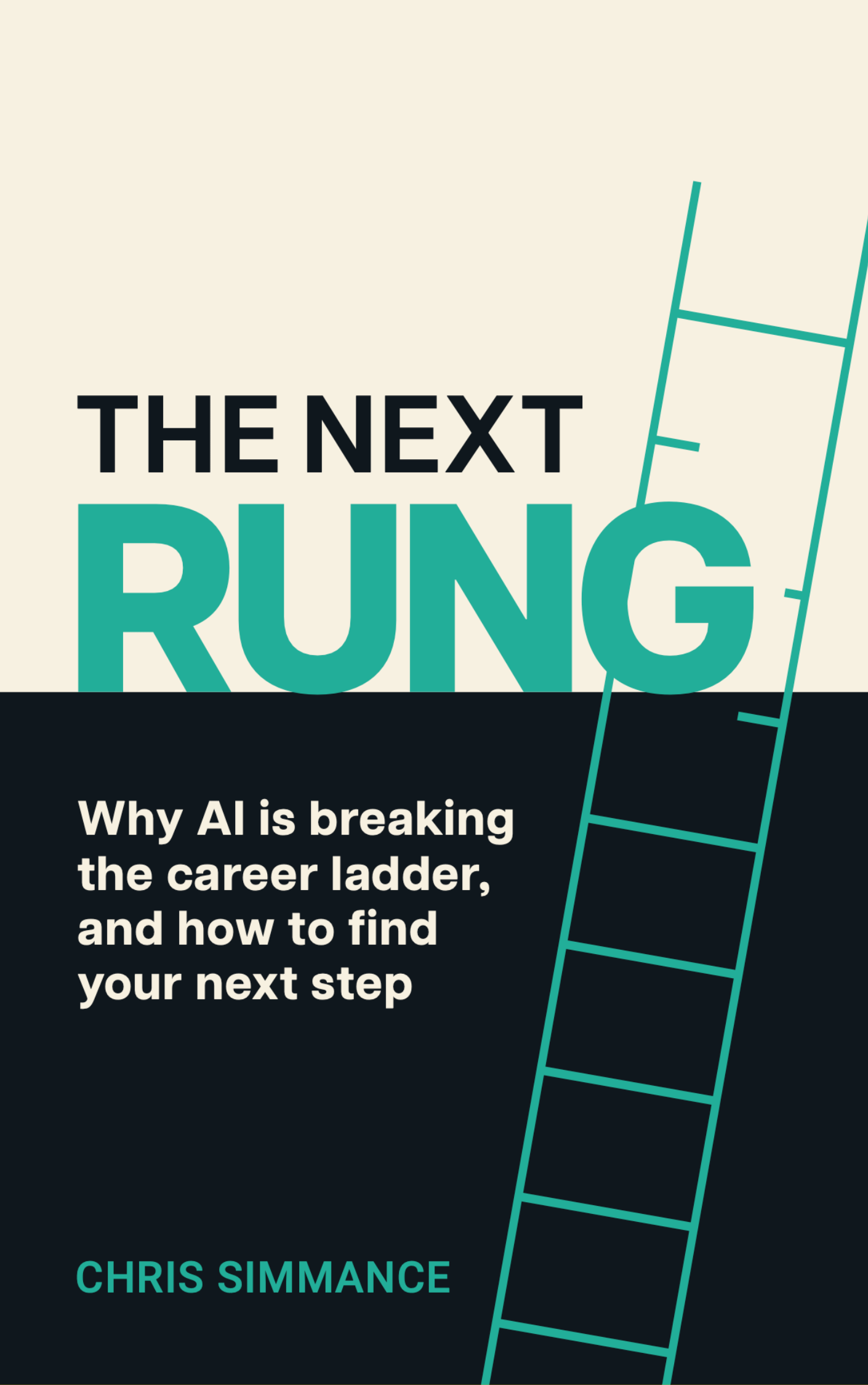
The Next Rung is a book on how AI is quietly dismantling the middle of knowledge work, and what you can do about it before the market decides for you: pre-order it before it publishes in January.
If I’m honest, most of what £800 a month at an agency is buying is orchestration. Keyword research. Content briefs. A bit of technical audit work. Reporting back. Maybe some outreach if the retainer stretches that far. The actual work is using tools that already exist, running them against the client’s site, interpreting the output, and turning that into something the client can action.
The agency isn’t doing magic. They’re doing competent translation. They take a set of tools the client could in principle learn but doesn’t have the time or appetite for, and turn the output into language and tasks he can understand. They’re the orchestration layer between him and the systems.
And that orchestration layer is what AI does first.
Here’s the awkward part. A lot of what an agency in the £500 to £2,000 retainer bracket does can already be done by a small operator with the right setup. Keyword research, content clustering, brief writing, technical SEO audits, most of the on-page work. All of it has a credible AI version now. Not as a single magic button, more like a stack of capable tools that, wired up properly, do roughly what the agency is doing every week. Faster. Cheaper. Fewer meetings.
That’s the bit “everyone telling me how powerful AI is” is picking up on. The general sense in the air. Most people who aren’t paid to deny it can feel it.
The LinkedIn DM doesn’t say what the right answer looks like. It just asks the right question.
The agency model assumed the client couldn’t or wouldn’t do the underlying work. So the agency did it for him and charged the retainer. AI changes the first half of that assumption, which means that he probably could now. He still won’t, because he’s running a business and he’s not going to spend his Tuesday evenings learning how to set up a content production pipeline. That’s why he was paying the £800 in the first place.
So the question isn’t whether AI can do the work. It’s who builds and runs the AI for him.
If the answer is the agency, the agency’s new value proposition is operating AI on his behalf at a fraction of the price the old retainer carried. Which a lot of agencies aren’t structurally able to do, because their cost base is people and meetings.
If the answer is him, with a one-off setup from someone who can actually build it, the maths look different. A few thousand to build, a couple of hundred a month to run and maintain, no monthly orchestration call, no monthly invoice for the bit he can now do himself with a system someone else has wired together.
I’ll be straight about where I sit in this. I run a managed AI service for founders, and I do AI advisory for businesses trying to work out where this actually fits their operation. More and more of the work I’m being asked to do is exactly this: someone who’s been paying for orchestration via human services has clocked that the orchestration is now buildable. They want someone to build it, configure it around how they actually work, then leave them to run it.
That’s not a great long-term position for the agency that used to charge £800 a month. It’s a better position for the customer.
The Next Rung is a book on how AI is quietly dismantling the middle of knowledge work, and what you can do about it before the market decides for you: pre-order it before it publishes in January.
Which is the actual pattern, and the part most agency owners I speak to are still talking themselves out of seeing. AI doesn’t kill the work itself. It kills the layer in the middle, the bit that was charging to manage the work for someone. The strategy still matters. The judgement still matters. Knowing what to build, what to leave alone, what not to bother with, that still matters. The orchestration in the middle, the bit that was £800 a month, that’s the bit that softens first.
The thing I keep noticing is how unprompted this was. He didn’t read it on Twitter. He hasn’t been at an AI conference. He’s running his business, he’s heard enough times that AI is powerful, he’s looked at his retainer, and he’s asked the obvious question.
That’s the bit that should worry every agency owner in the sub-£2k retainer bracket. The customer is doing the maths. He isn’t waiting for the trend piece, isn’t waiting for the case study. He’s looked at the invoice, he’s looked at the noise about AI, and he’s drawn a straight line between the two.
He doesn’t know yet exactly what to build. That’s where someone like me comes in. But he knows the £800 a month doesn’t make sense any more.
And he’s right.