
Everyone gets a penthouse.
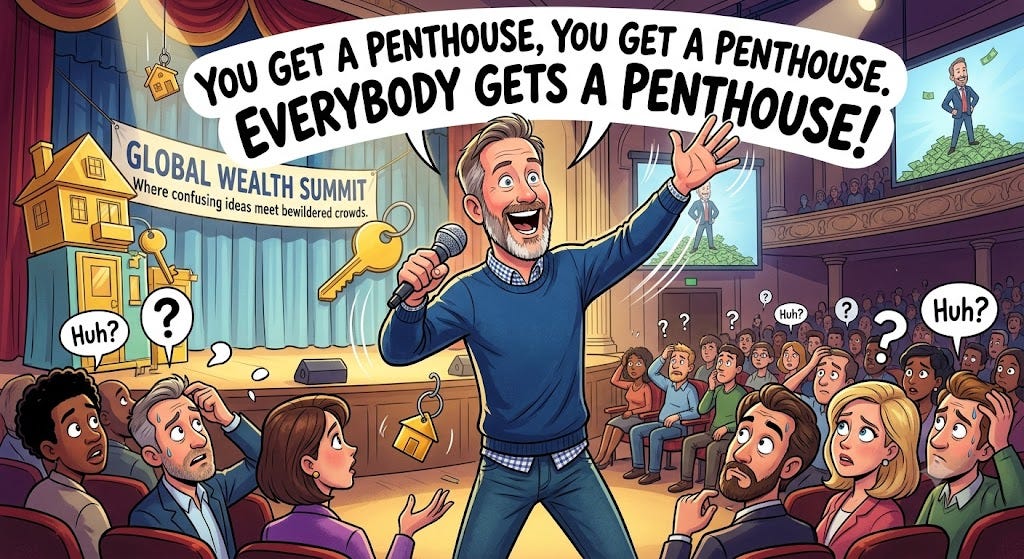
That’s the promise. Universal high income, not the basic sort, the high sort. Work becomes optional. Money becomes, and this is his word, irrelevant. Ten to twenty years and nobody has to earn a living ever again, because the robots earn it for us and we all just, what, collect.
It’s the nicest thing anyone has ever said to a tired person. And most people are tired. Mortgage that went up twice, a job that got heavier while the pay stood still, a pension that’s a rounding error, kids who’ll rent forever. Then a man worth more than some countries leans in and says don’t worry, there’s about to be so much of everything that you’ll never have to do any of this again. Of course it lands. It’s built to land. You’d have to be made of stone for some part of you not to want it to be true.
The Next Rung is a book on how AI is quietly dismantling the middle of knowledge work, and what you can do about it before the market decides for you: pre-order it before it publishes in January.
I want to sit with that for a second, because I don’t think the people cheering are stupid. I think they’re exhausted. And the pitch is aimed at exactly them, on purpose, because they’ve got the least reason left to defend a system that’s already treated them badly, and the most reason to want the whole thing torn up. Which makes them the perfect crowd to wave through the one thing that finishes the job.
Here’s the part the promise is built to stop you reaching.
Abundance doesn’t fall out of the sky. Somebody owns the factories that make the robots. Somebody owns the compute, the energy, the land it all sits on. “Universal high income” isn’t wealth appearing in your account by magic, it’s a transfer. And a transfer is a gift. A gift has a giver. And a giver, any giver, can stop.
So the only question that actually matters in the whole shiny picture is this: who owns the robots? And notice, the man telling you not to worry about the future is the man who’d own most of them. That isn’t a coincidence you can shrug off. That’s the tell.
Now, I’m not even saying he’s lying about the technology. The robots might well come. The curve is real, I’ve built on it, I’m not here to tell you the machines can’t do the work. They can, and they will, and a big chunk of the coordinating-and-organising jobs that hold the middle class together, three to four million of them in this country alone by the mid-thirties on my own reckoning, are going to thin out whether Elon promises you a penthouse or not.
The lie isn’t the tech. The lie is the word “everyone”.
Because even if you make everything, you can’t make the things people actually fight over. You can print a bigger car. You cannot print a car nobody else is allowed. The good address, the front of the queue, the table by the window, the quiet sense that you’re doing better than the bloke next door: none of that scales, none of it, because its entire value is that someone else hasn’t got it. Total abundance doesn’t kill status. It removes every other way of getting it, so the fight for position gets nastier, not kinder. “Plenty for everyone” is false at the exact level where humans decide whether they feel rich.
And then there’s the bit that should keep you up.
Right now the ordinary person holds precisely one card. One. The right to withhold their labour. Strike, quit, go slow, bargain. It isn’t much, but it’s the lever that built the weekend, the pension, the eight-hour day, every scrap of dignity that wasn’t handed down out of kindness. Take the work away entirely and you don’t free that person. You disarm them. No labour, no strike, no bargaining, no vote that money has to listen to. Just a stipend, set by people they’ll never meet, defended by nobody, switched off by anyone who owns the machine that pays it.
You’ve heard the dystopian version of this. “You’ll own nothing and be happy.” Everyone hated that one, quite rightly. But look at it properly and it’s the same building as the penthouse dream, just photographed from the other side. In both, you own none of the thing that makes the money. The only difference between the paradise and the collar is who’s holding the dial, and how generous they feel that decade. That’s a thin thing to stake a civilisation on. The mood of the people who own the robots.
This is how you get neo-feudalism, and you don’t need a villain or a coup to do it. You just need everyone to agree it’s for the best while it happens. A lord, a stipend, and a lot of people genuinely grateful for the roof, having quietly handed over the one thing that ever made them worth negotiating with. Nobody fights it, because fighting it feels like turning down free money. That’s the engine. The consent is the fuel.
So when you see the abundance post, and you feel that warm little lift, that yes please, that finally, do the thing the post is built to stop you doing. Ask the follow-up. Who owns it. What do I trade to keep my slice. What happens to me on the day the giver decides I’ve had enough.
The tech might be real. The plenty might even be real. Watch one number and ignore the rest. Not GDP, not the robot count, not the price of a fridge. Who owns the robots. Everything else in the picture is set dressing, painted very prettily, by someone who’d quite like you clapping instead of asking.