
In June, at London Tech Week, the government announced a guarantee. Young people in Wigan, Blackpool, Oldham, Blackburn, kids at risk of leaving school after their GCSEs and going nowhere, do a free AI bootcamp and they are guaranteed a paid apprenticeship at the end of it. JD Sports, BAE Systems, PA Consulting, the local councils. A guaranteed first rung on the ladder. Everyone clapped, because who argues with that.
I’ll argue with that.
Not with the intent. The intent is decent, and the people delivering it are decent people solving exactly the problem they’ve been funded to solve. The problem is that the problem they’ve been funded to solve is yesterday’s.
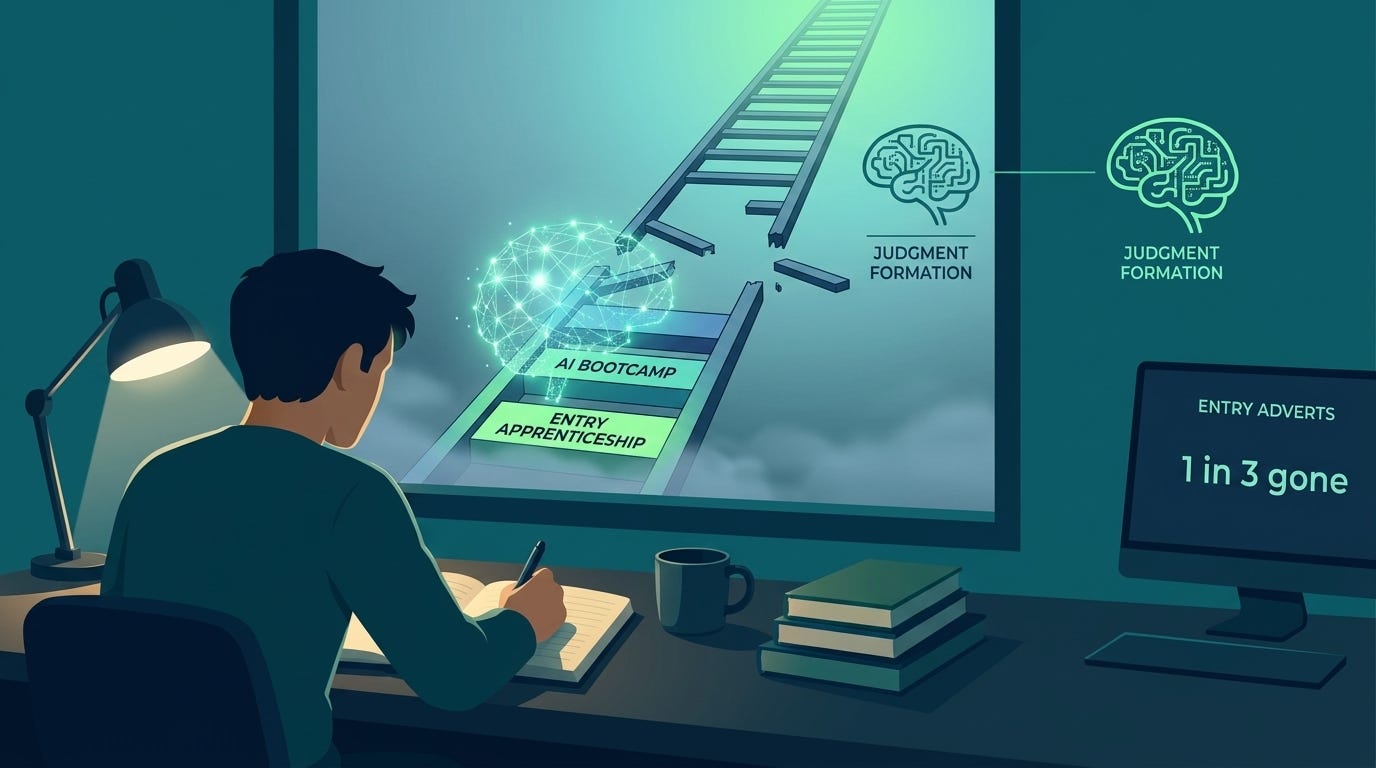
Here’s the picture. Since ChatGPT launched, roughly one UK entry-level job advert in three has gone. Not moved. Not rebranded. Gone. The government looked at that and concluded the issue is young people can’t get onto the ladder, so the fix is helping more of them onto it. Bootcamps. Guarantees. A £1 billion youth package, or £725 million extra in the new levy for 50,000 more young apprentices, depending which press release you read, the accounting between the two is not my favourite bit. Fund the bottom rung harder. That’s the whole play.
And to pay for some of it, this is the bit I keep coming back to, they defunded the rungs above. From September the Team Leader apprenticeship loses its funding. So does Operations Manager. So does Chartered Manager. Sixteen standards cut, mostly the ones people used to climb from entry-level into running things, about £200 million redirected downwards. Removed the next rung to pay for the bottom one.
The market is removing the bottom one anyway.

The Next Rung is a book on how AI is quietly dismantling the middle of knowledge work, and what you can do about it before the market decides for you: pre-order it before it publishes in January.
It’s the same everywhere, which is what made me want to write this down. In April the US Department of Labor launched a national push to embed AI skills into apprenticeships, around $243 million by one count, so that workers are “not merely participants in the AI economy but leading it”. Which in practice means teaching apprentices to use the tool that’s replacing apprentices. Singapore is handing out six months of free premium AI subscriptions with SkillsFuture courses and held a parliamentary debate literally titled “An AI Transition with No Jobless Growth”. Singapore is honestly the best of them. They’re at least putting serious money at mid-career workers as well, and they’re doing it before the crisis rather than after. But look at what all of it trains. Tool fluency. Prompting, operating, integrating. Entry skills, for a layer of work the tool itself is absorbing.
Why do governments keep doing this. Partly it’s measurement. Youth unemployment produces a statistic this quarter, and a department can fund against a statistic. The thing that’s coming doesn’t produce a statistic yet, so as far as a spending review is concerned it doesn’t exist. And partly it’s muscle memory. Retraining is what we did after the mines and the mills and the call centres, and it barely worked then. The New York Fed tracked 1.6 million job-training spells and found that outcomes for AI-exposed workers were limited. Limited is their word. We keep pulling the retraining lever because it’s the lever that’s there.
Meanwhile the researchers who went looking at firms actually adopting AI found junior employment falling about nine per cent within six quarters, call it eighteen months, and falling through reduced hiring rather than layoffs. Nobody gets marched out of the building. The building just stops letting people in. Hold that next to a government guarantee of entry.
So here’s tomorrow’s problem, the one no scheme I can find is aimed at. It isn’t youth unemployment. That’s just the visible edge of it. Tomorrow’s problem is where judgment comes from. Every senior person you rate got that way by doing years of junior work, drafting the thing, getting it wrong, being corrected, slowly building the pattern library that lets them look at a piece of work and know it’s off before they can say why. When AI absorbs the doing, that learning goes with it. A profession that no longer grows juniors into seniors eventually atrophies. I’ve spent a year looking for a government programme, any country, that funds judgment formation rather than tool use. The closest thing I found was a sentence in that Singapore debate saying AI cannot replace human judgment and empathy. Which is true. It’s also a sentence, and sentences aren’t policy.
What would solving tomorrow’s problem look like. I’m not certain, and I’d rather say that than pretend. But it starts in a different place. You’d fund the formation, the supervised reps, seniors paid to grow people rather than just review output. You’d build apprenticeships around challenging AI work rather than producing what AI already produces. And you’d say the thing nobody wearing a lanyard will say, which is that some of those kids in the bootcamp would be better served training as electricians. The plumber on sixty grand is structurally more secure than the marketing director on seventy-five. I wrote that in the book and it annoyed people, and it’s still true.
The bootcamp kids in Wigan start this summer. By the time they finish a Level 3 it’ll be 2028. Watch what the guarantee is worth then. I hope I’m wrong. One advert in three says I’m probably not.
This is the argument of my book, The Next Rung, out with Practical Inspiration Publishing in January. Pre-orders at thenextrung.co.