
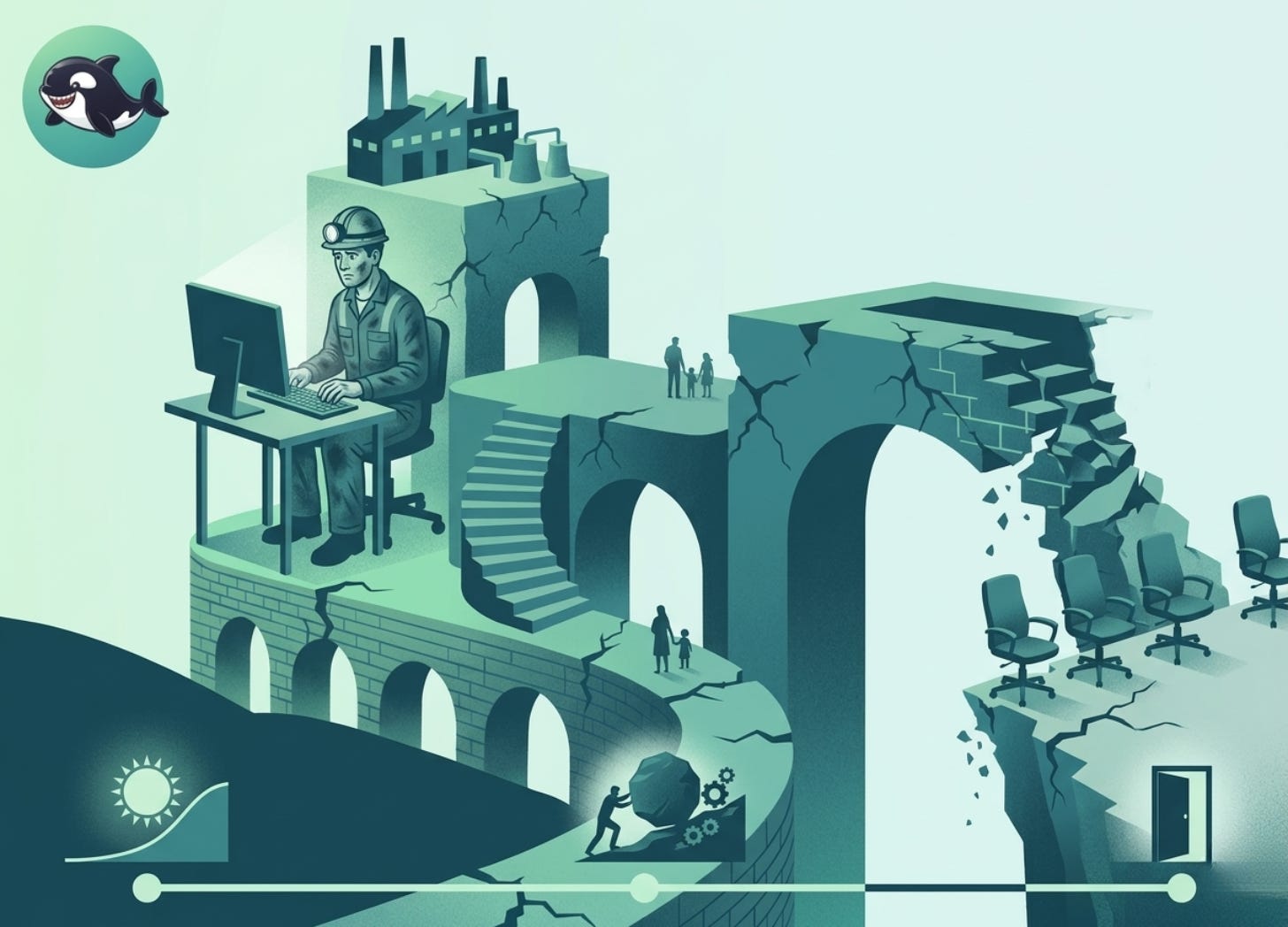
The retraining narrative is one of the most durable fictions in contemporary policy. When an industry dies, governments say: retrain them. When automation threatens jobs, economists say: retrain them. When a sector collapses, business leaders say: retrain them. It is the comfort story we tell ourselves because the alternative (that some people’s skills have no future and we have no plan for them) is politically impossible to say out loud.
The retraining narrative is also testable. We have data. Multiple countries have run retraining programmes for displaced workers. We know what actually happens.
The results are consistent, careful, and devastating: most retraining programmes fail to successfully transition people into new sectors at sustainable wages.
The United States coal mining closure study from 2009 onwards is the clearest case. Coal employment in Appalachia was collapsing. It was obvious, inevitable, and on the policy agenda. Governments committed billions to retraining programmes. Miners would learn software development, advanced manufacturing, green energy installation. The cognitive foundation was there (miners are often strong in mathematics and spatial reasoning). The will was there. The money was there.
The outcomes were not there. Most miners who went through retraining did not successfully transition to sustainable employment in the new sectors. Some did. The majority did not.
Why. That is the question that matters.
The Next Rung is a book on how AI is quietly dismantling the middle of knowledge work, and what you can do about it before the market decides for you: pre-order it before it publishes in January.
Here is what the economists who study labour transitions found: it was not because miners were incapable. It was not intellectual failure. It was structural failure, and the structure was threefold.
First, the cognitive distance between coal mining and software development is not a gap you bridge in a six-month course. Mining is about reading geology, understanding mechanics, managing immediate physical risk. Software is about abstraction, symbolic logic, building systems you will never physically touch. The underlying thinking is different in kind. You can teach someone to code. Teaching someone to think like a programmer from a starting position of reading coal seams is not a linear progression. It is a reorientation.
Some people make that reorientation. Many do not. The transition requires not just learning new information but reorganising how you think.
Second, the geography was wrong. The retraining programmes were built for people who could move to coastal tech hubs or move to manufacturing corridors. But most coal miners were in Appalachia, in communities where they had family ties, property ownership, roots. Moving to Silicon Valley or Austin or Atlanta meant leaving behind everything. At age 45 with a mortgage in a declining market and a spouse with local employment, that move is not a rational choice. It is a forced displacement.
Most people stayed. Which meant they did the retraining locally, in programmes disconnected from the actual job markets they were supposed to feed into. The jobs that opened in tech and advanced manufacturing were not in Appalachia. So you retrained for a job that was not geographically available to you, or you did not retrain.
Third, the credential and experience hierarchy was working against them. A fifty-year-old coal miner with twenty years of industry experience is competing at entry level with twenty-five-year-olds who are native to tech or manufacturing. In an industry that values foundational knowledge and peer networks, the fifty-year-old has neither. The entry-level position pays what entry-level paid in 1995. A fifty-year-old with a mortgage cannot rebuild from that baseline.
The Next Rung is a book on how AI is quietly dismantling the middle of knowledge work, and what you can do about it before the market decides for you: pre-order it before it publishes in January.
This is not failure on the part of the miner. This is structural failure. The economic system is working exactly as designed. It rewards young people in new industries and makes it very difficult for people beyond a certain age to enter from the outside.
When you combine those three elements, retraining becomes a false choice. Not because people are incapable of learning. Because the structural conditions that would make learning economically viable are not present.
This is the data point that matters, and it is why the retraining narrative is so dangerous right now. Every solution to AI displacement assumes that “retrain” is viable, that people can learn new skills and move to new sectors. But the precedent says that works for a minority of displaced workers under very specific conditions: young enough to absorb wage compression, geographically mobile or in a place where jobs are actually available, in a sector where credentials from other fields transfer.
The coal-to-tech transition had all of those conditions stacked against it and it still failed for most people. AI displacement is going to be worse.
The sheer scale is different. Coal mining employed about 100,000 people in the US in its decline. AI could affect millions of knowledge workers across dozens of sectors simultaneously. There is no single new industry to retrain into. There is no unified effort or geographical alternative. Retraining narratives require that there is somewhere to retrain to. When the displacement is this broad, the “somewhere” does not exist.
The demographic is different. Coal miners were disproportionately working-class. Knowledge workers affected by AI displacement are middle-class with mortgages, dual-income households with geographic constraints, older professional cohorts with less patience for wage compression and geographic instability. The coal story was that they could move to a new region and start over. The knowledge worker story is different. They cannot start over. They have family, property, obligations. The retraining has to work in situ, or it has to work in a way that maintains their economic standing. And that is rarely what retraining achieves.
The skills are different. Coal mining requires physical presence in a specific place. Software development can be done remotely, can be done from anywhere. Some knowledge work that AI is displacing has the same property. But some of it does not. Relationship management at scale is place-dependent. Strategic judgment in an organisational context requires being present. Complex creative work often benefits from physical proximity and informal collaboration. You cannot retrain someone in those things remotely, at scale, in a six-month programme.
And then there is the psychological element, which the policy papers barely mention. When retraining fails, it does not fail cleanly. It fails after years of effort, after investing time and emotional energy into learning something, after believing the story that this was your path forward, after watching peers leave and succeed or fail, after watching the original job market continue to exist (in nostalgia, in memory, in community stories). The retraining narrative does not just fail to deliver work. It fails to deliver dignity.
The honest position is this: for most people whose jobs are automated by AI, retraining is not a viable solution. It is a story we tell so we do not have to confront the alternative, which is that we have no plan. The minority of people who will successfully transition to new sectors will be the ones who were already mobile, already young, already positioned to absorb wage compression, already embedded in networks that span sectors. The rest will do other things. Some of those things will work. Most will involve downward economic adjustment.
The question is not how to retrain people. The question is how to manage the economic transition for people who cannot be retrained, and we have not started that conversation, because it requires admitting that retraining is not the answer.