
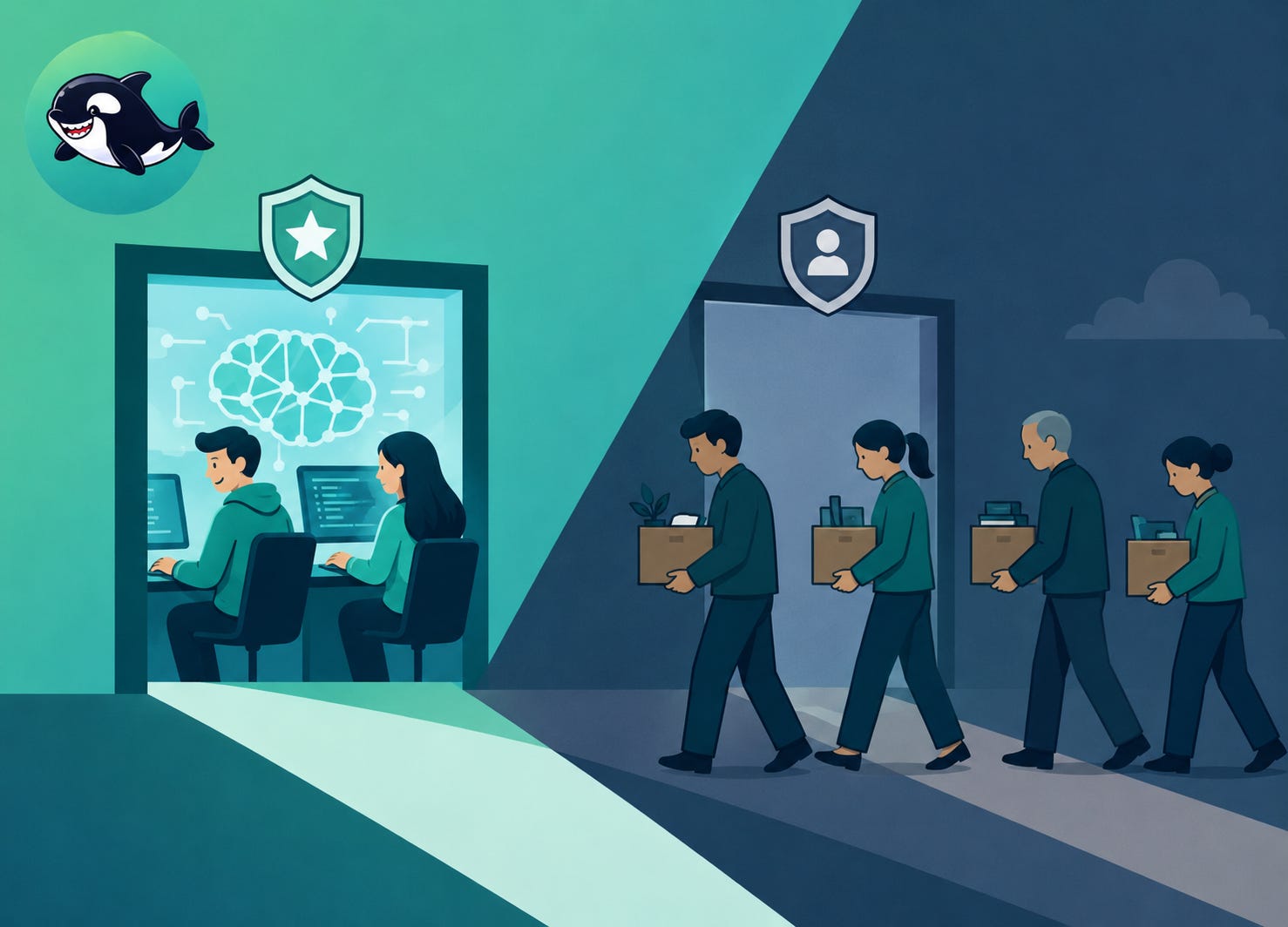
Microsoft offered voluntary buyouts to roughly 7 per cent of its workforce in spring 2026. The programme targeted longer-tenured employees in operations and infrastructure roles. The AI and Copilot teams were explicitly exempt.
Read that again. The company that writes 30 per cent of its code with AI offered packages to the people who keep the lights on, while the people building the thing that replaces the people who keep the lights on were told they’re essential.
This is the two-speed company. It arrived without a press conference.
In Chapter 4 of the book, I describe something I call the quiet squeeze. The mechanism by which displacement happens without anyone saying the word “redundancy.” The vignettes in that chapter are composites, but they all share the same structure: the job doesn’t disappear, it gets restructured, reclassified, made voluntary, offered as a package. The language is soft. The outcome is the same.
Microsoft didn’t fire anyone. They offered a package. Totally different. Except it isn’t.

The Next Rung is a book on how AI is quietly dismantling the middle of knowledge work, and what you can do about it before the market decides for you: pre-order it before it publishes in January.
A voluntary buyout is a signal dressed as a choice. It says: we think your role is worth less than the cost of keeping you, but we’d rather you make the decision than force us to make it. The people who take the package leave with money and a story about choosing to move on. The people who stay do so knowing the company valued their role at “worth offering money to leave.” Neither outcome is comfortable.
The exemption is the part that matters most. When you exempt the AI teams from a buyout programme, you are drawing a line through the organisation. On one side: the people building what comes next. On the other: everyone else. The operations staff, the infrastructure teams, the support functions. The people whose work is increasingly being absorbed by the tools the exempt teams are building.
Thirty per cent of Microsoft’s code is now written by AI. That number was reported by the company itself. It’s not a projection. It’s a current figure. The developers writing the other 70 per cent are not safe. They’re just not yet at the threshold where the buyout makes financial sense. Give it eighteen months.
Here’s the thing. Microsoft employs roughly 228,000 people. Seven per cent is about 16,000 roles targeted. The company spent $80 billion on AI infrastructure in the fiscal year ending June 2025. The maths is not complicated. When you spend that much building AI capability, the return on investment has to come from somewhere. It comes from headcount. Not all at once. Not with a single announcement. Through a series of voluntary programmes, quiet restructurings, and strategic exemptions that gradually reshape the workforce into something leaner, more automated, and more polarised between the people who build the AI and the people the AI replaces.
The Next Rung is a book on how AI is quietly dismantling the middle of knowledge work, and what you can do about it before the market decides for you: pre-order it before it publishes in January.
The pattern is already visible across the tech sector. The 2024-25 layoffs hit roughly 276,000 across the industry. The hiring that followed was concentrated in AI, machine learning, and infrastructure roles. The net effect is a workforce that’s smaller in total, more expensive per head in the exempt categories, and structurally different from what existed three years ago.
What this means for anyone outside Microsoft is simple enough. The two-speed company is not a Microsoft-specific phenomenon. It’s a template. Every large employer is going to face the same decision: which teams are building the future, and which teams are servicing a structure that the future makes redundant. The exempt list will be short. The package list will be long. And the language will always be voluntary.
Tom, the composite graduate in Chapter 4 of the book, applied to 43 positions and didn’t know the Bristol agency had cancelled the role he’d have got. Nobody told Tom the job was gone because nobody needed to. The job simply wasn’t posted. Microsoft’s buyout is the corporate-scale version of the same mechanism. The roles aren’t being eliminated. They’re being offered a way out. The distinction matters to HR departments and employment lawyers. It does not matter to the person holding the envelope.
The question I keep coming back to: if 30 per cent of the code is already written by AI, and the AI teams are exempt from buyouts, what happens when it’s 50 per cent? What happens when it’s 70? At some point the exempt list and the essential list become the same thing, and everyone else is on the other list.
Microsoft is not the villain here. They’re the company honest enough to put the structure on paper. The rest will do the same thing with less transparency.