
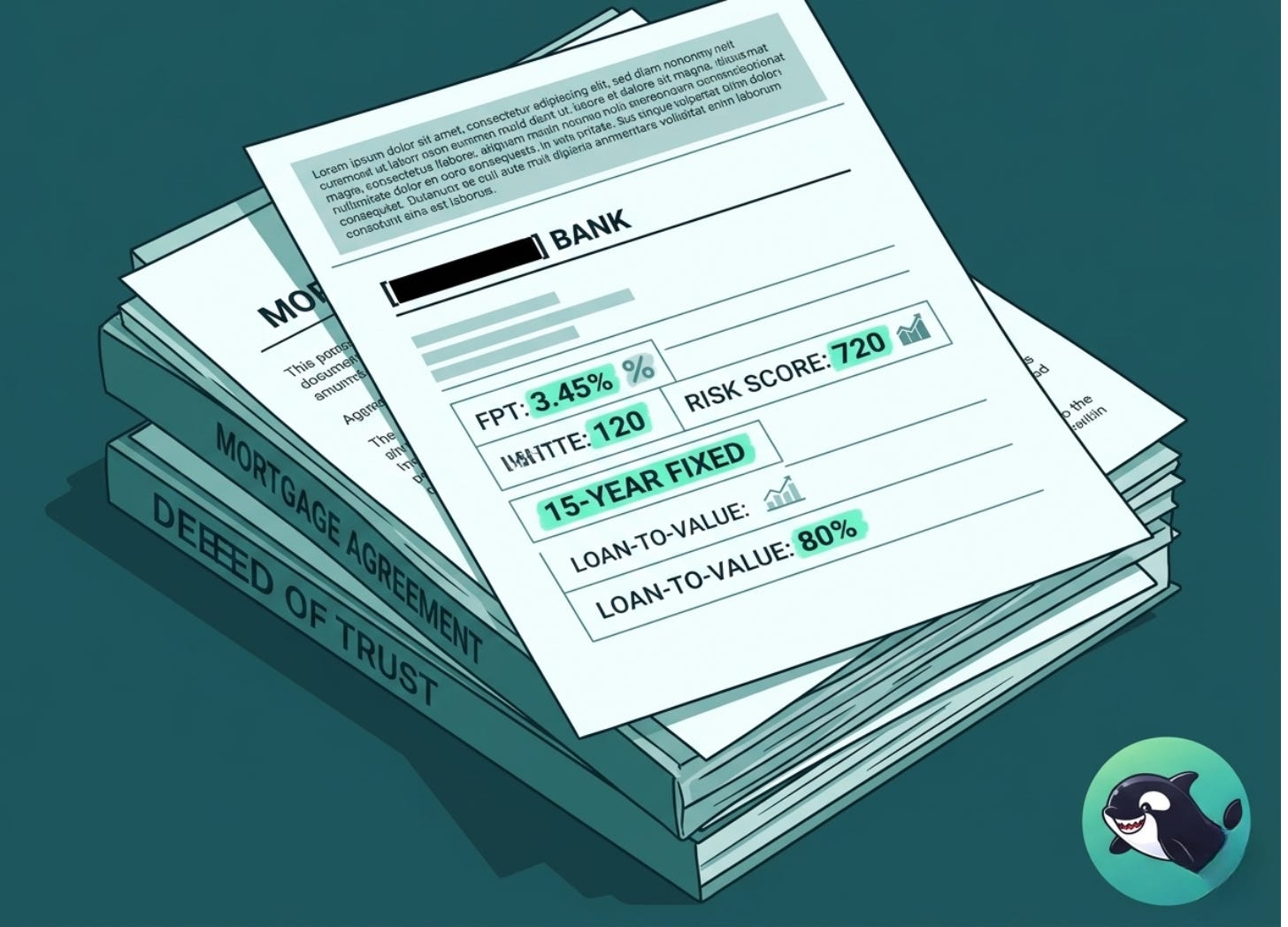
There is a memorandum. It exists in a folder somewhere in the Retail Banking Division of a major UK lender. It’s marked preliminary. It has a date-stamp and a distribution list that stops at Group Risk Committee. It contains numbers that are large enough to require board-level briefing. The memo is about you, if you’re a professional-class homeowner with a mortgage in the London or South East commuter belt. It’s about what happens to the housing market when a thousand people a week stop earning what they’re supposed to earn.
The memo uses language designed to make frightening things sound manageable. “Emerging correlated default risk” means a lot of people in the same neighbourhood are going to miss their mortgage payments at the same time. “Income volatility patterns” means people are losing their jobs. “Structurally invalidated income assumptions” means the salary that justified the loan doesn’t exist any more.
Here’s what the memo says:
UK professional-class homeowners with mortgages: approximately 1.2 to 1.5 million households.
Average London professional-class mortgage: £450,000 to £500,000.
Total exposure in this segment: £540 billion to £750 billion.
Current mortgage balances in arrears nationally: £20.6 billion (1.2% of total).
Modelled default rate under simultaneous income shock: 15 to 20% of the professional-class portfolio.
Problem mortgages under that scenario: £81 billion to £150 billion.
Which is a 4 to 7 times increase in arrears across the entire national system.
The Next Rung is a book on how AI is quietly dismantling the middle of knowledge work, and what you can do about it before the market decides for you: pre-order it before it publishes in January.
The memo notes that this pattern is not how the existing stress tests work. The existing stress tests assume idiosyncratic defaults, meaning individual borrowers experiencing individual hardship, spread across different regions and sectors. The scenario the memo describes is correlated defaults, meaning thousands of people in the same profession, in the same region, losing income simultaneously. The existing stress tests were calibrated for the 2008 financial crisis, which was a credit supply failure. This scenario is a labour market shock. Different shape. Different trigger. Different contagion pathway.
The memo recommends dedicated review of portfolio concentration risk. Scenario modelling for 10%, 15%, and 20% default rates. Early engagement with the PRA. Board-level briefing on findings.
The thing about a memo like that is that by the time it reaches action, it’s already obsolete. The lead time for policy response is shorter than the speed of the trigger. By the time the pattern is confirmed in arrears data, the provisioning window has already passed.
But let me tell you what the memo doesn’t say.
Tom and Priya bought a house in 2024. Three bed, semi-detached, Zone 4 London, excellent transport links, which means you can hear the 07:42 from the kitchen. £575,000. Tom in financial services compliance, £68,000. Priya a paralegal in commercial property conveyancing, £42,000. Combined: £110,000. Mortgage: £460,000. Loan-to-income: 4.2 times. Within the constraints. Within the rules. The numbers worked on paper.
The numbers always work on paper. Paper doesn’t lose its job.
The Next Rung is a book on how AI is quietly dismantling the middle of knowledge work, and what you can do about it before the market decides for you: pre-order it before it publishes in January.
Priya’s firm restructured first. Not dramatically. A memo using the words “operational efficiency” and “right-sizing.” Eight paralegals becoming two. The work she’d done for four years, reviewing title documents, compiling completion bundles, could now be done by an AI system that processed in an afternoon what the team processed in a week. The system needed oversight, the firm was keen to emphasise this, but oversight by two people, not ten.
Tom’s income alone was 38% of net pay to mortgage. Manageable technically. Not comfortably. Not with council tax and energy and car payment and nursery fees. Not for more than a month or two.
Priya looked for work. Legal recruitment in London was what recruiters, speaking off the record, called “challenging.” Which meant: hundreds of paralegals, handful of jobs, all the mid-tier firms restructuring, all using the same tools, all shedding the same roles. The positions that existed were either senior, which required experience she didn’t have, or junior, which paid £28,000 and left her earning nothing after childcare costs.
She signed up for Universal Credit. Six weeks processing. When it arrived, it covered approximately one-third of the mortgage payment.
Tom’s employer announced an operational transformation. The compliance team of twelve became six. Tom was one of the six who didn’t survive the restructuring. Redundancy: twelve weeks at full salary. £13,600. Which covered 3.2 months of household expenses at current burn rate.
The household had savings. £8,200 in an ISA. £1,100 in current account. £9,300 total.
The calculation: redundancy pays for three months. Savings cover another two months. Universal Credit covers a third of the mortgage. They applied for a payment holiday. Interest accrues. It gets added to the debt. They applied for forbearance. Deferred payments defer but don’t disappear. They accrue at the mortgage. They have the structure of relief and the mathematics of debt accumulation.
Eight months after Priya lost her job, Tom took a facilities coordinator role at £38,000. A 56% reduction from his previous salary. They stopped talking about mortgages at the kitchen table. They stopped talking about most things. The mortgage statement is still in the drawer. They both know the number.
This is where the abstract memo meets the actual mathematics of a household trying to maintain a lifestyle built on income assumptions that no longer exist.
The stress tests assume distributed risk. Individual defaults spread across time, sector, geography. The system has capacity to absorb individual shocks because individual shocks happen individually. But when the shock is correlated, when it’s thousands of professional-class households in the same postcodes losing income in the same quarter because their employers adopted the same technology, the system’s absorption capacity breaks.
The mortgage system works on the assumption that income is durable. You earn more as your career progresses. The property appreciates. You’re less exposed twenty years into the mortgage than twenty months in. That model holds when the income is actually durable. When the job doesn’t disappear because the role is being automated, it holds.
But what happens when the assumptions break?
For Tom and Priya’s cohort, the professionals in London and the South East with mortgages at four times income, the assumption broke in 2025. It will break for the next cohort in 2026. And the cohort after that in 2027. Not because anyone made a reckless decision. Because the architecture of UK mortgages is built on durability assumptions that are no longer true.
The mortgage broker who approved a £460,000 mortgage on £110,000 income was following the rules. The rules say you can lend up to 4.5 times income, with stress testing for rate rises and modest employment disruption. The broker stress-tested for a rate spike. For house price falls. For one income dropping temporarily. He didn’t stress-test for structural, correlated, simultaneous income loss across a demographic because that wasn’t something the historical data suggested would happen.
The historical data was wrong.
So the memo sits in the risk committee folder. The defaults accumulate in arrears. And households like Tom and Priya’s navigate the space between “we have a mortgage” and “we can no longer afford this mortgage” by making decisions that feel like success even though they’re compression: moving the child out of nursery, one parent taking a lower-paid role, holidays cancelled, saving stopped, the slow withdrawal into the minimum viable life that the mortgage allows.
For 1.2 to 1.5 million professional-class homeowners, the salary assumption that justified the lending no longer holds. Not because they’re bad at their jobs. Because the jobs are being automated away. And the system has no plan for what happens when that assumption fails at scale.
The dual-income mortgage trap is that it only works if both incomes are resilient. If Priya had worked in teaching, or nursing, or a trades business, Tom’s job loss would have been survived through her income plus benefits. Instead, both incomes were in sectors experiencing correlated automation shock. The paralegal work was automated. The compliance work was automated. The system had compressed them from two professional salaries to one reduced salary and Universal Credit, and there’s no recovery trajectory from that except time and luck.
This is not a moral failing. It’s how the system built itself. Dual professionals in the same economic corridor are cheaper to lend to than single earners because they appear more resilient. But when the correlation is professional sectors, not just household income levels, the resilience disappears.
The mortgage system was designed for individual risk. It’s being tested by correlated risk. And the households currently in the middle of that test are the ones learning, at the kitchen table, at 3 a.m., what it means when the system’s assumptions fail and your life is the mathematics that remains.