
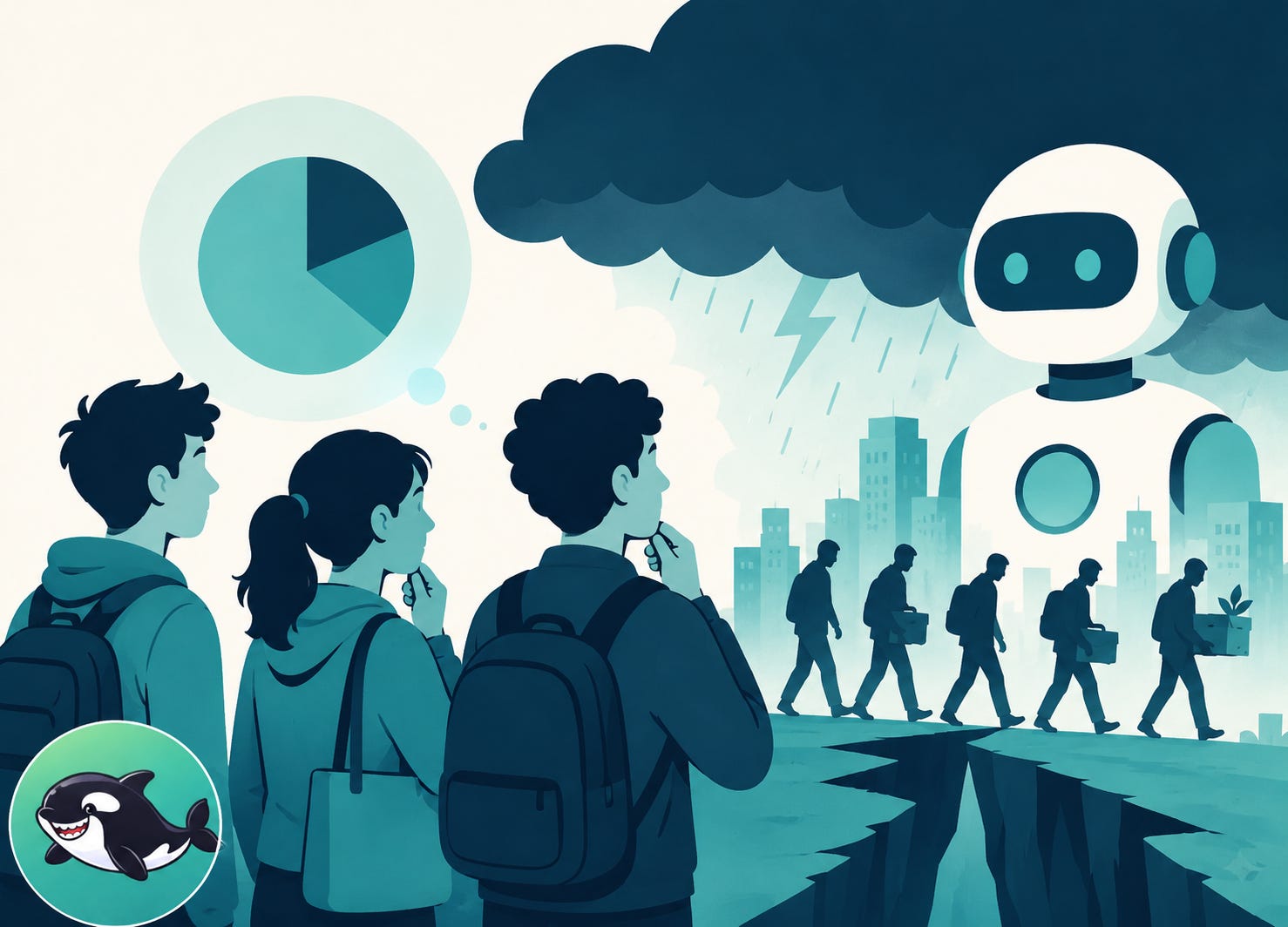
A survey found that more than one in five people in Britain believe AI could eliminate jobs quickly enough to trigger civil unrest. Among university students, the figure is one in three. Sixty-nine per cent of workers are worried about the economic impact.
Those numbers sit in an odd space. Not high enough to be a crisis. Not low enough to be background noise. One in five is the kind of number that policy makers can file under “concern” rather than “action.” One in three among students is harder to dismiss, but students worry about everything. Right?
The problem with that framing is that sentiment data is a leading indicator. It tells you where people are heading before they arrive. And where these numbers are heading is toward one of the five conditions I outline in Chapter 9 of the book for turning gradual economic pressure into political crisis.
The five conditions are: visible mass displacement concentrated in a politically articulate demographic, a credible narrative that connects personal loss to systemic cause, declining trust in institutional responses, a triggering event that crystallises the narrative, and pre-existing social infrastructure that channels anger into action. You don’t need all five at once. Three will do. Four makes it likely. Five makes it inevitable.
The survey data is an early signal of condition two. A narrative is forming. It’s not yet fully articulated, not yet attached to a political movement or a specific grievance beyond general anxiety. But the raw material is there. Twenty-one per cent of the population and thirty-three per cent of students have already connected AI to the possibility of social breakdown. That’s not an abstract concern about technology. That’s a specific fear about consequences.
The Next Rung is a book on how AI is quietly dismantling the middle of knowledge work, and what you can do about it before the market decides for you: pre-order it before it publishes in January.
Here’s where it gets interesting. The 69 per cent worried about economic impact is a broader, softer number. Worry is not the same as belief in civil unrest. But worry is the soil in which sharper beliefs grow. When 69 per cent of workers are worried, and 21 per cent have already arrived at “this could get dangerous,” the distance between the two groups is not as large as it looks. A few bad quarters, a visible mass layoff, an energy price spike that coincides with a restructuring wave, and the worried become the alarmed.
The book’s framing for this is borrowed from Alexei Yurchak’s work on the late Soviet Union: everything stays the same until it suddenly does not. The point is not that Britain is the Soviet Union. The point is that the transition from “this is manageable” to “this is not” is rarely gradual. Systems absorb pressure until they can’t. The pressure builds invisibly. Then a trigger event, often something quite small, makes the accumulated pressure visible all at once.
One in five is not a crisis. It’s the pressure gauge reading that tells you the system is absorbing more than it looks like from outside.
The student number is the one I’d watch. University students are entering a job market where 38 per cent fewer roles exist in the categories they trained for. They’re carrying debt for qualifications that are declining in market value. They are, by definition, the demographic that has invested most heavily in the knowledge-economy ladder and stands to lose most if that ladder disappears. When a third of them think AI could trigger civil unrest, they’re not being dramatic. They’re reading their own situation accurately.
The political response so far has been reassurance. AI will create new jobs. The transition will be managed. Retraining will be funded. The historical pattern suggests these promises are not wrong in the long run. They are wrong in the medium term, which is the term that matters to someone graduating in 2026 with a student loan and no job offer.
The Next Rung is a book on how AI is quietly dismantling the middle of knowledge work, and what you can do about it before the market decides for you: pre-order it before it publishes in January.
I don’t write this to be alarmist. The most likely outcome, as the book argues, is not unrest. It’s something quieter and in some ways worse: a slow slide into a stable but deeply unequal arrangement where capital owners capture the productivity gains and everyone else adjusts downward. Subsidence, not earthquake. That’s the neo-feudal default, and it doesn’t require anyone to choose it. It just requires no one to choose something better.
But the survey data tells you that a significant minority of the population has already mentally leapfrogged from subsidence to earthquake. They’re not wrong to think it’s possible. The five conditions are partly in place. Whether we end up with managed transition, subsidence, or something sharper depends on choices that haven’t been made yet.
One in five. One in three among students. Sixty-nine per cent worried. These are the numbers before anything has visibly broken. The numbers after will be different.