
You’re flat out. You’d say so if anyone asked, and the diary backs you up, because there’s nothing in the diary that isn’t a meeting, and whatever the diary doesn’t fill the inbox does.
So what did you do on Friday the 13th?
Microsoft 365 went down on the Thursday afternoon, about quarter past four UK time, and it stayed down through Friday. Outlook, Teams, SharePoint, Copilot. And people did what people do, which is go on Reddit and X and LinkedIn and tell everyone what sort of day they were having. I had forty-four of those posts pulled together on the Friday, names blacked out, and then a forty-fifth turned up afterwards, which is the one that made me sit down and write this.
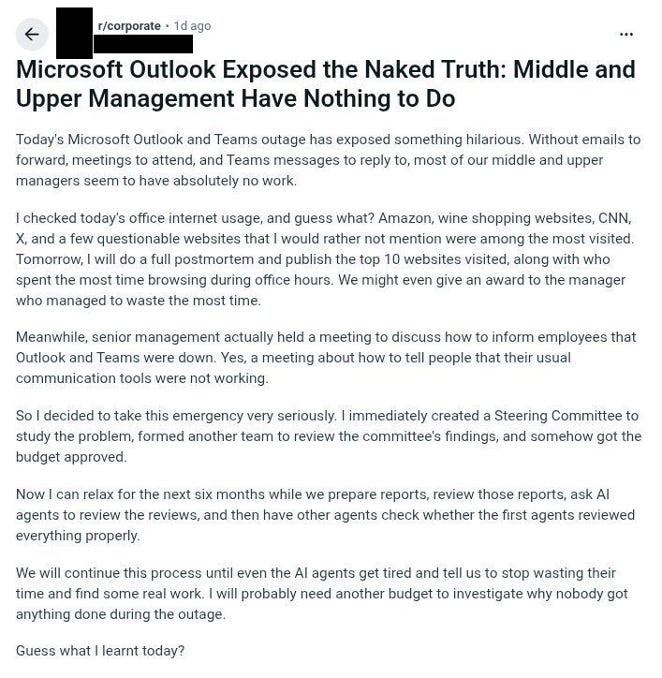
Now that one’s a joke. The steering committee, the six months of reports, the AI agents checking the other AI agents, somebody wrote that for a laugh and fair play to them. But the first paragraph is the bit people recognised. No emails to forward, no meetings to attend, no Teams messages to reply to, and then nothing.
And you don’t need the joke version, because plenty of people said it straight.
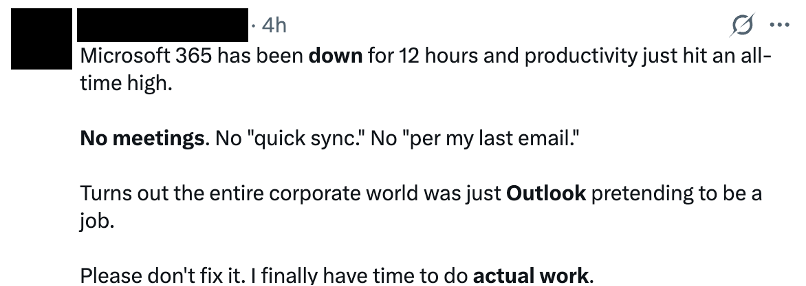

“Senior management on the other hand have nothing to do.” That’s from somebody further down, who spent the morning doing the things they never get round to because of the emails.
It wasn’t only people further down saying it either.


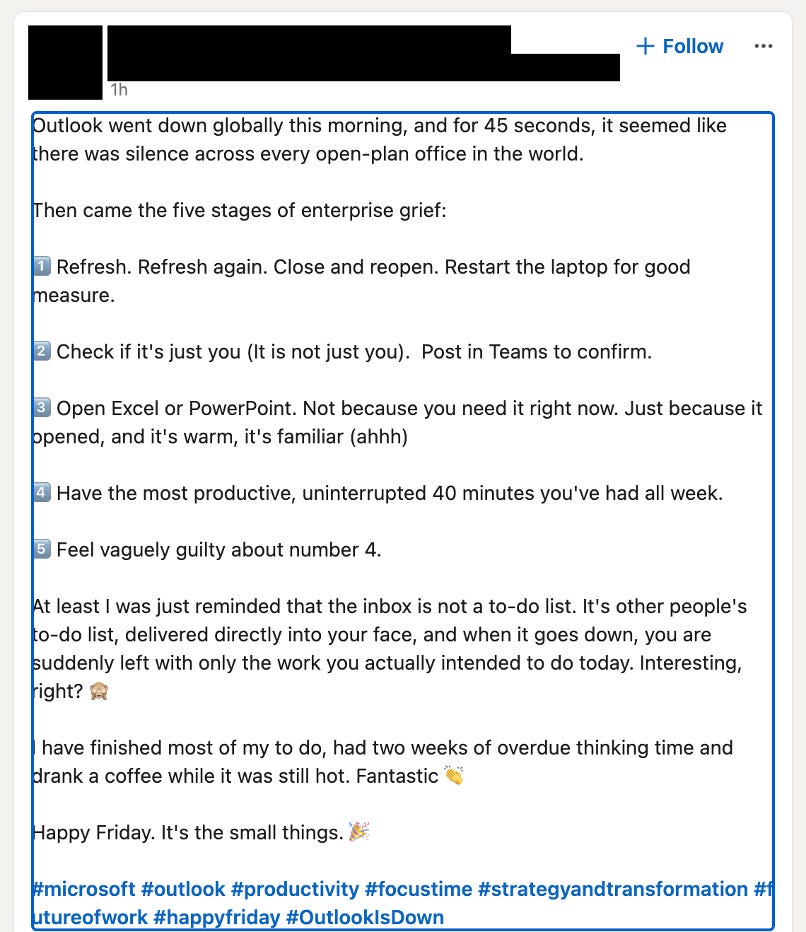
The third one there is a chief executive. The last one is a strategy and transformation director, who got through most of the to-do list, had two weeks of overdue thinking time and drank a coffee while it was still hot. These are senior people saying in public that the best day they’ve had in ages was the day the thing they do all day was switched off. “It’s other people’s to-do list, delivered directly into your face.” I keep going back to that line. If that’s what the inbox is, and the inbox is most of the day.
Then there’s the other lot, who didn’t get a snow day. They got nothing.


“My entire job is receiving email-based help desk tickets, sending emails to internal people about the tickets, and then sending emails back to the person who sent the ticket.” I’m not having a go at whoever wrote that. It’s a more accurate job description than most job descriptions. Email down, no communication, cannot work, that’s the tax one. The one in equity comp said the same thing with more words and a regulator attached. And the service desk person changed the phone message to say IT can’t do anything, and went home after 45 minutes.
One group says the email gets in the way of the job, the other group says the email is the job, and they sound like opposites but they’re describing the same week. A lot of what goes on in an office is moving information from one person to another person. Forwarding it, chasing it, summarising it, having a meeting to say it out loud. Take Outlook away for a day and some of the office is free and some of it has stopped, and both of those tell you how much of the week was the moving. And moving information from one person to another person is the thing these AI tools are being bought to do.
Which is why I’d say don’t be surprised. I don’t know when it comes, nobody does, and I’m not going to pretend I do. But being flat out felt like proof you were needed, and Friday was the day the flat out stopped and you could see what was left. If you could see it, so can whoever does the headcount spreadsheet, and they don’t need an outage to work it out. So when the restructure email does turn up, and it’ll be a polite one, don’t be surprised by it.
The AI went down too, by the way.


“Copilot is down so I can’t think for myself.” That’s a joke as well. The one under it isn’t. Copilot was down, so productivity was cut in half. So the tool is already doing half of somebody’s work, well, half by their own reckoning, and they’ve told the internet that on a Friday for nothing. The same information is available to their employer.
And then the people who didn’t notice.


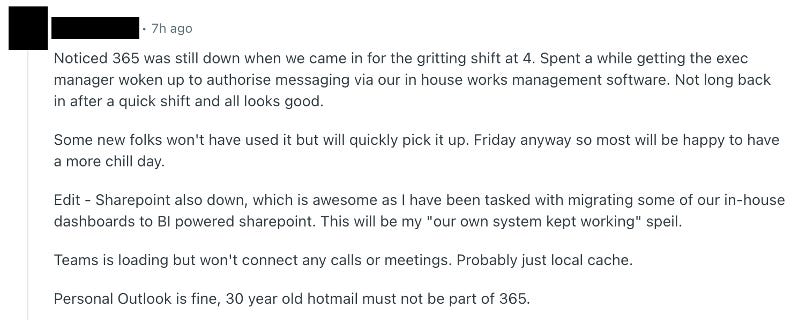

An electrician. Somebody with no work email at all. A gritting crew who came in at four in the morning, got the exec manager woken up, switched to their own system and got on with the shift. In the book I call this the exposure inversion, which is that this goes for the educated, well paid desk jobs before it goes anywhere near the trades. Friday was a small free demonstration of it. “Blue collar is best collar.”
I should say these are people who chose to post, forty-five of them, so nobody should read it as a survey. And for a lot of people it was a properly bad day. One of them says the NHS was having serious issues, before going on to say they stayed in bed until nine and went for a walk.
So here’s a thing you can do in about ten seconds. Take last week. Count the hours that were email, meetings, Teams and chasing people, and then count what’s left over. There’s a business analyst in the book who does it properly, over a weekend, task by task, and gets to 29 of the 40 hours.
I don’t know what your number is. A lot of people got a rough idea of theirs on Friday, and then Outlook came back.
Disclosure, this is what my book is about. The Next Rung, paperback, out 19 January with Practical Inspiration Publishing. Chapter 14 is the audit. thenextrung.co

The Next Rung is a book on how AI is quietly dismantling the middle of knowledge work, and what you can do about it before the market decides for you: pre-order it before it publishes in January.