
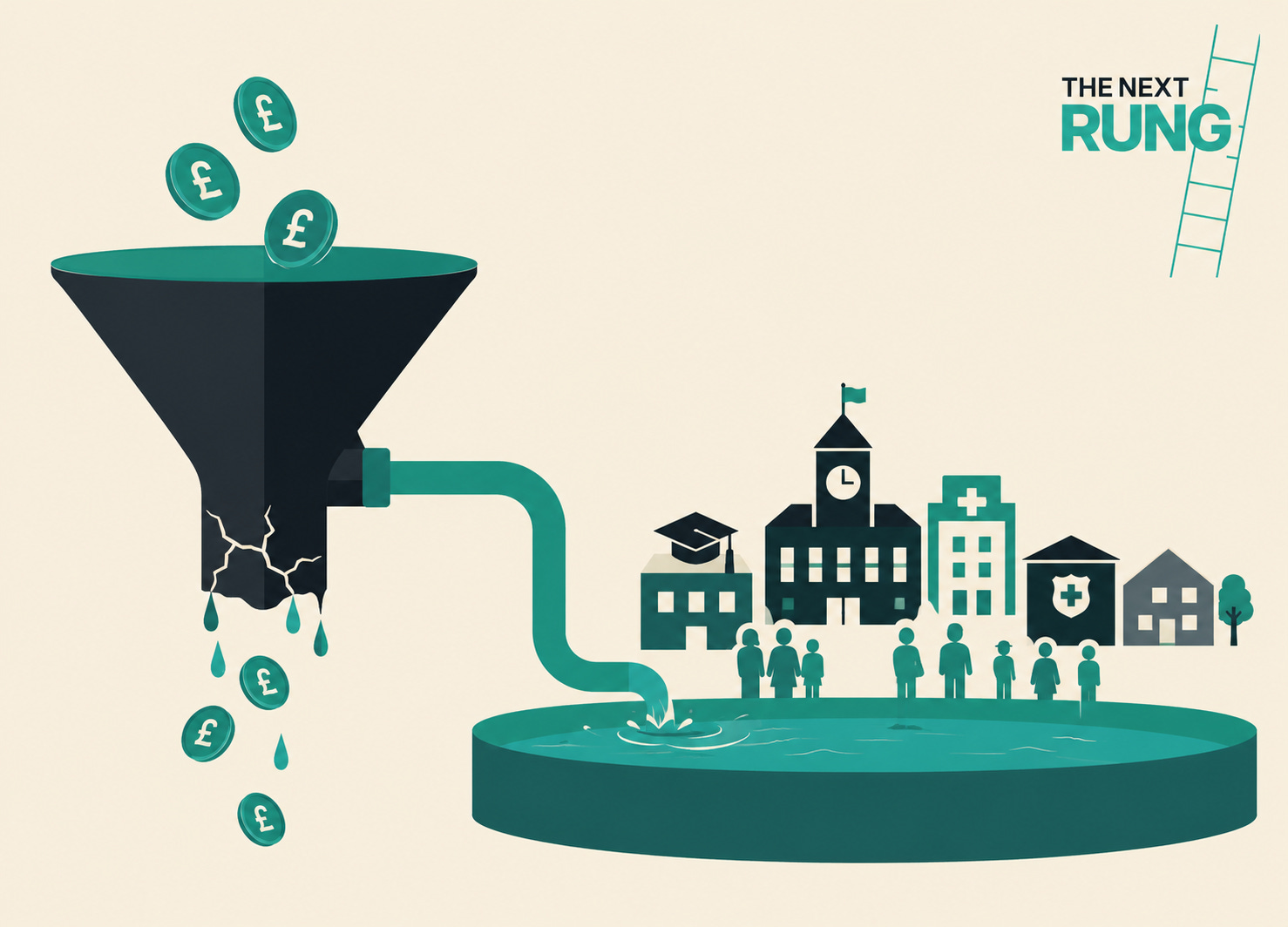
Preston did not create new money. It stopped the existing money from leaking. That sentence is doing a lot of work, so let me back it up a bit.
Years back, Preston’s context was bottom-twenty-per-cent deprivation and central government grants halved from thirty million to eighteen million pounds under austerity. No cavalry coming. And the logic the council tried is almost embarrassingly simple. The anchor institutions, the council, the NHS trust, the university, the police, the housing association, were already spending hundreds of millions a year on procurement. Most of that money was leaving the town the moment it was spent. Catering to national firms. Cleaning to national firms. IT to national firms. The local economy was running as a funnel when it needed to be a reservoir.
So they redirected the spend. Local suppliers, local hiring, cooperative development. Nothing in that list requires a new law, a new tax, or permission from Westminster, which I think is the part people consistently miss about it.
Did it work? Researchers at the University of Liverpool measured a 4% employment-rate improvement against similar-sized areas without the programme. Preston climbed out of the bottom 20%. There is more to the evidence than that, including who gained most, which surprised me, and what has happened since as other places copied it. But those details are in the chapter and I would rather you read them in context, because the context is what makes them matter.
Why is this in a book about AI displacement at all? Because the book’s early chapters are about incomes disappearing faster than institutions can respond, and it would be a cowardly book if it stopped there. In an economy where professional-class incomes are falling and local spending power is contracting, keeping money circulating locally stops being a nice idea and becomes a survival strategy. Preston is not a theory. It already happened, in a mid-sized English town, run by ordinary councillors, under worse funding conditions than most places will ever face.
Right now, there is no way for someone in central government to talk about community wealth building without ending up a pariah. When the pain is strong enough, that changes. The same was true before the New Deal and before the NHS. Political permission arrives late, and it arrives because somewhere already proved the thing works.
Chapter 12 covers Preston alongside five other institutions that already exist, already run, and already produce results. No moonshots, and so on. The point of the chapter is that the answers are less exotic than people assume. The hard part is not invention. It is adoption.

This is from Chapter 12 of The Next Rung, my book on what AI displacement actually looks like from inside. It’s open for pre-order now: