
If what you took from the weekend is that the AI labs are slowing down because the models have stalled, and the doom talk is cover for a missed IPO, I’m not going to argue with you. Take it as read. What I want to show you is what’s left when you’ve won that argument, and it isn’t much.
A TikTok that turned up in my feed put it as two options. One, two companies who’ve never shown much regard for the rest of us decide on the same day to slow down the thing they build behind closed doors, because it might gain consciousness and end civilisation inside three years. Two, the same two companies notice each release is a smaller step than the last and, rather than say so, build a story about how powerful it all is, which frightens everyone and hands their investors a reason for the promises they haven’t kept. Two firms that can’t agree on a benchmark agreed on this inside a weekend, so yes, I’d be suspicious too.
What actually happened
The facts, quickly. Dario Amodei published his essay on Saturday 12 September. Sam Altman backed it within hours and Elon Musk followed. On the Monday Nvidia lost three percent and Intel six. Altman told Fortune the same weekend that this was an “ill-advised moment to go public”, so no OpenAI listing in 2026, and that’s a company that has already filed confidentially. The Conversation asked whether it’s a safety pause or a strategic retreat. PJ Media skipped the question and called it cartel-building. The incentives line up. I’ll give you all of it.
The bit I can’t cost yet
What I can’t work out yet is what a real ceiling does to the money. The data centres, the chip orders, the whole capex story was priced on the next model being better than this one. Monday was a small preview of that and it ran on nothing more than a blog post. A permanent ceiling is a much bigger question and I haven’t got to the end of it.
The bit I can
The labour side I can speak to, because I build one of the tools. Orca runs on the models that exist today, live, with paying clients, on whatever the frontier was in the spring. Every bit of the value came from the scaffolding round the model, the tools it can reach and the approval queue with a human sat in front of it. The model was the cheap part. If nobody ships another one, my clients won’t notice. The work it took over stays taken.
Two thirds haven’t switched it on
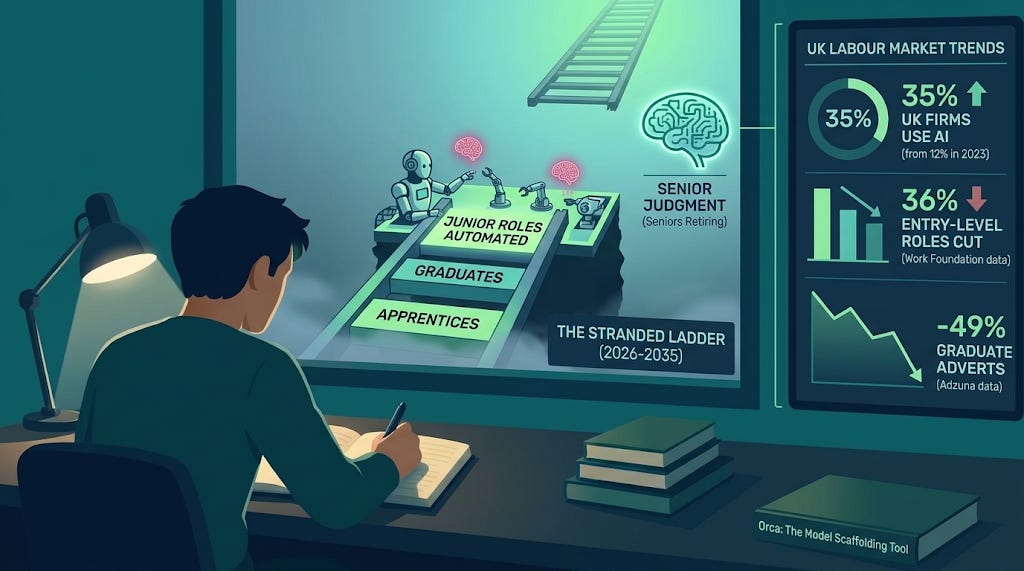
Now the number that matters, and it isn’t a market one. Around a third of UK firms with ten or more staff say they use any AI at all, thirty-five percent the ONS said in July, up from twelve at the end of 2023, and the ones that do use it average one point six tools. Construction is at thirteen. So two thirds of British employers haven’t switched on what already exists, and the third who have are running one and a half things. That’s the headroom, and it’s roughly what Altman himself said in June, that adoption is early and most firms are still working out where to put it. Nothing in Dario’s essay touches any of that. He says plainly that pacing doesn’t mean halting training and that “progress will still seem fast”. He’s slowing the next model. The current ones stay on sale.
What the current models already did
And look at what the current ones did before anyone said the word pause. A Work Foundation survey out in August found thirty-six percent of UK employers had already cut entry-level roles. Adzuna counted graduate adverts in July down forty-nine percent on the year. Vacancies overall were the lowest since spring 2021, and the government’s own review in January found the same pattern in the exposed occupations. All of that happened on models that already exist. Some of it on models that are two versions old now. A freeze doesn’t unship them.
Forty years of nothing, then the rebuild
The last time a general purpose technology did this it took forty years, and the lag is the interesting part. Paul David wrote a short paper in 1990 about the dynamo. Edison’s bulb was 1879, the first generating stations 1881, and by 1900 electric motors drove under five percent of factory machinery. The gain only came when someone stopped swapping the big steam engine for a big dynamo and put a small motor on every machine, then rebuilt the factory floor round that. Decades of nothing, then the rebuild, and the rebuild is where the jobs moved. The difference this time is the rebuild is a licence in a Microsoft tenancy and a person with a browser. The lag is procurement and nerve, and neither of those needs a new model to run out.
Freeze it and the ladder gets worse
Now the part nobody’s costed, and it’s the part that gets worse if you’re right about the wall. Firms cut the juniors because today’s models do junior work. That’s what the Work Foundation number is. Freeze the models and they never get to senior work. So in 2035 you still need the senior, the person who can tell when the output is wrong, and you stopped making them in 2026. The training was always funded by junior output and the junior output went to a subscription. A plateau doesn’t rescue the graduate. It strands the firm as well, about eight years later, when the seniors it kept start retiring. If I believed the wall, that’s the version of the ladder I’d be worried about.
Mollick has the general version
Ethan Mollick at Wharton has been saying since 2023 that if development stopped today you’d have five years, then it was ten, of absorbing what already exists, and he said it again this week as the pause talk started. He’s right, and it’s the general version. He’s talking about integration and productivity. The bit missing is the pipeline. Absorbing a technology takes people who know the job well enough to rebuild it round the tool, and the entry rung is where those people used to come from.
What a freeze does change
What a freeze does change is speed, and I should be straight about that. Without a launch every quarter the roll-out runs at the pace of procurement and legal, which is slow. In the book I said mid-2030s for the damage across the middle. I’d still say that, maybe move the far end out a year, two years, I don’t know. What I wouldn’t move is the tipping point. One competitor halves its delivery cost with the tools that exist and everyone in the sector follows inside a year, no launch event needed. Everything stays the same until it suddenly does not. That line’s in chapter nine and it was written before any of this.
Ten seconds
So, ten seconds. Open last week’s calendar. Count the things you did that the Copilot licence your IT team already bought couldn’t have done. Then find out whether it’s been switched on for your department yet. That answer matters more than anything the labs decide this month.
Disclosure, since it matters here: I build one of the tools doing this, and I wrote a book about what it does to the ladder.
The Next Rung is a book on how AI is quietly dismantling the middle of knowledge work, and what you can do about it before the market decides for you: pre-order it before it publishes in January.