
Hello.
Quick introduction, then we get on with it.
I’m Chris. I run an EdTech company called Enterprise Skills that teaches business capability to sixth formers and apprentices. Before that, I ran a digital agency for a decade. I pivoted one agency and sold my stake in the other back before COVID, took a breath, and spent eighteen months doing three things: building a product called Orca that automates knowledge work using Claude, built a platform to measure human skills in Skills Hub (Enterprise Skills, and writing a book called The Next Rung about what happens to the British economy when AI absorbs the bottom of the office-job ladder.
That’s the who.
The what is this newsletter. Three tracks, two posts a week, for twelve weeks, and then whatever makes sense after that.
Track one is Honest Realities. Essays about what’s actually happening to the UK economy and the people in it. Not the LinkedIn version where everyone wins and prompt engineering saves your career. The version where Sarah the marketing coordinator in Croydon does the maths on her job and doesn’t like the answer. The version where Tom and Priya’s mortgage payment assumed two salaries and now only has one. The version where a Year 11 student at a comprehensive in Bolton is being told to pick his GCSE options on the basis of a labour market that will have changed beyond recognition by the time he sits his A-levels. These essays are free and they will stay free.
Track two is The Next Rung. The book is finished. It comes out in July. Between now and then I’ll serialise the arguments that matter most: why the three mechanisms that used to absorb labour shocks are cracking at the same time, why “just retrain” is a lie we keep telling ourselves, why the most honest probability weighting on the next ten years is considerably darker than the consensus, and what positioning (not predicting) looks like in practice.
Track three is Built In. The story of building Orca in public. Why I built it, what it does, who it’s replaced, what the demos look like, what the objections are, what the first hundred customers taught me. This is the product track. It will be commercial. It will also be honest about the ethical weight of selling a tool that removes people from payrolls.
Two posts a week across the three tracks, with short thoughts slotted into the gaps. Twelve weeks. Then we see.
That’s the what.
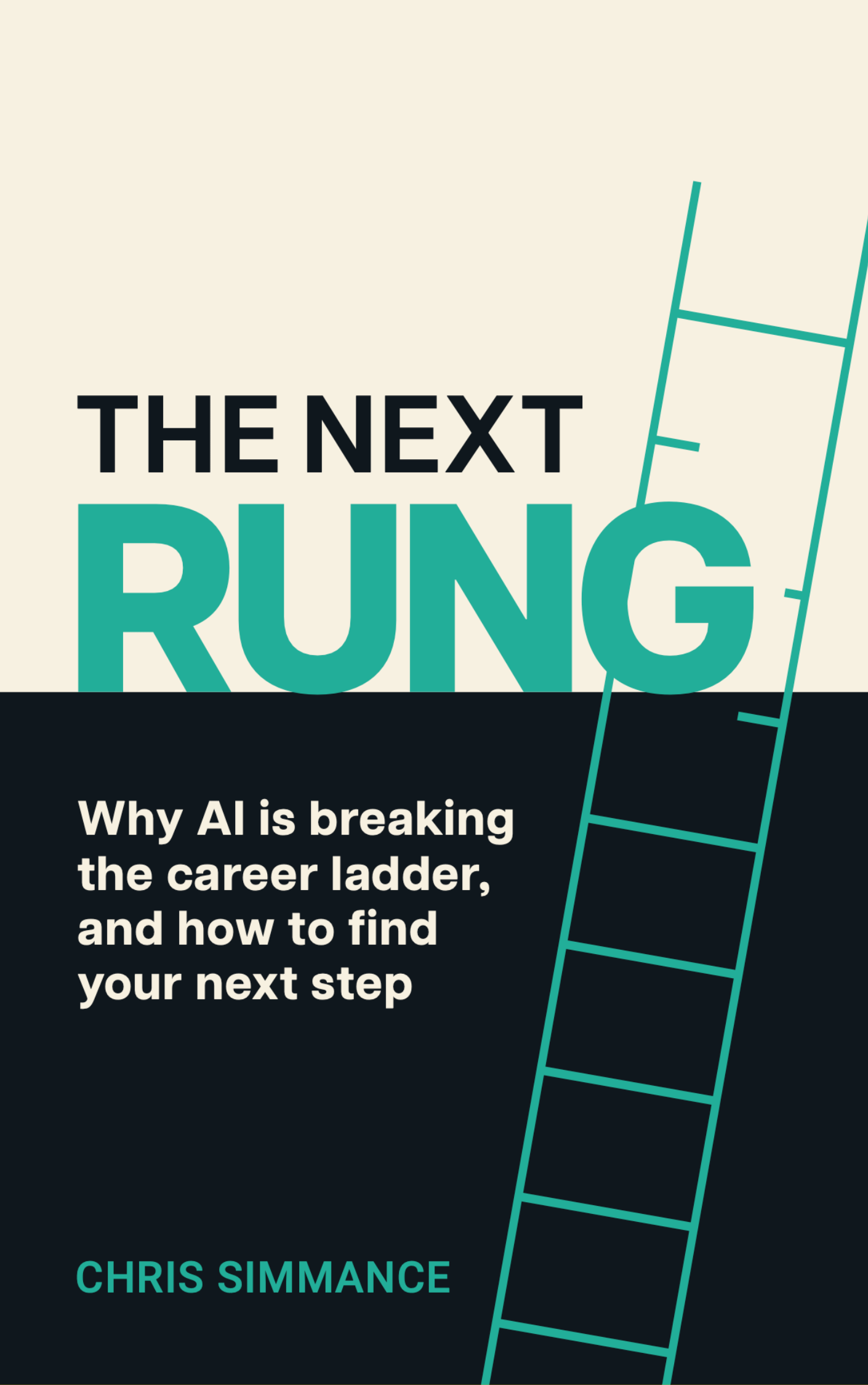
The Next Rung is a book on how AI is quietly dismantling the middle of knowledge work, and what you can do about it before the market decides for you: pre-order it before it publishes in January.
Here’s the why.
The thing that is happening to knowledge work is big. It is probably the biggest economic transition since the factories closed. Most of the public conversation about it sits in one of two registers: frothy hype from people selling courses, or flat denial from people whose jobs depend on it not being real. Both registers are useless to the person trying to decide whether to remortgage, whether to retrain, whether their child should do A-level Business or an electrician’s apprenticeship.
I want to write in a middle register. Grounded, specific, willing to be uncomfortable, unwilling to pretend certainty I don’t have. The book is my best attempt at that. The newsletter is the same attempt in shorter form, more often, with more room for the bits that didn’t make the final edit.
And finally: why here, why Substack, why not just post this stuff to LinkedIn where I already have an audience.
Three reasons.
LinkedIn rewards a specific shape of writing. Short. Punchy. Inspirational. Ideally with a three-line setup and a one-line payoff and a call to engagement. That shape is fine for some things. It is the wrong shape for the things I want to say. The things I want to say need space to develop. They need permission to be uncomfortable for a paragraph before resolving. They need room for a footnote and a qualification and an honest “I’m not sure about this bit.” LinkedIn doesn’t give you that room. Substack does.
LinkedIn is a feed. You scroll past things. You miss things. The algorithm decides what you see and the algorithm has its own agenda, which is not the same as my agenda or yours. Substack is an inbox. If you subscribe, you receive it. If you don’t want it, you unsubscribe. The relationship is direct and the attention is consented to. That matters more to me than reach.
And there’s a practical reason. A book is a long project, and running a newsletter alongside it is the best training ground I know for working out what actually lands. Every post is a small test of an argument. Every reply is a signal. By the time the book comes out in July, I’ll have a much better sense of which bits resonate, which bits need reworking, and which bits are just me shouting into the void. That’s useful. That’s worth doing out in public.
Plus, if I’m being honest: LinkedIn monetises your attention in ways that don’t serve the writer. Substack lets me own the list. If the platform changes its rules tomorrow, I still have my readers. That’s a better long-term position.
The Next Rung is a book on how AI is quietly dismantling the middle of knowledge work, and what you can do about it before the market decides for you: pre-order it before it publishes in January.
So that’s the why.
One more thing. I am not going to pretend I have the answer. I don’t. Nobody does. What I have is a clearer view of the question than most of the public conversation is offering, a book-length argument that I believe is more honest than the alternatives, a product that demonstrates the argument in practice, and twelve weeks to lay out the case.
If that sounds useful, subscribe. If it doesn’t, no hard feelings, the unsubscribe button is at the bottom of every email.
We start Monday. The first post is called “It was fine last time,” and it’s about why the people who are relaxed about this are pattern-matching to the wrong history.
See you then.
Chris
I'm joining late, not used this app in earnest before, how do I catch up on the discussion?