
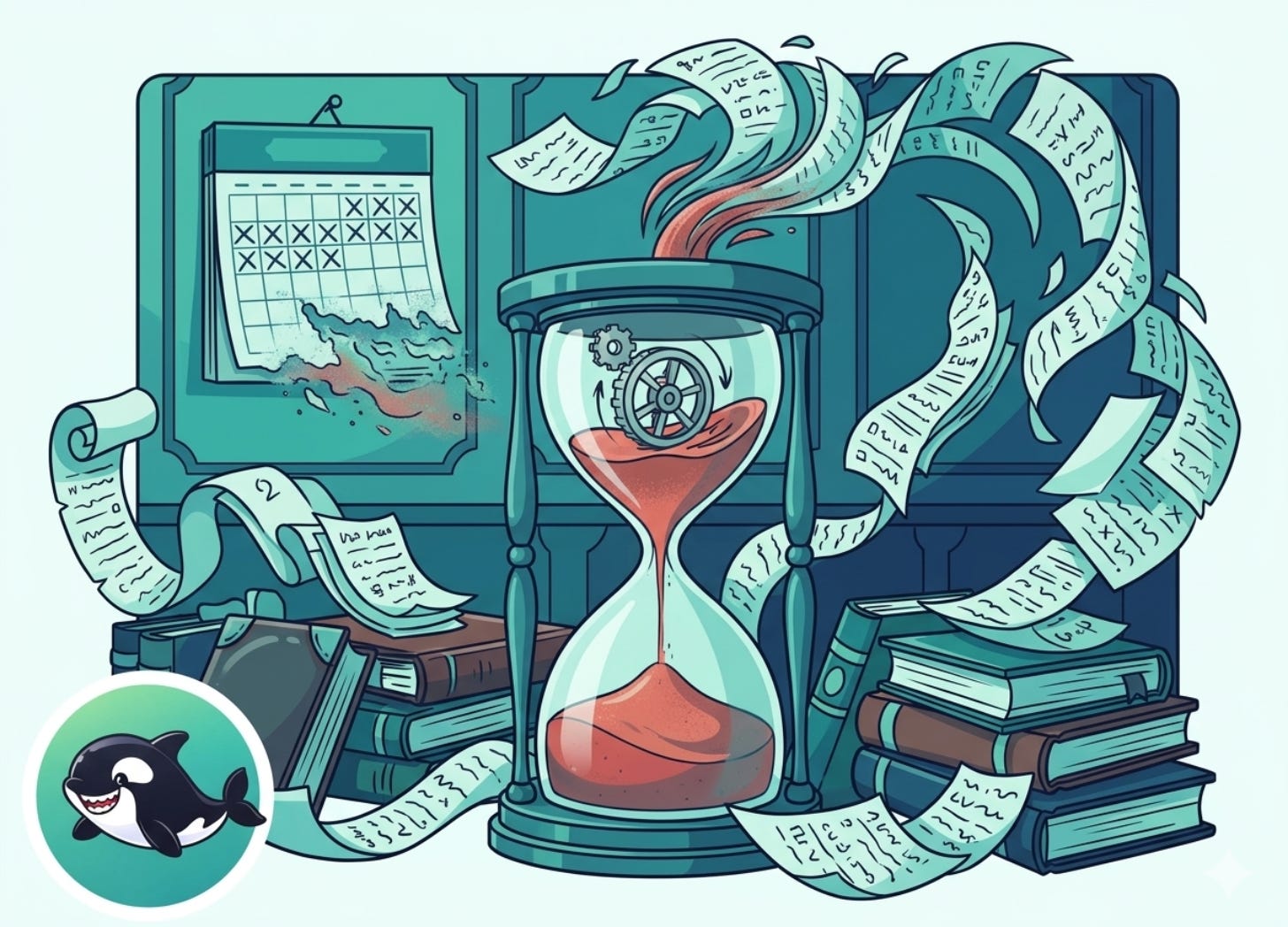
Here is a fact that does not get enough attention in professional development circles: the half-life of technical skills has shortened to about two and a half years. That means half of what you learned in a specialist technical domain will be outdated, superseded, or rendered less relevant in two and a half years.
This is not a new observation. It has been tracked in engineering, IT, and data science for about a decade. But the implications have not been absorbed into how people actually think about their careers.
The standard response to skill decay has always been Continuing Professional Development. Take courses. Attend conferences. Read white papers. Keep up. This was sensible when skill half-lives ran at ten to fifteen years. You could take a course in 2010 on a technical framework and still be deploying that framework competently in 2020. The investment had a decade-long tail.
When the half-life shortens to two and a half years, the economics change entirely.
If you take a course on a specific technical skill today, half of what you learn will be outdated in thirty months. That is not a long enough runway to build career capital. It is not a long enough runway to move from learner to practitioner to expert. It is barely long enough to move from learner to functional.
Consider the practical timeline: you take a course on technology A. Three months to move from competent student to functional practitioner. Six months to deploy it in a real system where the theory meets the constraints of actual infrastructure. Twelve months to develop genuine expertise. Eighteen months to be the person people call when it breaks.
At two years, you are finally at the point where the time investment has paid off and you can add value by teaching someone else. At two and a half years, the technology is becoming obsolete. The pattern that worked for you is being replaced by a new pattern.
You can learn the new pattern, of course. But you are now starting over. The opportunity cost of the first two and a half years was learning something that is becoming obsolete. You are not building on the previous foundation. You are discarding it.
The Next Rung is a book on how AI is quietly dismantling the middle of knowledge work, and what you can do about it before the market decides for you: pre-order it before it publishes in January.
This is the hidden cost of accelerating technical change. It looks like increased opportunity. More skills available to learn, more technologies emerging, more certifications available. What it actually is: a shortened useful lifespan for every piece of technical knowledge you acquire.
The response from the education industry has been to suggest learning faster. Do more courses. Do micro-credentials. Do bootcamps. Stack up the certifications. Build a portfolio. The arithmetic is seductive: if skills are becoming obsolete faster, just learn more skills faster.
This misses the fundamental problem. It is not a problem of speed. It is a problem of half-life.
If you learn skills at a rate of one major technical area per two years, and the half-life of each skill is two and a half years, you are running on a treadmill that is accelerating. You are always in catch-up mode. You are always behind. You cannot build genuine expertise because by the time you reach it, the technology has moved on.
The micro-credential industry is built on this dynamic. The promise is that you can keep up by doing smaller, more frequent learning. But if the half-life is two and a half years, and you are spending three months per micro-credential doing an updated certificate, you are still in catch-up. You are just doing it with more frenetic energy and less depth.
Professionals in these fields often describe it as a treadmill feeling. Constant learning, constant motion, constant awareness that you are falling behind. Because you are. The half-life is not something you can out-learn. It is a structural property of how fast the technology is changing relative to how fast humans can acquire mastery.
The second-order problem is the one that matters more. When the half-life becomes this short, you cannot build stable long-term career capital in technical depth anymore. You can build it in proximity to the technology - in understanding patterns, in knowing which person to call, in having the context to learn the new version when it arrives. But you cannot build it in the technology itself.
This is why the most valuable people in rapidly-changing technical fields are not the ones with the deepest knowledge of the current framework. They are the ones who have seen the previous three generations of frameworks and understand the pattern underneath. They can move to the new technology faster because they have learned how to learn at the architecture level, not the implementation level.
This requires a shift in how people think about professional development. The standard approach is to keep the technical knowledge current. That is increasingly a losing game. The alternative approach is to stop trying to keep technical knowledge current and instead build meta-skills: learning how to learn new technologies, understanding the patterns across generations of frameworks, developing judgment about which framework to apply in which context.
Those things do not become obsolete in two and a half years. They compound.
The Next Rung is a book on how AI is quietly dismantling the middle of knowledge work, and what you can do about it before the market decides for you: pre-order it before it publishes in January.
But CPD is not structured that way. CPD is structured on the assumption that you can accumulate specific knowledge and that knowledge will remain valuable. Courses are built on that assumption. Certifications are built on that assumption. Continuing Professional Development hours are mandated on that assumption.
When the half-life of the knowledge being taught is two and a half years, mandating forty hours of CPD per year is a ritual, not a hedge. You are going through the motions of staying current while the very concept of current is becoming a moving target.
The honest position is this: if your career depends on technical knowledge, you have a problem. The half-life of that knowledge is shorter than the time it takes to move from competent to expert. You cannot build a career on expertise in a specific technology anymore. You have to build a career on the ability to move between technologies.
That is a different skill. It is a harder skill. It is not something you learn in a course. It is something you learn by doing it repeatedly, by seeing the patterns across multiple generations, by developing judgment about architecture and principle rather than memorising implementation.
For people in rapidly-changing fields, the choice is: spend energy trying to keep technical knowledge current and always feel behind. Or accept that technical knowledge will decay and build your career on being the person who can navigate that decay with judgment and speed.
CPD is comforting because it feels like you are doing something. But if the underlying knowledge is decaying faster than you can update it, the action is not hedging the risk. It is performing the illusion of risk management while the actual risk accumulates in the background.