
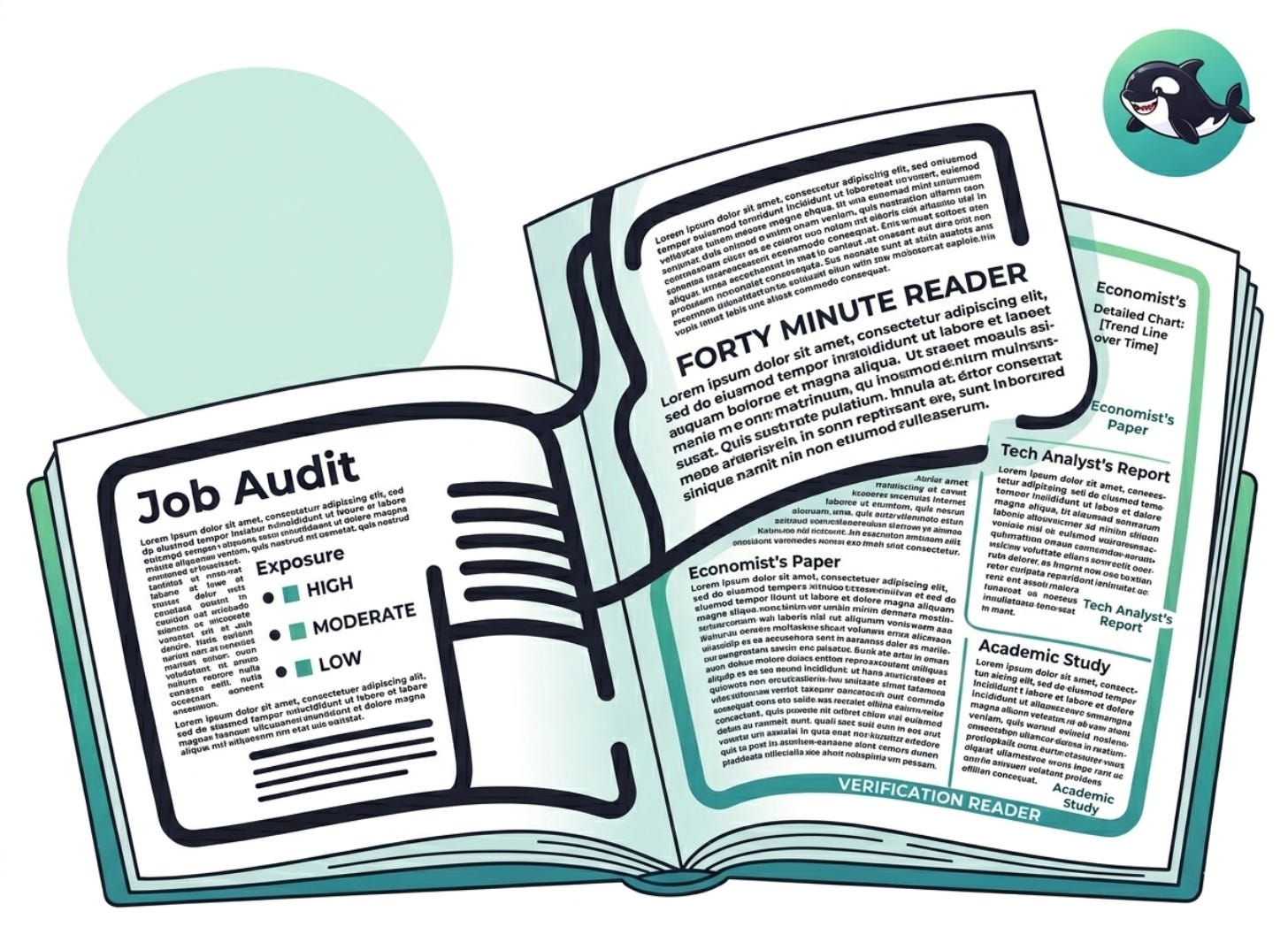
People don’t read books straight any more. They skim. They skip the bits that don’t seem to apply. They read the first paragraph and the conclusion and skip the middle. Some of them read nothing except the bold-faced sentences and the headers. That’s not laziness. It’s time management. The people whose jobs are most exposed to AI displacement, the ones this book is written for, are almost by definition the people with the least time to read a full-length manuscript.
So I built the argument twice.
Once, in full. Chapters with analysis, observation, composite characters, the texture that makes something feel like a real story. The second, in bold. Every chapter has a bold layer: the summary written in the densest possible prose. Argument without elaboration. Claim without evidence. Just the frame.
This is deliberate constraint writing. You can’t include every nuance in five thousand words across an entire book. So you have to ruthlessly eliminate the supporting detail and keep only the skeleton of the argument. The claim that cannot be removed without the whole thing collapsing.
The process was iterative and difficult in unexpected ways. I’d write a full chapter, thirty or forty pages on something like the task-level exposure audit. Then I’d ask: if I had to reduce this to four or five pages of pure argument, what’s load-bearing? What can disappear? The process strips away the writing. What remains is the shape.

The Next Rung is a book on how AI is quietly dismantling the middle of knowledge work, and what you can do about it before the market decides for you: pre-order it before it publishes in January.
Chapter 16, “The Honest Audit,” becomes: Your job is not one thing. It’s a bundle of tasks with different exposure levels. Map your week. Score each task high, moderate, or low. If 60 per cent of your day is high-exposure work, your role is in trouble even if the remainder is distinctly human. Your employer is paying for the whole day. Beyond 40 per cent high-exposure, the maths stop working. Include a skills currency check. Include household risk assessment. Include the dual-income concentration problem. The audit tells you where you stand. That’s all it does. That’s all it needs to do.
That’s roughly one-fifteenth of the chapter. Every other detail, every composite character, every conversation, every worked example that made it feel human and grounded and real, all of that is construction. Load-bearing is: the framework plus the honesty about what the framework means.
The reason this matters is structural. The people time-poor enough to be in the highest-exposure roles are almost by definition the people least able to read a fourteen-chapter manuscript. They’re working sixty-hour weeks. They’re managing teams. They’re billing hours to clients. They’re rebuilding their home offices while managing school pickups. The last thing they have is an afternoon.
So if the argument matters enough to be read, it matters enough to be skimmable. And the only way to write something skimmable without producing something superficial is to build the scaffolding explicitly. Here’s what’s essential. Here’s what’s supporting. Read the bold. Trust that the rest is there if you need it. But you might not. The bold layer should stand alone.
The risk of this approach is obvious: it looks like you’re not trusting your argument. Like you think people need cliffs notes. The opposite is true. You’re assuming your readers are smart and time-constrained. You’re treating them as adults capable of deciding how deep to go. You’re saying: the frame is here. If you want the texture, it’s there too. If you don’t have time, don’t read it.
The secondary benefit is something I didn’t anticipate when I started. Writing the bold layer forced me to test whether every claim was actually necessary. Did this character serve the argument or was I just telling a story I liked? Did this example illuminate the point or was I just padding? The constraint made the argument sharper. Not shorter. Sharper. Necessary.
The practical result is something between a book and a primer. Read only the bold. You’ve read the book. Really it’s five thousand words of dense argument. You understand the displacement logic, the scenarios, the positioning framework, the household risks. You don’t have all the detail. You have the spine. Read the full text around the bold. You have the spine plus the texture. The evidence, the characters, the ethical grounding, the sense that someone has thought about this in detail and it’s not a thesis. It’s a pattern from advisory work that the analysis confirms.
This is what I wish someone had done for me in 2019. I was reading three research papers a day trying to understand the AI displacement pattern. An economist’s paper on labour market disruption. A tech analyst’s report on enterprise adoption curves. An academic study on the skills half-life problem. If I’d had a book where the bold layer gave me the frame and the full text let me verify it was grounded, I’d have saved probably a hundred hours. I’d have understood the pattern faster. I’d have positioned differently.
The Next Rung is a book on how AI is quietly dismantling the middle of knowledge work, and what you can do about it before the market decides for you: pre-order it before it publishes in January.
There’s a philosophy underneath this. Which is: accessibility is not a reduction. Good writing is writing that works at multiple depths. A sentence can be clear as journalism and precise as an academic claim simultaneously. You don’t have to choose. You’re just choosing which reader you’re optimising for on any given sentence.
The bold layer optimises for the reader with forty minutes and a paper, who needs the frame. The full text optimises for the reader who has time but wants grounding. Between the two, there’s a book that works for how people actually read.
One more thing. The bold layer made the argument testable in a way the full text alone wouldn’t. I could print the bold layer separately, five pages stapled together, and say: does this frame feel like it accounts for what you’re seeing? Does the scenario list feel complete? Are the positioning principles missing anything? People who would never read a 80,000-word manuscript would read five pages and give feedback. That feedback was how I caught gaps. How the argument sharpened. How I confirmed that the pattern Chris I was seeing in advisory work matched the pattern the research predicted.
If the bold layer lands, you’ll read the book. You’ll want the detail. You’ll want the characters and the composite examples and the ethical reasoning underneath the claim that we’re likely heading toward neo-feudalism at almost fifty per cent probability rather than managed transition.
If it doesn’t land, if the frame doesn’t feel like it accounts for what’s actually happening in your industry or your household, then you haven’t wasted an afternoon. You’ve spent forty minutes figuring out that this book isn’t written for where you’re standing.
That’s honest. And it respects your time. Which, if you’re in a high-exposure role, is the scarcest resource you have.