
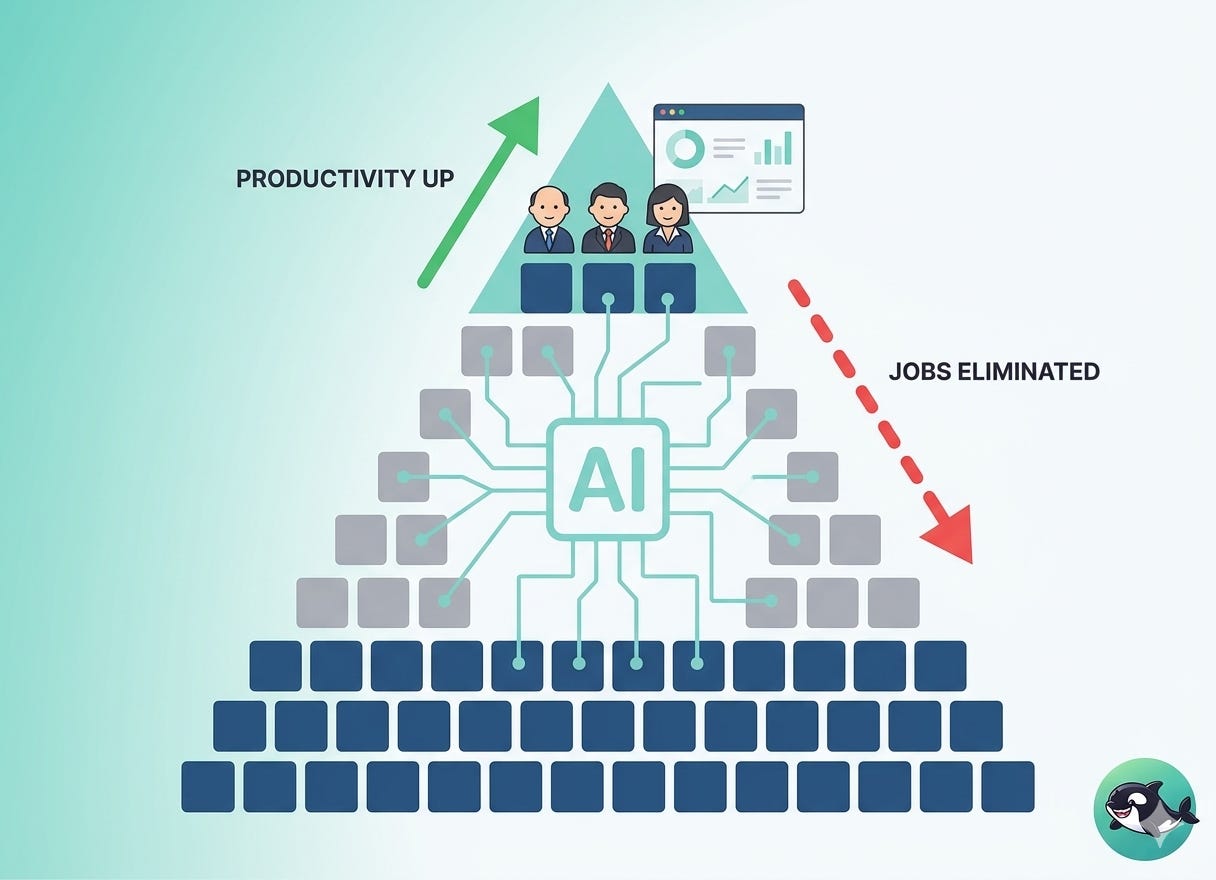
In May 2023, BT announced that it would cut up to 55,000 jobs by the end of the decade, around 42 per cent of its workforce. Around 10,000 of those cuts were directly attributed to AI and automation. The then-CEO Philip Jansen said the company would emerge “leaner” and better positioned for the future. The share price bounced. The announcement got praised as bold.
Two and a half years later, his successor Allison Kirkby has warned that the number could go higher. EE, the BT-owned mobile operator, runs a virtual assistant called Aimee that handles around 60,000 customer conversations a week. That’s the labour of somewhere between 200 and 400 full-time customer service agents, depending on how you count. Those agents are not being hired. The conversations happen, the customers get answers, the productivity shows up on the operational dashboard, and the headcount that used to be there isn’t.
BT is not a special case. It’s the case, done loudly and in public. The quieter version is happening everywhere, in every sector that has a knowledge work component.
Every time one of these deployments gets covered, the coverage focuses on the three human supervisors still running the system, or the small number of new “AI strategist” or “prompt engineer” roles being created. The implicit argument is that the jobs aren’t really disappearing, they’re just changing. The coverage never gets around to the forty-seven people who used to do the work and now don’t.
This is the book in one paragraph. The deployment maths doesn’t close. The absorption mechanism doesn’t exist. The conversation doesn’t acknowledge either fact.
The cases that are already in the open
Klarna, 2023: roughly 700 customer service roles replaced by AI. Public case study. By 2025, the company is quietly rehiring, but at a smaller number and in less secure roles. Net displacement: probably several hundred.
Duolingo, late 2023: contractor headcount reduced by around 10 per cent, functions absorbed by AI. Translators, copy reviewers, content developers. The learners haven’t noticed any quality change that affects engagement metrics. The displaced contractors didn’t get a press release.
IBM, 2023-2024: Arvind Krishna announced a back-office hiring freeze, with an estimated 7,800 roles targeted for reduction or replacement. HR, finance, administrative functions. By 2025, parts of this were quietly walked back, but the direction is clear: net reduction in administrative knowledge work.
BT, 2023 onwards: 55,000 announced, a meaningful share already executed, more signalled for 2026 and beyond. Customer service, operations, network management.
Amazon, 2024 onwards: multiple rounds of corporate layoffs totalling tens of thousands, some of which the company has explicitly linked to AI-driven efficiency programmes.
Microsoft, 2025: major rounds of corporate cuts alongside aggressive Copilot rollouts internally. Not always framed as AI-caused, but the timing isn’t coincidence.
None of these are controversial or disputed. They’re in the public record. Add them up and you’re already in the low hundreds of thousands of named, announced, AI-attributable displacements in the UK and US, with more in train.
The optimistic framing is that these are offset by new jobs being created elsewhere in the economy. The optimistic framing has one very large problem. Nobody has produced a credible list of the new jobs. Every attempt to do so collapses into “AI will create jobs we can’t yet imagine”, which is a statement of faith, not an argument.

The Next Rung is a book on how AI is quietly dismantling the middle of knowledge work, and what you can do about it before the market decides for you: pre-order it before it publishes in January.
The graduate intake signal
A better leading indicator than named layoffs is what happens at the entry level. If AI is eliminating middle-skill knowledge work, the career ladder into that work gets compressed. You can see this in professional services graduate hiring.
Major UK accounting firms reduced their graduate intake for 2025 entry compared to 2023. Magic circle law firms held intake roughly flat while increasing reliance on AI-assisted document review. Management consulting firms reduced intake substantially, particularly at the strategy end, where AI-augmented partners can cover ground that previously required teams of analysts.
The story for 2026 is still forming, but the early signals suggest the compression is continuing. Law firms are tightening trainee retention rates. Accounting firms are redesigning graduate programmes around AI-literate specialist tracks rather than broad-based training. Consulting firms are quietly restructuring the analyst pyramid into something with a narrower base.
What this means, practically, is that the 22-year-old graduating this summer has fewer places to start than the same graduate would have had five years ago. Not zero places. Fewer. The effect compounds across cohorts. A smaller cohort starting now produces a smaller cohort at mid-career in ten years, because the intake has shrunk permanently rather than temporarily.
This is the mechanism by which the middle layer hollows out. It doesn’t happen through mass layoffs of existing middle managers. It happens through the gradual under-recruitment of the next generation, while the existing generation works with AI assistance until retirement.
The outcome is fewer middle-skill professionals, concentrated among older cohorts, trained in a previous era, doing their jobs with AI tools. The next generation never gets trained in depth, because there aren’t enough entry roles to train them.
What the forty-seven do
If the absorption mechanism is broken, what happens to the people displaced or never hired?
Some retrain successfully into genuinely AI-resistant work. Trades, care roles, specialised professional work that requires physical presence. The pool that makes it through this door is real but small, bounded by physical training capacity and the job market in each destination.
Some accept lower-quality substitute work. Gig economy, part-time, flexible-but-precarious. This is the Klarna hybrid model’s demographic: students, parents, rural workers taking flexible AI-augmented customer service roles for less than they’d have earned in a traditional call centre a decade ago. The roles exist. They don’t substitute for what was lost.
Some exit the workforce. Early retirement if they can afford it. Caring responsibilities taken on formally. Long-term disability that was previously masked by low-demand work. Informal economy participation.
Some stay unemployed or underemployed for extended periods, burning through savings, drawing down equity in homes, borrowing against retirement. This is the category nobody likes to talk about because it’s politically uncomfortable, demographically concentrated among middle-aged middle-class workers, and fiscally expensive.
A small number become loud. This is the category that shows up in political movements, public protest, and the kind of electoral shifts that governments fail to predict. If the Next Rung thesis is right, the loud minority gets larger over the next decade, and the politics get sharper.
The forty-seven don’t evaporate. They distribute across these destinations, unevenly, with consequences that accumulate quietly until they don’t.
The NHS version
Rowan’s conversations about rework in the NHS are the sharpest example of the hidden-cost problem. If rework runs at 30 to 60 per cent of NHS activity, the hidden cost runs into tens of billions a year. This is separate from the Next Rung thesis but connects to it in a specific way.
AI is being aggressively piloted in the NHS for diagnostics, summarisation, administration, and workflow optimisation. The productivity case is being made, loudly. If the deployment follows the pattern this series has traced, gross productivity gains will be reported, rework costs will be absorbed invisibly, and the net benefit will be smaller than claimed. Meanwhile, the 60 per cent rework rate sits there, uncounted, consuming resources that could pay for defence spending twice over.
The combination is worth staring at. We have a public healthcare system running on a 30-60 per cent error rate that nobody measures. We’re deploying AI into that system with productivity claims based on gross output. We’re simultaneously cutting administrative roles on the basis of AI-driven efficiency gains. The same mechanism that gives you the efficiency gains hides the rework cost. The rework cost, if it were measured, would dwarf the efficiency gain.
This is not an AI problem. It’s a measurement problem that AI is making worse. And the people who pay the cost are patients, taxpayers, and the displaced administrators who used to catch errors before they propagated.
The Next Rung is a book on how AI is quietly dismantling the middle of knowledge work, and what you can do about it before the market decides for you: pre-order it before it publishes in January.
What the argument needs to be
The Next Rung thesis is usually summarised as “AI is eliminating knowledge jobs and the economy can’t absorb the displaced workers”. That’s true, but it’s incomplete. The fuller version includes the rework dimension.
AI is eliminating knowledge jobs on the basis of gross productivity claims that don’t net out. The displaced workers can’t move up the ladder because the ladder has been compressed. The economy can’t absorb them because the mechanisms that used to do the absorbing aren’t operating. The productivity gains that would have made displacement more tolerable are smaller than advertised. The rework cost of AI-augmented workflows will, over time, offset a meaningful share of the announced efficiency gains. The displaced workers will neither get new jobs nor cheaper goods to buy as consumers.
The only group that wins, unambiguously, is the owners of the AI systems and the capital that funds them. Labour loses jobs. Consumers lose quality. Governments lose tax revenue from the displaced workers, and inherit the fiscal cost of supporting them.
This is not a story that resolves itself. It’s a story that compounds, slowly, until the politics catches up with the economics.
The decade ahead
I put the quiet squeeze period through 2028. The breaking point comes between 2028 and 2032. The reshaping follows through the 2030s. These are directional estimates, not forecasts. The specific year depends on the interaction of labour market statistics, political response, and the pace of AI capability gains. All three are uncertain.
What’s not uncertain is the direction. The displaced worker count keeps rising. The offsetting new-job count does not catch up. The productivity gains get reported gross, and the rework costs accumulate quietly. The QC rung doesn’t open at the scale required. The graduate intake compresses. The middle layer hollows out.
At some point, probably before the end of the decade, the politics of this becomes unmanageable through the usual mechanisms. Tax the AI. Regulate the deployment speed. Redistribute the gains. Break up the platforms. Something. The specific policy response depends on which party is in power when the pressure breaks, and which country breaks first. The pressure itself is already building.
The book I’m writing is about the period between now and then. What the mechanism looks like from inside. Why it’s hard to see while it’s happening. What the people who are paying attention should do, both for themselves and for the wider economy.
Rowan’s contribution to this project, which started with a response to the original Next Rung post, has sharpened the argument in a specific way. The rework dimension matters because it breaks the productivity consolation. If the gross gains were real and net, the displacement might still be worth it on utilitarian grounds. If the gains are gross and the net is smaller, the displacement is worse than advertised, and the whole policy calculation changes.
Seven pieces of writing later, including this one, the argument is harder to dismiss than it was when I started. That’s the point of writing a book on something rather than a blog post. You get to see the argument from more angles, against more evidence, with more pressure on the weak points.
The weak points that have survived this process are the ones worth defending. The rework-adjusted displacement thesis has survived. It’s the load-bearing wall for what comes next.
With thanks to Rowan Jackson, whose feedback on the original Next Rung post catalysed this series, and whose ERW paper, published in December 2024, supplied the analytical framework that runs through all six pieces. The orthopaedic consultant’s 60 per cent NHS rework estimate in particular is worth sitting with. It may be the most consequential back-of-envelope figure I’ve encountered since starting this project.
Primary sources: BT strategic update (2023) and subsequent AGM commentary (2024-2025); Klarna public disclosures and press coverage, 2023-2025; IBM back-office automation disclosures, 2023-2024; UK Office for National Statistics labour market data through Q4 2025; law and accounting firm graduate intake reporting, 2024-2025; Rowan Jackson, ERW paper, December 2024; NHS England financial directions 2025-26; H.J. Harrington, Business Process Improvement, 1991; HBR, Beyond Toyota: How to Root Out Waste and Pursue Perfection (1996); HBR case study on Danaher Business System.