
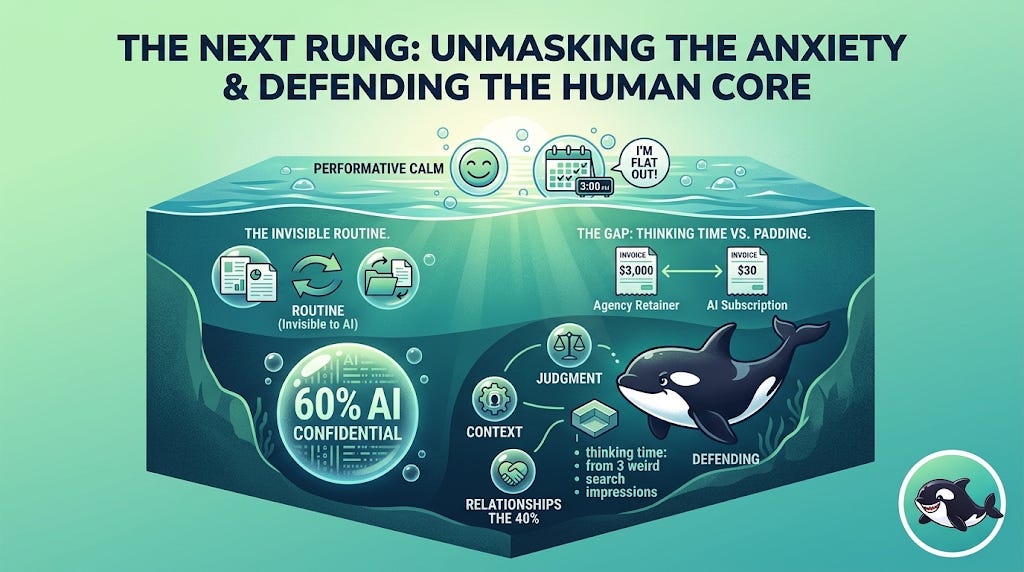
Partway through I asked a question I thought I knew the answer to. If a client rang you today and asked how much of your job AI could do confidently, right now, what would you tell them?
Sixty per cent, one of them said.
And nobody argued. That’s the bit I keep coming back to. Not the number, the silence after it. A room full of smart, employed, busy people heard a colleague price sixty per cent of their profession into a subscription, and every one of them just nodded, because they’d all done the same maths privately months ago. They’d just never been anywhere it was safe to say out loud.
That’s the part that should make you angry. Not at them. At whatever it is that made a leadership-free room the only place the true number could exist.
Because here’s what those same people are swimming in. Feeds full of exciting times, and love what this unlocks, and we’re all in on AI. An industry where the only acceptable public emotion about this technology is enthusiasm. You can be excited at work. You can be curious at work. You cannot be worried at work, not out loud, because worried reads as behind, and behind reads as next. So the worry doesn’t go away. It relocates. It goes home, turns up at three in the morning as mortgage arithmetic, and comes back in the next day wearing a smile and posting about productivity gains.
Everyone is performing calm for everyone else. Leadership performs it for the team so nobody panics. The team performs it for leadership so nobody looks replaceable. The keynote circuit performs it for money, which is at least honest work. And every layer of the performance makes the next person more certain they’re the only one doing the 3am maths. They are not. They are all doing it. I have now sat in enough rooms to tell you they are all doing it.
Now, the uncomfortable bit. Sixty per cent is the polite number.
Here’s the mechanism, because this is where most of the commentary stops and it’s exactly where it shouldn’t. When you ask someone what a machine can’t do about their job, they answer with their best moments. The judgment call that saved an account. The thing they spotted that nobody else saw. The client who trusts them specifically. All real. Every one of those things is real, and none of them is what the working week is made of. The week is made of briefs, updates, reports, coordination, moving information from one place to another with a professional finish on it. The judgment moments are the reason they got promoted, which is precisely why they’re the moments that get remembered when the question lands. The routine is invisible to the person doing it because it’s routine. So when someone says sixty per cent, what they’ve done is count honestly for the first time and still round in their own favour. The remainder, the genuinely human bit, is real. It’s just not eight-hours-a-day big. And the salary was priced on the whole eight hours.
That’s the actual problem. Not that the human bit doesn’t exist. That it was never the bulk of the day, and the bulk of the day is now a feature in someone’s product.
There was a second question that afternoon, and I nearly didn’t ask it because I knew where it went. Eight hours of work, two years ago, took eight hours to do. How long does eight hours of work take now?
Two.
So here’s the question nobody in professional services wants asked in front of a client. How do you bill ten hours when the work takes two? Sit with how uncomfortable that is for a second, and then notice who the discomfort is protecting. Not the client. The client is already running their own version of the sum every time an invoice lands. Three grand a month to the agency, thirty quid a month to the tool, and a growing suspicion that the gap between those two numbers is padding.
Sometimes it is padding. Let’s not pretend otherwise, some retainers out there are running on momentum and a nicely formatted report. But I want to tell you what the gap looks like when it’s real, because this is the bit the invoice never shows.
In that same session, someone described a client who wanted a thousand meta descriptions done, because the tools make it nearly free and more sounds like progress. The team said no. Not because they couldn’t, because it was a waste of the client’s money and the client couldn’t have known that. Someone else talked about reading the recent algorithm updates, the ones going after mass-produced AI content, and quietly steering clients away from plans that would have run straight into a penalty. The client will never know the disaster that didn’t happen. That’s the product. The disaster that didn’t happen has no line on the invoice.
And the version of it I carry around from my own agency years. I used to watch a paving company’s search data every month, and every month one weird term showed up with three impressions. Three. For a product that didn’t exist. I Googled it, found nothing, eventually asked about it in their office, and someone behind the desk said oh, we get calls about that. It was a little plastic corner piece for resin paving. They made it. It sold everywhere, because nobody else had noticed the demand. Three impressions a month, spotted by a human with time to be curious, turned into a product line. No deliverable schedule produces that. Thinking time produces that, and thinking time is exactly what the two-thousand-nine-hundred-and-seventy-quid gap is supposed to be buying. The scandal isn’t that the gap exists. The scandal is how rarely anyone shows the client what’s in it.
The full diary is the other lie people are leaning on. I’m flat out, so clearly I’m needed. I can see time data across a whole business, and I’ll tell you where the hours actually go. Messaging. Coordination. Keeping each other updated about work the tools are increasingly doing. The busiest people I meet are frequently the most exposed, and their calendar is telling them the opposite, and they believe the calendar because the calendar is the only thing still saying nice things to them.
And then there’s the reassurance industry. The it-created-more-jobs-last-time crowd. Five words doing an extraordinary amount of load-bearing work, offered by people who will not be the ones carrying the load if it turns out to be wrong this time. Last time worked because the displaced had somewhere obvious to go. The factories were hiring. Tell me where the factories are for a forty-five-year-old account director, specifically, with a street address, and I’ll relax. Until then I’d gently note that the people saying it loudest are, almost without exception, people whose income does not depend on it being true.
For what it’s worth, I don’t think the team I sat with are in trouble. They were more honest in ninety minutes than most conferences manage in two days, and the honesty is the asset. The judgment is real, the context is real, the relationships are real, and crucially, once they’d said the sixty per cent out loud, they could finally talk about defending the forty. You cannot defend a position you won’t admit you’re standing on. Most of their industry is still refusing to admit the position. That’s the difference, and it has nothing to do with the technology.
So do the thing I asked them to do. Write one paragraph about your job that a tool couldn’t claim. Not your title, not your task list. The actual human part. Judgment you’ve exercised, context you carry, relationships that would walk out the door with you. If it comes easily, you’ve probably got something worth defending. If you’re on your third attempt and it all keeps coming out sounding like process, that’s information too, and better to get it now, from yourself, in private, than in eighteen months from someone holding a spreadsheet.
The room went quiet when I set that exercise, by the way. Same silence as the sixty per cent. Everybody already knows.
I’ve written a book about all of this. The Next Rung, out with Practical Inspiration Publishing in January. Pre-order at thenextrung.co if you want the long version of the 3am maths, and what to do about it.
The Next Rung is a book on how AI is quietly dismantling the middle of knowledge work, and what you can do about it before the market decides for you: pre-order it before it publishes in January.