
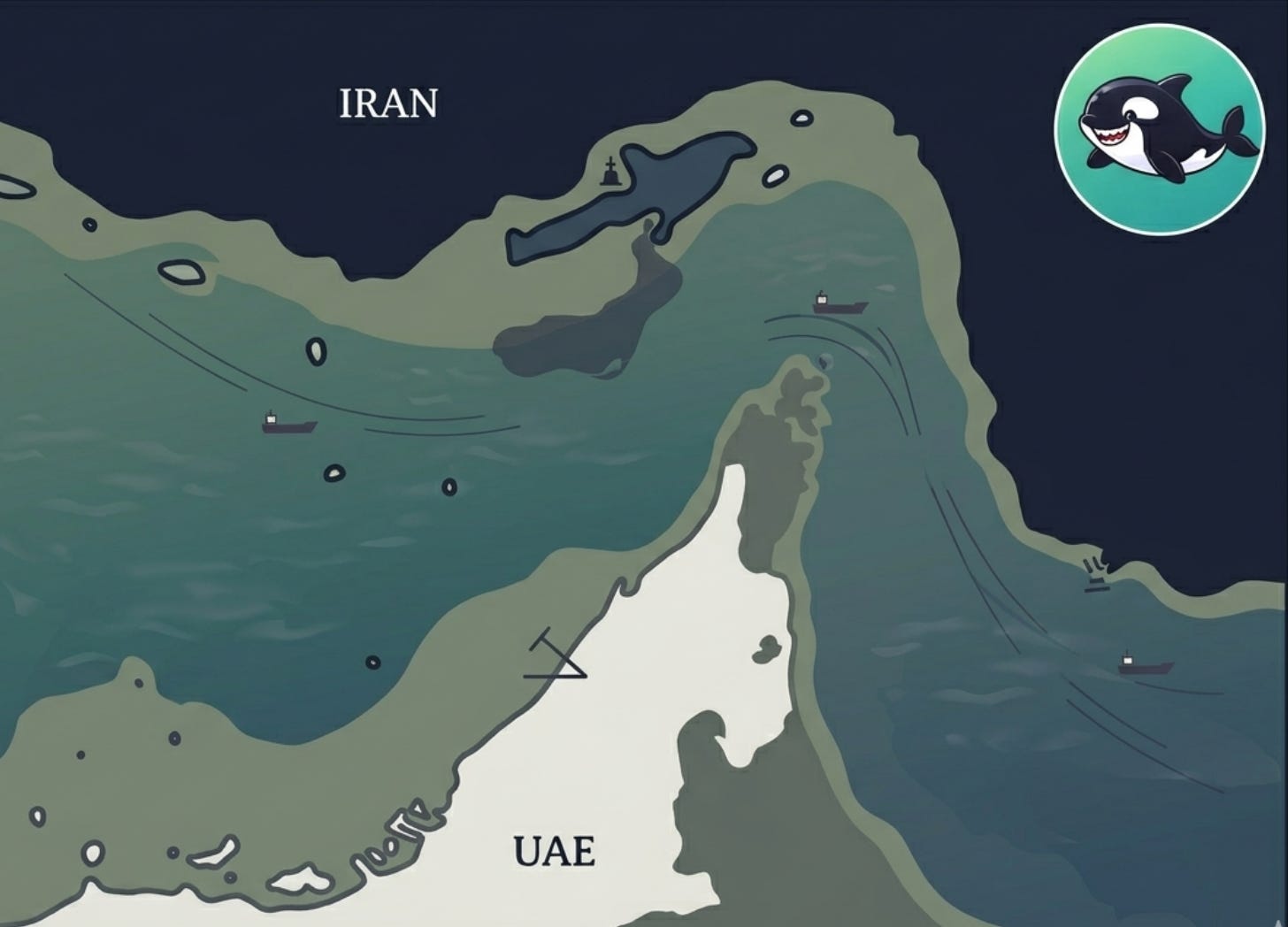
The labour displacement from AI is a story about time. How fast the adoption happens. How long the transition takes. How many people have runway left to adapt before the ladder collapses. The Strait of Hormuz closure in late February 2026 changed the timeline entirely.
On 28 February, the United States and Israel conducted military strikes on Iran. Iran’s Supreme Leader Ali Khamenei was killed. In response, Iran launched retaliatory attacks on US military bases and Gulf states. The Islamic Revolutionary Guard Corps issued warnings that halted vessel traffic through the Strait. Twenty million barrels of oil a day normally transit that strait, roughly 20 per cent of global seaborne oil trade. Another 20 per cent of the world’s liquefied natural gas moves through the same channel.
Within days, the closure became the largest disruption to global energy supply since the 1973 embargo. Brent crude surged past $100 per barrel on 8 March for the first time in four years, and continued climbing to $126 at its peak. The UK wholesale gas market reacted within hours.
Three days after the initial strikes, UK wholesale gas prices spiked noticeably. The April price cap had already been locked in by Ofgem’s calculation window, so households didn’t feel the shock immediately. But the July cap, set in mid-June based on the months between mid-April and mid-May, will catch the new market prices. Expect it to increase substantially.
The Next Rung is a book on how AI is quietly dismantling the middle of knowledge work, and what you can do about it before the market decides for you: pre-order it before it publishes in January.
Here is what that means for the timeline.
The story of AI displacement in knowledge work runs on two parallel tracks. One is technical adoption: how fast enterprises deploy AI tools, integrate them into workflows, and observe the headcount compression that follows. This track moves reasonably slowly. Enterprise adoption of any new tool takes time. There is organisational inertia, change management friction, the lag between decision and implementation. The technically possible and the actually happening diverge significantly. Most estimates put critical mass adoption around 2027 to 2028, with the visible headcount compression starting seriously in 2028 to 2029.
The other track is financial pressure. When energy costs spike, when interest rates respond to inflation, when client revenues contract due to economic shock, CFOs accelerate decisions that were marginal before. The investment in the AI tool that used to have a three-year payback cycle now has a twelve-month one. The consultant recommending a hiring freeze gets taken seriously instead of dismissed as pessimistic. The restructuring that was under discussion becomes urgent.
The Strait closure created a genuine energy emergency. It also created artificial urgency around any efficiency decision that could be justified to a board as a response to that emergency. “We’re restructuring to protect margins in a high-energy-cost environment,” carries more weight than “we’re restructuring because the AI is good enough now.” For at least the next five months, until roughly October, there is political cover for decisions that would otherwise require more justification.
This window is real. Enterprises that were sitting on AI implementations, waiting for a better moment, now have an actual external pressure point to justify the acceleration. The cost-benefit calculation that was marginal becomes obviously favourable. The redundancy consultations that were theoretical become necessary. The contractor squeeze-outs that were being debated become executable.
I want to be specific about what this means for specific types of workers.
Orchestration roles are most exposed. The roles whose primary function is synthesising data, routing decisions, reporting on status, coordinating between teams and systems. Roughly 1.5 million to 2 million of these roles in the UK are at serious risk over the next eight to ten years under a normal adoption timeline. Under an accelerated timeline, compressed into eighteen months instead of five years, the math changes entirely. The people in those roles don’t have the runway they thought they had. The lateral moves into slightly different roles, the upskilling opportunities, the staged progression they were counting on, all of those now have to be compressed into months instead of years.
Entry-level roles face similar acceleration. The graduate cohort starting in September 2026 enters a market where the hiring freezes that were meant to be temporary have hardened into permanent structural reductions. The contractor market, which was meant to be a stepping stone, now has permanent reduced demand. The internship pipelines that were supposed to funnel graduates into junior analyst roles are being recut to funnel them directly into AI tool supervision or nowhere at all.
But the energy shock does create one opportunity that matters.
The Next Rung is a book on how AI is quietly dismantling the middle of knowledge work, and what you can do about it before the market decides for you: pre-order it before it publishes in January.
Anything that requires cheap energy becomes more valuable in the next five months. Data centres are energy-intensive. Training large language models is energy-intensive. Running inference at scale requires power. When the cost of energy spikes, the investment in building infrastructure to run that training and inference becomes more economically defensible. The ventures that were waiting for energy costs to stabilise, betting that the next generation of chips would be more efficient, now get accelerated funding because the current cost structure makes their business case viable immediately.
This favours skill in AI systems, infrastructure engineering, capability building, and anything that sits in the stack between the model and the user. It does not favour the 1.5 million orchestrators watching their roles compress into uncertainty.
The five-month window is crucial for a specific reason. Enterprise board meetings and budget cycles hit in autumn. The companies that have accelerated their decisions and implementations through the summer now have data to report, case studies to justify, confidence in the numbers. The companies that didn’t move during the emergency window will face a different conversation come October. “We didn’t need to restructure during the crisis” is not the same as “we don’t need to restructure.” But it does mean they’re restructuring from a position of having missed the window, which changes the conversation.
For workers in high-exposure roles, the honest assessment is that the personal runway is shorter than it looked in January. If you have one year to transition, the five-month emergency window compresses it to an effective eight months. If you have eighteen months, it compresses to thirteen. The decision points that were meant to arrive in autumn 2027 are arriving now, in the summer of 2026.
The energy shock is real. Its duration is uncertain. The US and Israel and Iran are engaged in a serious military conflict with no clear off-ramp. It could be resolved by September. It could persist through winter. It could escalate.
But even if it resolves tomorrow, the decisions made under the pressure of the emergency don’t reverse. A headcount cut justified by an energy emergency doesn’t get reversed when energy prices normalise. A restructuring accelerated by the crisis gets treated as the new baseline, not as something that was temporary. The technical infrastructure built in response to high energy costs stays in place even if the energy costs fall. The contractors who get squeezed out don’t automatically get hired back.
The five-month emergency created a legitimate reason to do what many organisations wanted to do anyway but hadn’t quite justified to themselves. That reason now exists. The decisions flow from it. And by October, when the energy situation has hopefully improved, the labour market will have already shifted into a different shape.
Here is what I would tell anyone in an orchestration role right now. You have from now until mid-September to make a positioning move. Not a panic move. A deliberate move. Into something that either sits below the orchestration layer (hands-on, trades-level, requires your physical presence) or above it (genuine creative vision, strategy that reframes problems, leadership that develops other humans). The middle is being compressed by an emergency that will probably last five months and creates decisions that will persist for years after that.
The IEA forecast global oil demand growth of 640 thousand barrels per day in 2026 as of March, having revised it down repeatedly through the year as economic pressure mounted. The Strait closure is now the dominant variable in that forecast. If it persists through summer, demand destruction accelerates, prices eventually normalise, but not before the restructuring has happened. If it resolves by late May, there is a brief normality before the July price cap hits UK households. Either way, the window is five months. The decisions made within it are permanent. The people affected by those decisions need to understand that the timeline they were operating on no longer exists.