
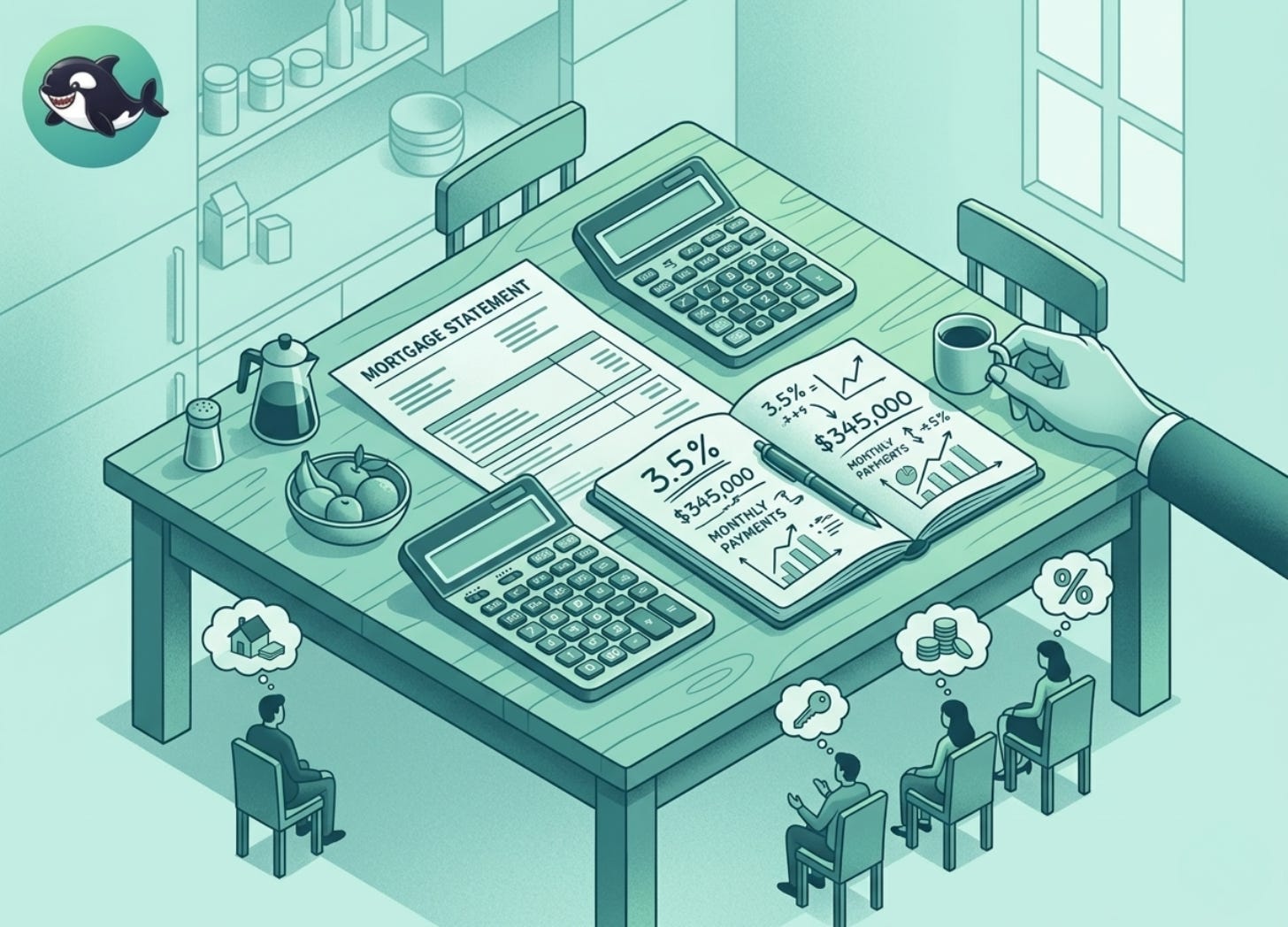
The economic conversation happens at the wrong altitude. Economists and policymakers talk about household debt-to-income ratios, disposable income distribution, precautionary savings as a percentage of GDP. These are coherent at a macro level. At a kitchen table, they’re abstractions that don’t speak to the actual number that matters: how long can we keep the house if both incomes disappear.
UK household debt stood at 116.9% of disposable income in Q3 2025. That means the average household owed £117 for every £100 earned. The Office for National Statistics tracks this. The Bank of England stress-tests against it. The Financial Conduct Authority uses it to set mortgage lending criteria. And almost no one looking at their own situation thinks about it in those terms.
What they think about is this: we have ten grand in savings. We have a mortgage of four hundred and sixty thousand. We have a joint income of one hundred and ten thousand. The mortgage is forty-two times our savings and four-point-two times our income. Now, what does ten grand actually buy us.
The answer depends entirely on household outgoings. The Tom and Priya scenario from the book uses a real London professional-class household: mortgage £2,180 a month, council tax £180, energy £150, nursery fees £800, car payment £250, insurances and transport £200, utilities and basics £400. Total: roughly £4,200 a month. Their ten grand covers, at best, two and a half months of that burn rate. After tax and redundancy payments, it’s closer to two months before the account empties.
The word for this is not security. The word is precarious.
Precautionary savings exist to handle the thing that hasn’t happened yet. Car breaks down. Boiler fails. Illness means time off work. These are expected within a reasonable horizon. The financial services industry uses three months of expenses as the baseline: emergency fund sufficient to handle a short-term shock. Anything less, and you’re not covered. Anything more, and depending on the definition of “more,” you’re either being prudent or leaving capital idle.
But three months of expenses assumes the income returns. It assumes the boiler doesn’t break in month two of a six-month job search. It assumes your industry doesn’t restructure while you’re laid off. It assumes the redundancy payment covers the gap. All reasonable assumptions in a stable labour market. None of them hold in a market where task-level AI exposure quietly eliminates job categories over a eighteen-month period.
What’s happening now is that jobs are disappearing not through dramatic redundancy announcements but through hiring freezes, contractor squeeze-outs, and roles that don’t get backfilled when someone leaves. The paralegal who lost her job to an AI compliance system didn’t get a redundancy letter. Her firm restructured. Eight roles became two. She was one of the eight. The documentation said consultation period. The economics said redundancy. The bank account didn’t care which word they used.
The Next Rung is a book on how AI is quietly dismantling the middle of knowledge work, and what you can do about it before the market decides for you: pre-order it before it publishes in January.
This is the shape of the quiet phase. It’s not a crash. It’s a compression. And the compression hits the household that has stretched their finances to the absolute limit of what the lending tests allow. The mortgage broker calculated they could afford £460,000 on £110,000 income because the maths said so on paper. The paper said four-point-two times income was within the stress-test parameters. The Bank of England ran scenarios where rates spiked and house prices fell and employment remained stable. It ran scenarios where employment fell and rates remained stable. It didn’t run the scenario where the income loss is permanent and structural because that income loss comes from the work being automated away.
And so we’re left with Tom and Priya at a kitchen table with £8,200 in an ISA, £1,100 in a current account, and a mortgage of £460,000. The calculation is brutal because the units of analysis matter. You can’t stretch £9,300 very far against £4,200 a month in household outgoings.
Here’s what actually happens. Priya loses her job first. Tom’s salary covers the mortgage and the essentials. It doesn’t cover everything. They pause the ISA contributions they’d planned for their daughter’s nursery place in September. They stop the regular savings pattern they’d maintained for four years. They run down the buffer month by month. Eight months later, Tom’s employer announces an operational transformation. The compliance team of twelve becomes six. Tom is one of the six who leave.
Now they have no income. They have the redundancy payment: twelve weeks at full salary. That covers just over three months of £4,200 spend. After that, they’re on Universal Credit. Both of them. A household that paid sixty-five thousand in combined income tax now qualifies for means-tested benefits. The benefits cover about a third of the mortgage. They apply for a payment holiday. Interest accrues and adds to the debt. They apply for a forbearance scheme. The deferred payments defer but don’t disappear. They accrue at the mortgage. The house is built on an assumption that no longer holds.
The stress tests assumed distributed risk. Individual households would lose income at different times, in different sectors. Not thousands of households in the same sector losing income in the same quarter because their employers adopted the same technology. When the risk is correlated, when the shock is demographic rather than individual, the numbers that worked on paper don’t work in practice.
The Next Rung is a book on how AI is quietly dismantling the middle of knowledge work, and what you can do about it before the market decides for you: pre-order it before it publishes in January.
And so the unit of analysis that actually matters, that sits at the kitchen table where real decisions get made, is not the macroeconomic ratio. It’s the number of months of household expenses you have accessible right now. Not theoretical future savings. Accessible, liquid savings. Now.
For the UK median household earning thirty-five thousand a year with household expenses of roughly two thousand, ten grand covers about five months. For the professional household earning one hundred and ten thousand with expenses of four thousand plus, ten grand covers two and a half. The better your income, the tighter your budget, because you stretched to match your income. That’s not recklessness. That’s how mortgages work. The system is designed to stretch you.
The honest assessment: most UK households have between two and four months of household expenses in accessible savings. Most know this number. Some know it precisely. They’ve calculated it because they’ve thought about the thing that hasn’t happened yet. They’ve done the maths at the kitchen table. And they’ve understood, at three in the morning, that if both incomes disappear simultaneously, they have between two and four months before the system that holds their life together starts to fail.
That’s not long.