
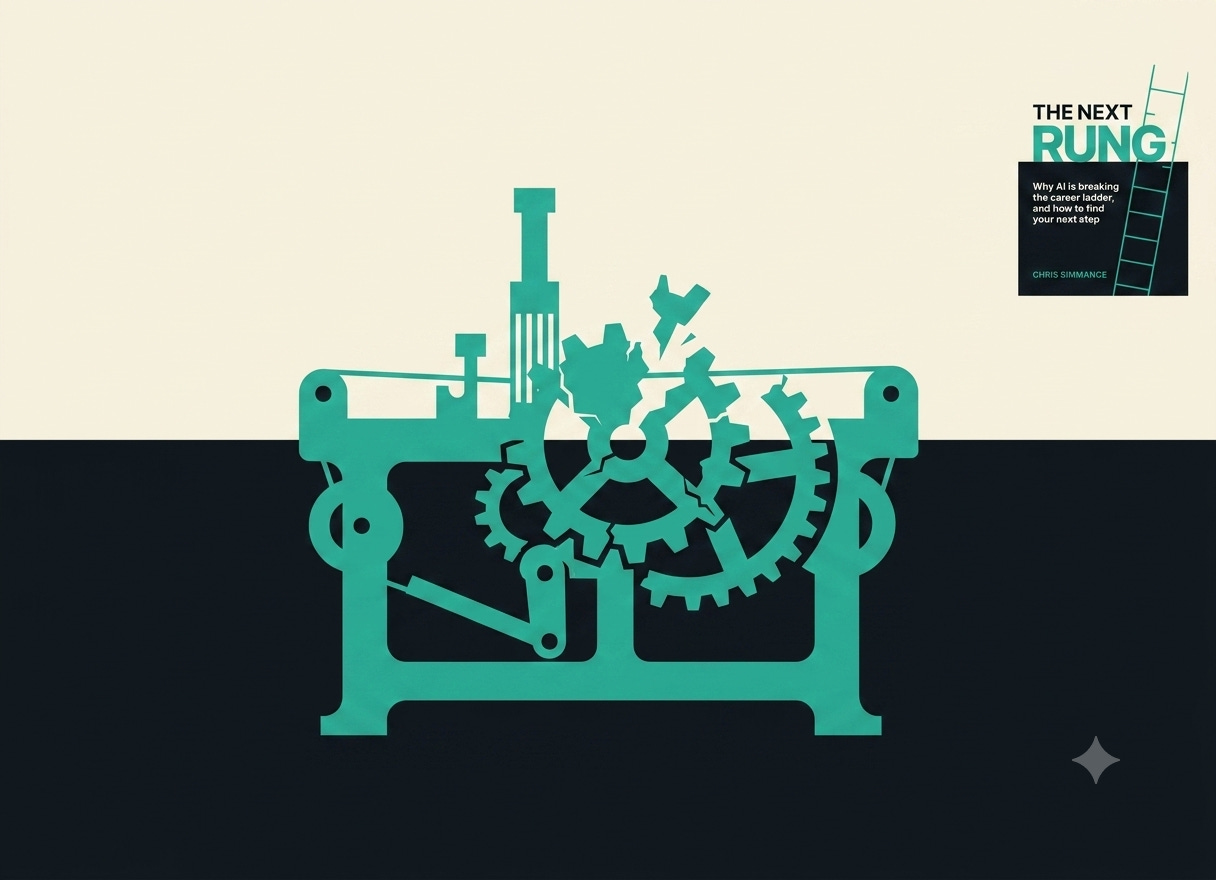
The British government deployed some twelve thousand troops to put down the Luddites. Five years of unrest, four counties, an actual insurgency. Whatever you were taught the word means, that is not the response you mount against a few confused men with hammers.
The word has been turned into shorthand for someone who does not understand technology, and that is unfair to a fairly sharp group of textile workers. They were framework knitters. They smashed stocking frames because the new mechanised looms were producing cheaper, lower-quality stockings that undercut their craft. Their concern was specific: these machines are destroying our livelihoods, and what they are producing is worse. On the local destruction they were entirely correct. The machines did destroy their livelihoods. Several of them were executed for pointing it out too loudly. Lord Byron defended them in his only ever speech in the House of Lords.
Where they were wrong was in assuming the destruction of their particular jobs meant the destruction of work itself. The textile industry mechanised, expanded enormously, and employed far more people than before. The Luddites were not part of the expansion, but the expansion happened. And that is where the Luddite fallacy comes from, the five words people still reach for: it was fine last time.
For two hundred years those five words have been quite correct. But “for two hundred years” is doing a great deal of work in any sentence that uses the historical pattern as reassurance now. Every previous wave automated something narrow. Looms automated weaving. Computers automated calculation. AI is not narrow. Dario Amodei at Anthropic has put it in one phrase: a general labour substitute for humans. Chapter 1 of the book walks through the three pillars that made every previous absorption work, new task creation, demand expansion, skill transferability, and why all three are breaking at the same time. I won’t rehearse the whole argument here. That is kind of the point of the chapter.
What I want to sit with instead is the other half of the comparison, because it is the half the policy world is not thinking about. There is a comfortable assumption in policy circles that AI displacement happens quietly. The Luddites would like a word.
The difference this time is the cohort. AI displacement does not start on a factory floor in a mill town. It starts in capital cities, among white-collar workers who are more mobile, louder, better networked, and with stronger organising capacity than the professional class has historically needed. They are not people who are already poor, which is exactly why the scale of their response can be much larger than the analysts have pencilled in. The World Economic Forum has already named this cohort the “AI precariat”.
And I suspect the first major event will not look like 1811 at all. A coder fired because an AI replaced them does not march. They might run a digital riot, systems taken offline, things brought down that other people depend on. That is speculation, I should be honest about that. But it is the register the affected cohort already lives in, so it is the register the first event is likely to emerge from.
Chapter 9 sets out the watch-markers for that first event, the five conditions that produce movements, and the two other flashpoints I think are worth tracking alongside it. The Luddites got the Army. What this generation gets instead is the question the chapter ends on.
This is from Chapters 1 and 9 of The Next Rung, my book on what AI displacement actually looks like from inside. It’s open for pre-order now: