

Here’s the uncomfortable part of scenario planning: the most likely outcome is not the one anyone is trying to create. It’s the one that happens when nobody makes a conscious choice.
Neo-feudalism is the path of least resistance. When productivity gains from AI go entirely to capital owners, when there’s no political mechanism to redirect them, when every current trend points in one direction: wealth concentrates, platforms consolidate, labour fragments. The scenario doesn’t need to be chosen. It just needs to not be prevented.
The mechanism is simple enough. Capital captures most AI productivity gains. A small class persists: people whose work depends on human trust (the relationship roles), genuine originality (top-tier creative work), and liability (the oversight functions where someone needs to sign off). Everyone else works in fragments. Three hours of content moderation here, a delivery shift there, a micro-task on a platform that takes 35% commission. Housing becomes extractive. You never own. You rent from corporate landlords or the people who accumulated property when professional salaries still existed.
The political system becomes performative. Elections happen. Manifestos are published. But the legislation that actually shapes daily life, platform regulation, tax policy, housing law, the employment status that determines whether you have protections or not, is written by people whose employers profit from things staying as they are. Democratic forms persist. The substance hollows out.
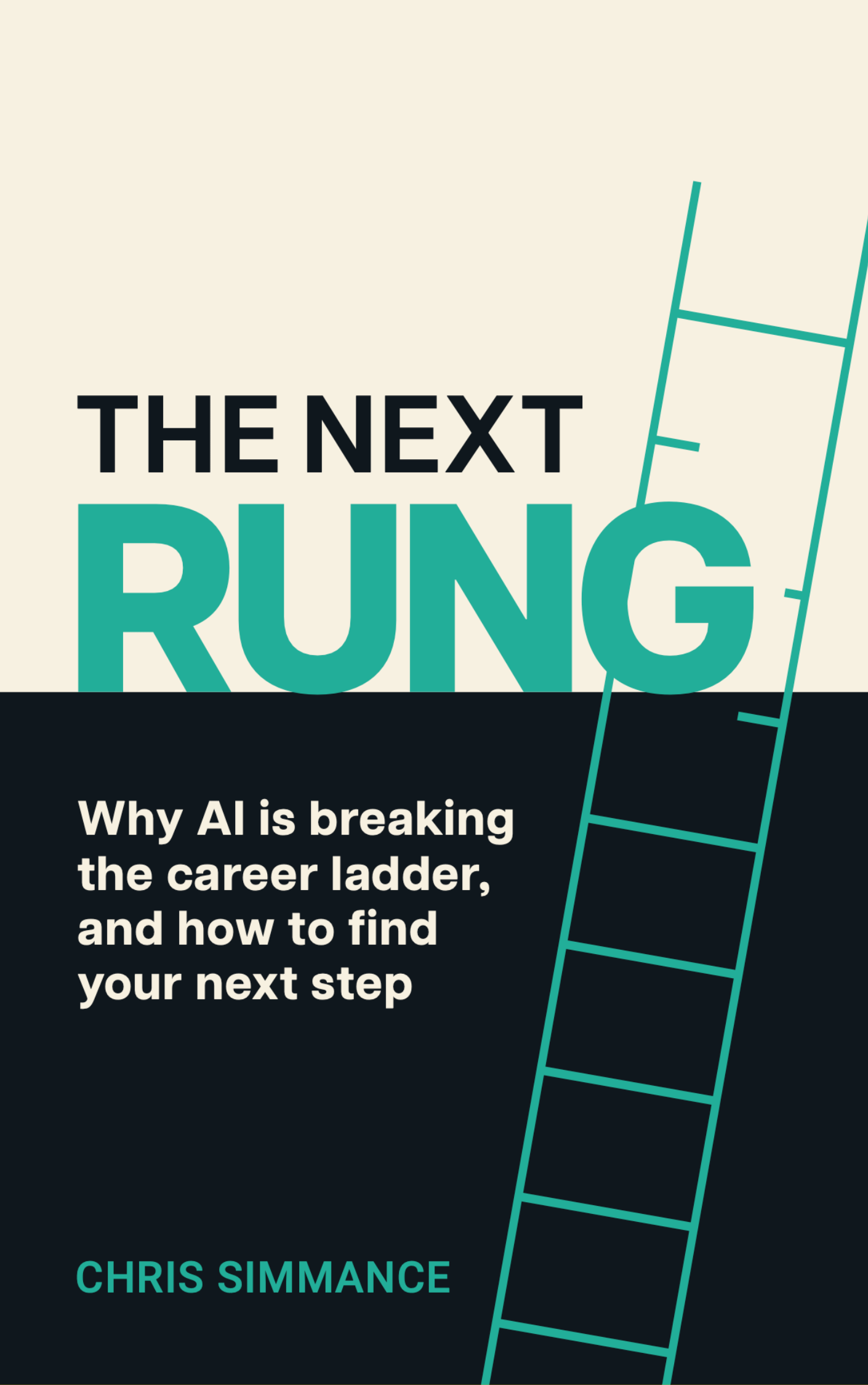
The Next Rung is a book on how AI is quietly dismantling the middle of knowledge work, and what you can do about it before the market decides for you: pre-order it before it publishes in January.
This is not science fiction. There’s a growing body of academic literature mapping exactly this trajectory. Yanis Varoufakis calls it “technofeudalism” and describes how platforms function as feudal lords: you don’t own the marketplace or the tools or the customer relationship. You rent access, and the rent goes up whenever the platform decides. Jodi Dean’s work traces the mechanism by which platform economics recreates feudal extraction. Cedric Durand examines how the digital economy tends toward rent-seeking rather than production. Shoshana Zuboff describes surveillance capitalism as a tribute system that would make a medieval lord envious.
The current data supports this trajectory. Oxfam reported in January 2026 that global billionaire wealth jumped 16% in 2025 to 18.3 trillion dollars. An 81% increase since 2020. Three thousand billionaires for the first time. Billionaires are 4,000 times more likely to hold political office than ordinary citizens. In the UK, 56 billionaires hold more wealth than 27 million people. Meanwhile, one in four people globally lacks regular food access.
The World Inequality Lab data shows the pattern in detail. India’s top 1% wealth share increased from 13% in 1961 to 39% in 2023, a threefold increase in 62 years. US billionaires grew from 835 in 2024 to 924 in 2025. The pattern reflects concentrated tech wealth, AI-driven productivity, and the simple mathematics that returns on capital exceed returns on labour, which is the dynamic Piketty described and which AI accelerates rather than reverses.
What does daily life look like in this scenario. Take Hannah, a former marketing manager. She rents a room in a house she would have owned outright before AI displaced her role. The house was purchased by a property investment company in 2031 when the original owners defaulted. She works three simultaneous gig tasks: content moderation for an AI platform at four hours daily, algorithmically managed, flagged for performance if accuracy drops below 94% in any 15-minute window. Virtual customer service for a subscription wellness company at variable hours, paid per resolution at a rate declining annually as AI handles the easier queries. Occasional freelance marketing through a platform that takes 35% commission and rates her five-star, where 4.7 is borderline.
Her income is roughly 40% of what she earned in her old role. No pension. No sick pay. No holiday. No employer. Her children’s school has lost funding for everything except core curriculum. The careers lead position was cut in the last budget round. The local GP practice closed; healthcare is a 40-minute bus ride and a four-week wait. She votes in every election. Nothing changes. The local MP gives passionate speeches about supporting working families and votes reliably with the platform companies that employ those families on terms the MP would never accept for themselves.
The Next Rung is a book on how AI is quietly dismantling the middle of knowledge work, and what you can do about it before the market decides for you: pre-order it before it publishes in January.
Why is neo-feudalism at 45% probability rather than lower. Because it requires nothing. No coordination. No political will. No conscious choice. Just inertia plus the compounding mathematics of capital accumulation. Every trend currently visible, wealth concentration, platform consolidation, labour fragmentation, institutional decay, points toward this outcome. The scenario doesn’t need to be chosen. It needs to not be prevented.
The comparison to the Industrial Revolution is instructive. The benefits took 50 to 70 years to reach working populations. Without intervention, capital captured the gains and everyone else adjusted downward. We have precedent. We have evidence from that period about what happened and how long it took. And we have no political mechanism currently visible that would produce a different outcome this time.
That’s why the other 55% matters. Managed transition at 30% requires deliberate policy reversal of twenty years of trend. Fragmentation at 20% requires regional divergence rather than global concentration. The black swan at 5% is the admission that something we haven’t modelled might reshape everything. All three require something to be done differently than it’s being done now.
Neo-feudalism requires nothing but inertia. And inertia is what we have in abundance.