
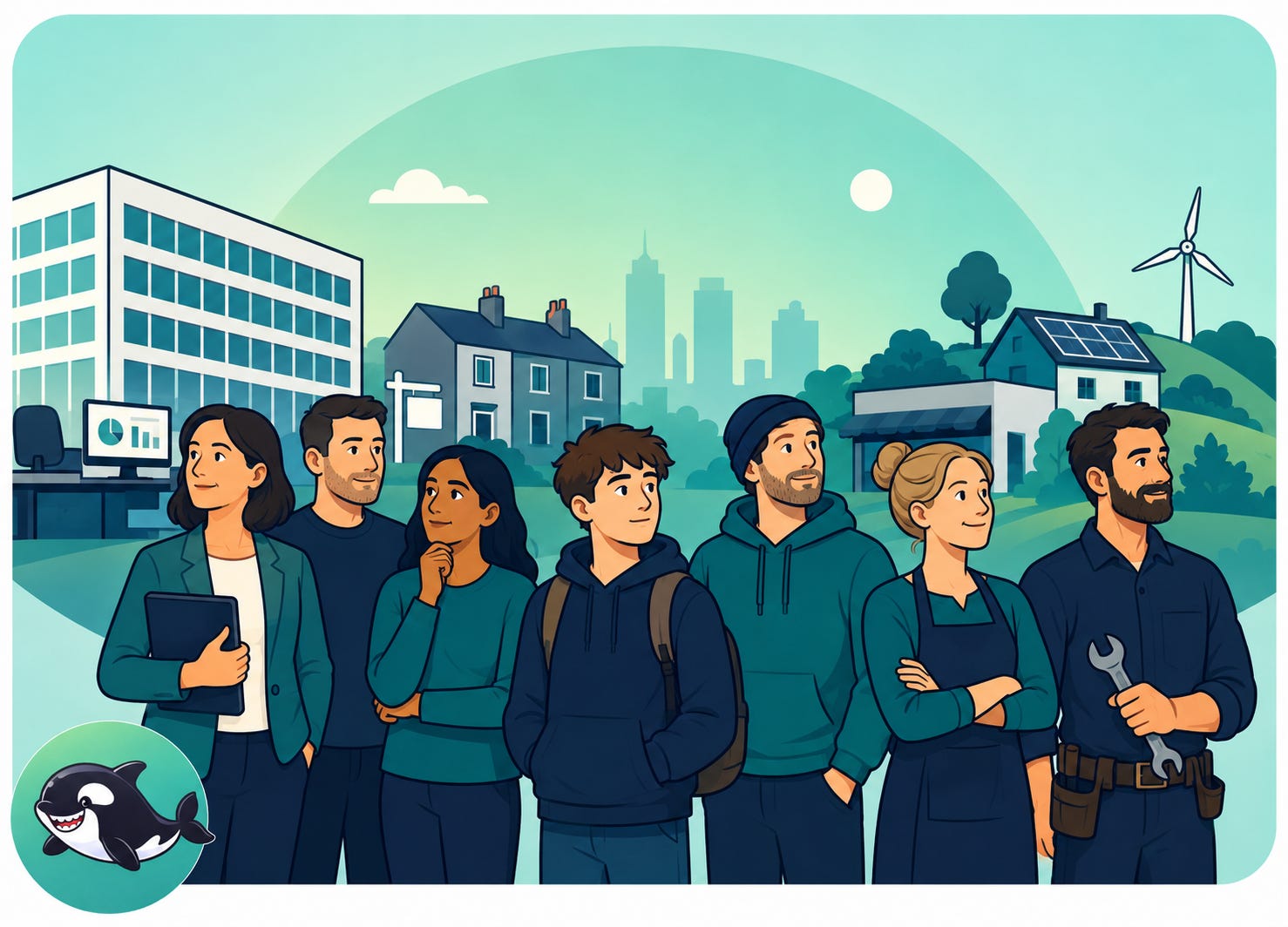
The book is built around people. None of them are real. All of them are true.
They are composite characters, assembled from hundreds of conversations I have had over three years with clients, colleagues, friends, strangers at conferences, people who emailed after reading this newsletter. The patterns matter more than the individuals. And naming real people in a book about job loss is a cruelty nobody asked for.
So I built composites. Here they are.
Sarah is a marketing director. Forty-one, agency side, twelve-person team. Chapter 2 follows her from September to April as she watches her own role dissolve. In September she builds her usual forty-two-slide deck. By October an AI tool produces 80 per cent of it in six minutes. By January she has been asked to write the AI integration roadmap, which is a polite way of saying “plan the removal of your own team.” By April a junior presents a week’s work that was delivered in forty minutes. Sarah’s judgement is still hers. Her context is still hers. Her relationships are still hers. But those things are maybe twenty per cent of what she does all day.
Tom and Priya bought a £575,000 semi in 2024 on combined income of £110,000. He is in financial-services compliance. She is a paralegal. Mortgage at 4.2 times joint income. Priya gets made redundant when AI absorbs commercial property conveyancing. Eight months later, Tom is restructured. Three-month payment holiday adds £2,700 of interest. Negative equity. Chapter 7.
Reece is in Year 11. He is being told to pick GCSEs for a labour market that will not exist in the form his careers advisor describes. The exams he is preparing for select for work that AI replaces first. Chapter 13 asks what happens when the proxy breaks.

The Next Rung is a book on how AI is quietly dismantling the middle of knowledge work, and what you can do about it before the market decides for you: pre-order it before it publishes in January.
Ryan is the one who did not make it through. Former financial analyst, Slough. Three platform jobs: content moderation, freelance data work, delivery driving. About £18,000 a year after platform cuts and costs. Rent is 63 per cent of his take-home. £400 in savings. No maker space, no working partner, no cooperative, no town with a support network. He is the counter-example that the other five need. Chapter 11.
Leah took voluntary redundancy from a marketing director role where she ran a team of fourteen with a £2 million budget. She now runs a community enterprise in Swindon out of an old Debenhams on £28,000 a year. Her partner is an electrician. The trade-off between performative work and visible work is the point. The partner in a different sector providing runway is the structural insight. Chapter 11.
Gareth is the plumber. Thirty-six years in, heat pump certified, £85 an hour. Two ex-accountants applied for apprenticeships with him last year. His son is at college doing electrical installation. The hierarchy between trades and professions is inverting, and Gareth is on the right side of it. Chapter 11.
The Next Rung is a book on how AI is quietly dismantling the middle of knowledge work, and what you can do about it before the market decides for you: pre-order it before it publishes in January.
There are others. Tom the Bristol graduate who applied to 43 positions and did not know the agency had cancelled the role he would have got. Deepa whose Thursday meeting halved. Marcus whose day rate is still on his website but nobody is booking it. Fatima whose promotion criteria changed overnight. Sophie who broke the trap by stepping outside it. Amara on a three-job portfolio in Birmingham. Neil running a community energy cooperative in Totnes. Naomi making furniture in Margate.
Each of them carries a pattern. Sarah is the orchestrator who saw it coming and could not stop it. Tom and Priya are the mortgage problem. Ryan is what happens without runway. Leah is the trade-off. Gareth is the inversion.
I want to be clear about why they are composites. It is not a literary device. It is an ethical choice. Real people told me real things about losing their jobs, about watching their teams dissolve, about lying awake at three in the morning doing mortgage arithmetic. Using their names and specifics in a published book would have been accurate and cruel. The patterns are what the reader needs. The individuals deserve their privacy.
If you recognise yourself in any of them, that is the point. The patterns repeat. The book maps them so you can see yours before the floor gives way.