
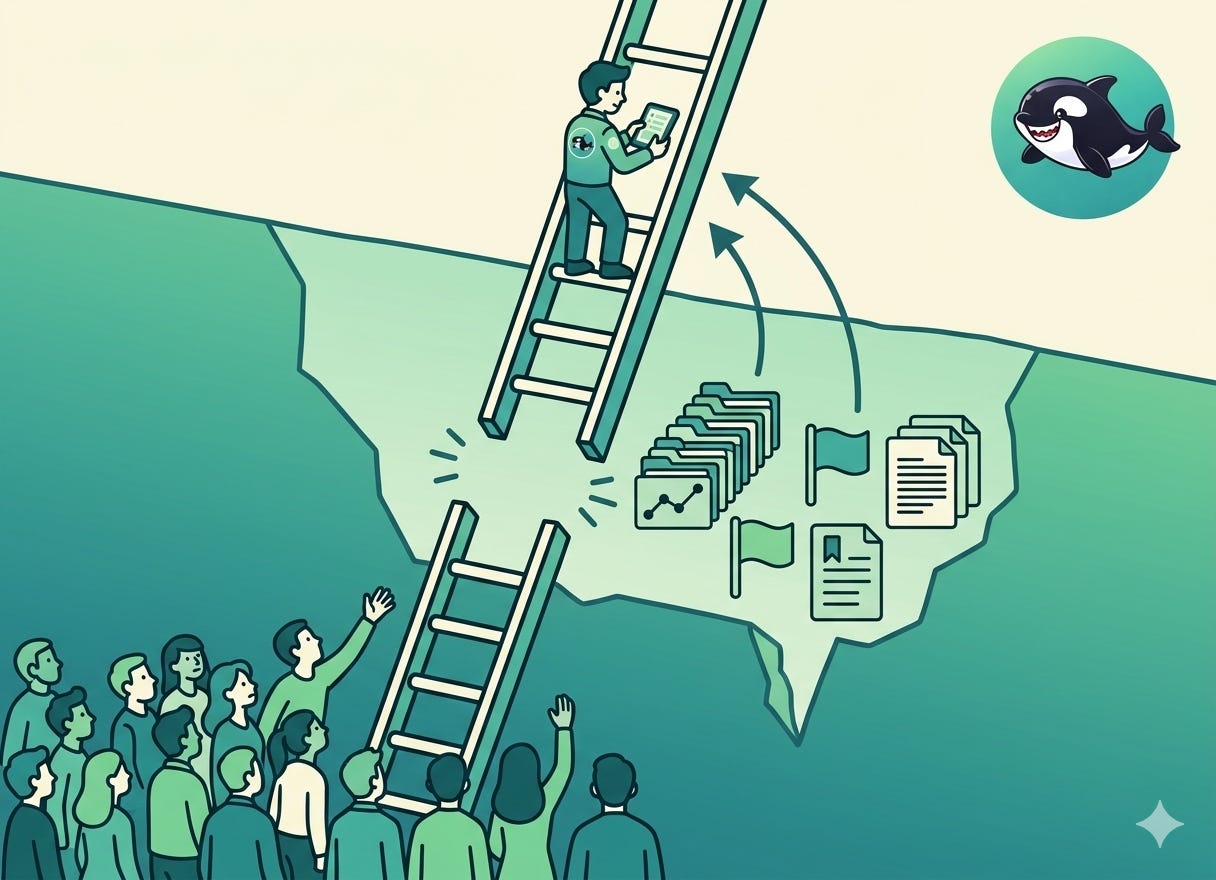
The most common response I get when I argue that AI is eliminating knowledge jobs faster than the economy can absorb the displaced workers is this: humans will just review the AI output. There’ll be a huge new category of AI auditors. Quality control becomes the new knowledge work. The next rung still exists, it’s just moved.
This is a comforting answer. It’s also wrong, and the arithmetic is not subtle.
A team of three human auditors can oversee the output of fifty AI agents. This is roughly the ratio you see in live deployments in customer service, content moderation, and document review. It’s the operational shape that makes the AI deployment economically attractive in the first place. If you needed one auditor per AI agent, you’d have saved nothing by deploying the AI. You’d just have shifted one human job to a different human job.
So the ratio is real, and the ratio is the point. If you displace fifty workers and need three auditors, you have forty-seven people without work. That’s not a transition to a new rung. That’s a net removal of forty-seven rungs.
This isn’t a hypothetical. It’s already visible in the companies that have rolled AI out at scale.
What the Klarna case actually shows
Klarna’s AI customer service deployment in 2023 was pitched as a case study in AI productivity. The company replaced around 700 customer service positions with an AI assistant. By 2024, Klarna was claiming the AI handled 75 per cent of all customer chats and did the equivalent work of those 700 people.
By spring 2025, Klarna was hiring customer service agents back. The CEO publicly admitted the quality was insufficient. The company moved to a hybrid model where AI handles routine queries and humans handle complex ones.
Here’s the part worth dwelling on. Klarna’s hybrid model is what the “QC rung” argument predicts. AI at the front, humans at the back, quality control distributed between them. It is also, measurably, not a return to the original headcount. The 700 displaced workers did not come back as 700 auditors. Some number came back, somewhere in the low hundreds based on reported hiring, to handle the residual work the AI couldn’t do. The rest are still displaced.
And the hiring Klarna has done is different in kind from what was lost. The new roles are targeted at flexible, part-time workers, remote, often students or parents. The original 700 were full-time salaried positions with career progression. The new structure is cheaper per head, less secure, and carries less institutional investment.
This is the QC rung in practice. It exists, but it’s narrower, lower-paid, and less stable than the work it replaced.

The Next Rung is a book on how AI is quietly dismantling the middle of knowledge work, and what you can do about it before the market decides for you: pre-order it before it publishes in January.
The content moderation precedent
The cleanest historical precedent for AI-augmented human quality control is content moderation at the big platforms. Facebook, YouTube, TikTok, and their peers deploy AI to triage posts, flag likely violations, and surface edge cases for human review. The humans make the final call on the most ambiguous content.
Meta, at its peak, employed around 15,000 content moderators globally, many through contractors like Accenture and Cognizant. The platform processes billions of pieces of content a day. The moderator-to-content ratio is something like one moderator per hundred thousand pieces of content. The vast majority of moderation is done by AI. Humans exist in the loop for the hardest cases, policy calibration, and training signal generation.
This is the shape AI quality control takes when it’s operating at scale. A small human cadre maintains the system, handles the exceptions, and generates the feedback that trains the next version. The headcount ratio is not one auditor per AI agent. It’s one human per thousands of AI interactions, or tens of thousands, depending on the domain.
And content moderation is a comparatively labour-intensive case, because the subjective calls are genuinely hard and the legal exposure is genuinely high. In domains where the AI is generating rather than judging, the ratio gets worse for the humans. A generative AI producing legal briefs can be reviewed by a human at roughly the rate a human could write them, because the review has to be substantive to catch hallucinations. But the AI produces them at ten times the speed. The math doesn’t give you ten auditors. It gives you one auditor checking every tenth brief, or reviewing all of them at reduced rigour, or rejecting the deployment as unsafe for the context.
Why the ratio can’t grow
The optimistic version of the QC rung argument assumes that as AI deployments scale, the auditor cadre scales with them. More AI means more auditors. New category of work, similar in shape to the old category, just shifted.
This doesn’t hold for three reasons.
First, the economic case for deploying AI depends on the ratio. If an AI deployment requires one auditor per AI, it’s simply a more complicated way of employing the person who used to do the job. Nobody invests in that. The deployments that happen are the ones where the ratio is heavily in AI’s favour. Which means the jobs that come back in the audit role are a small fraction of the jobs that went away in the production role.
Second, the audit role is itself being automated. Once enough human audit data accumulates, the system learns to flag its own low-confidence outputs, self-correct, and reduce the proportion requiring human review. The audit ratio degrades over time. Whatever QC rung exists in year one is narrower in year three.
Third, the audit work doesn’t scale geographically or demographically the way the production work did. A junior marketing manager in Leeds, a paralegal in Manchester, a business analyst in Cardiff, these were jobs distributed across the country, across demographics, across education levels, providing genuine middle-skill employment. The audit role concentrates. A small number of specialists in a small number of locations handle the quality control for work that used to employ tens of thousands. The distribution is gone.
This last point is the one that’s hardest to see from inside the productivity conversation. The Next Rung thesis isn’t just about net numbers. It’s about what happens to the geographic and social distribution of middle-skill work when the middle layer collapses. The audit rung, even if it existed at the scale of the lost rung, wouldn’t solve the distribution problem. And it doesn’t exist at the scale of the lost rung.
The error-rate problem
There’s a second reason the QC rung doesn’t solve the displacement question, and it comes directly from Rowan Jackson’s framework on errors, rework, and waste.
If AI output contains errors that look like competence, as I argued in the last piece, then the audit process has to be substantive. You can’t skim AI output and catch the fabricated citation or the contradictory clause. You have to read, check, verify, cross-reference. This is roughly the same work as producing the output from scratch.
Which means the audit role, where it exists, is not a cheaper version of the production role. It’s the same work, wearing different clothes. If the economics worked at one auditor per AI, it would also work at one producer per producer, which is where we started. The deployment only makes economic sense if the audit is done cheaply, which means superficially, which means the errors get through.
There are two outcomes from this. Either organisations accept the error rate and push the cost downstream to customers and counterparties. Or they invest in substantive audit and lose the productivity gain that justified the deployment. In practice, most organisations do the first, quietly. This is why the rework ledger matters: without it, the cost of bad AI output gets absorbed in places the accounts don’t show.
Rowan’s ERW work puts this cost at 20 to 45 per cent of operating expenses in industries where rework has been studied. In industries where rework is hidden in AI-augmented workflows, nobody knows what the number is. The plausible range is the same or higher. That’s a lot of invisible cost to be accumulating while reporting gross productivity gains.
The Next Rung is a book on how AI is quietly dismantling the middle of knowledge work, and what you can do about it before the market decides for you: pre-order it before it publishes in January.
The case of the legal paralegal
Consider what’s happening in law right now. Large firms are deploying AI-assisted contract review, legal research, and document drafting at scale. Allen & Overy rolled out Harvey in 2023. Clifford Chance followed. A number of US firms have built internal systems or licensed external ones. The productivity claims are substantial. Some firms are reporting that junior tasks which used to take two days now take two hours.
The QC rung prediction would be that paralegals and junior associates move into AI audit roles, reviewing the output, catching the errors, adding the legal judgment the AI can’t apply.
What’s actually happening is a reduction in paralegal headcount and a tightening of junior associate intake. The work that used to be done by two paralegals and a junior is now done by one senior associate with AI assistance. The audit is happening, but it’s being done by people senior enough that their time is too expensive to call an audit role. It’s just part of the senior job. The junior roles are gone, and with them the career pipeline that would have produced the next generation of senior associates.
This is not a new category of audit work. It’s a compression of the existing career ladder, with the bottom rungs removed. The AI didn’t create a new rung. It removed two.
What the audit case actually produces
When AI is deployed well, with substantive human oversight, what it actually produces is not a new audit profession. It produces a small number of highly skilled human roles at the top of the output chain, serving a much wider production base than was previously possible. The senior associate reviewing AI-generated briefs can now service three times as many matters. The senior editor reviewing AI-generated articles can now oversee ten times the output. The senior analyst reviewing AI-generated reports can cover a portfolio that used to require a team.
This is genuinely productivity-enhancing at the senior level. It is also genuinely displacement-causing at the middle and junior levels. The senior role doesn’t scale with the production increase. The junior and middle roles get eliminated in proportion to the production increase.
The net effect is fewer jobs, paid better, concentrated in senior specialists. This is good for the specialists who keep their jobs. It is catastrophic for the people who would previously have been junior specialists working their way up.
The book I’m writing, The Next Rung, is fundamentally about this collapse. The middle of the ladder is where the rungs are being removed. The top of the ladder continues to function. The people already on the top rung are fine. The people on the bottom rung have a hard time getting onto the second rung, because the second rung doesn’t exist any more.
The policy version
At the policy level, the QC rung argument is being made to justify doing nothing. If the market will naturally create new audit roles, there’s no need for industrial strategy, no need for transitional support, no need for retraining investment. The market will handle it.
This is the “it was fine last time” argument in a new coat. It assumes a mechanism that is demonstrably not operating at the scale required. It asks us to bet millions of livelihoods on a ratio that the economics explicitly forbid.
The honest version of the argument would accept that AI deployment produces fewer jobs than it displaces, and ask what we do about that. The dishonest version insists on a QC rung that the deployment data doesn’t support, because accepting the honest version means accepting that we need policy, and nobody wants that conversation.
What to actually do
If you’re an individual worker thinking about career positioning, the QC rung is a trap. Don’t plan your career around being the human auditor of AI output, unless you’re already senior enough to command the rates that make the role economically defensible. The junior and middle audit roles won’t sustain.
If you’re an employer thinking about deployment, be honest about the headcount arithmetic. If your AI deployment case assumes you’ll create quality control jobs to replace the production jobs you’re displacing, check your numbers. The ratio won’t support the story. And the invisible rework cost will catch up with you either way.
If you’re a policy maker, accept that the transition mechanism you’re relying on doesn’t exist at the scale you need. Previous transitions absorbed displaced workers because the new industries needed bodies. AI deployments specifically don’t need bodies. They need a small number of expert supervisors and otherwise they’re designed to operate without human labour. This is the whole point of them. Expecting them to generate employment is expecting the product to do the opposite of what it was built for.
The next rung isn’t being built. The QC rung doesn’t exist at the scale required. The question of what to do about that is the question this book is about.
With thanks to Rowan Jackson, whose ERW framework continues to inform the quality-and-rework dimension of this analysis, and whose observations about the limits of technology deployed onto broken processes (notably, “I have seen Salesforce destroy a company’s sales system”) echo the same structural point from a different direction.
Primary sources: Klarna public statements and press coverage, 2023-2025; Meta, YouTube, and TikTok content moderation staffing disclosures; industry coverage of Harvey (Allen & Overy) and legal AI deployments; ONS labour market data to early 2026; Rowan Jackson, ERW paper, December 2024; H.J. Harrington, Business Process Improvement, 1991.