
Dario Amodei, CEO of Anthropic, said publicly that AI could disrupt half of entry-level white-collar work. His own company’s research mapped 800 occupations and found programmers at 74 to 75 per cent task exposure. Customer service at 70 per cent. Fortune called it a potential great recession for white-collar workers.
I use Anthropic’s API every day. It is the engine inside Orca. I pay them for access. I build a product on top of their technology and sell it to clients.
The CEO of the company I build on is saying what the book says. Chapters 1 and 3, specifically. The four-tier exposure map. The inversion where AI hits the educated and well-paid first. The 47 per cent earnings premium in the most-exposed roles. Graduate-degree holders at 17.4 per cent in the high-exposure bracket versus 4.5 per cent in the zero-exposure bracket.
These are not my numbers. They are Anthropic’s numbers, published in their March 2026 research. I cite them in the book because they are the most granular occupation-level analysis available. And now the CEO is doing interviews explaining what they mean.
The Next Rung is a book on how AI is quietly dismantling the middle of knowledge work, and what you can do about it before the market decides for you: pre-order it before it publishes in January.
Here’s the thing. I am not an outsider making predictions about a technology I read about in a report. I am inside the contradiction. I built a product on Amodei’s technology that does exactly what Amodei is warning about.
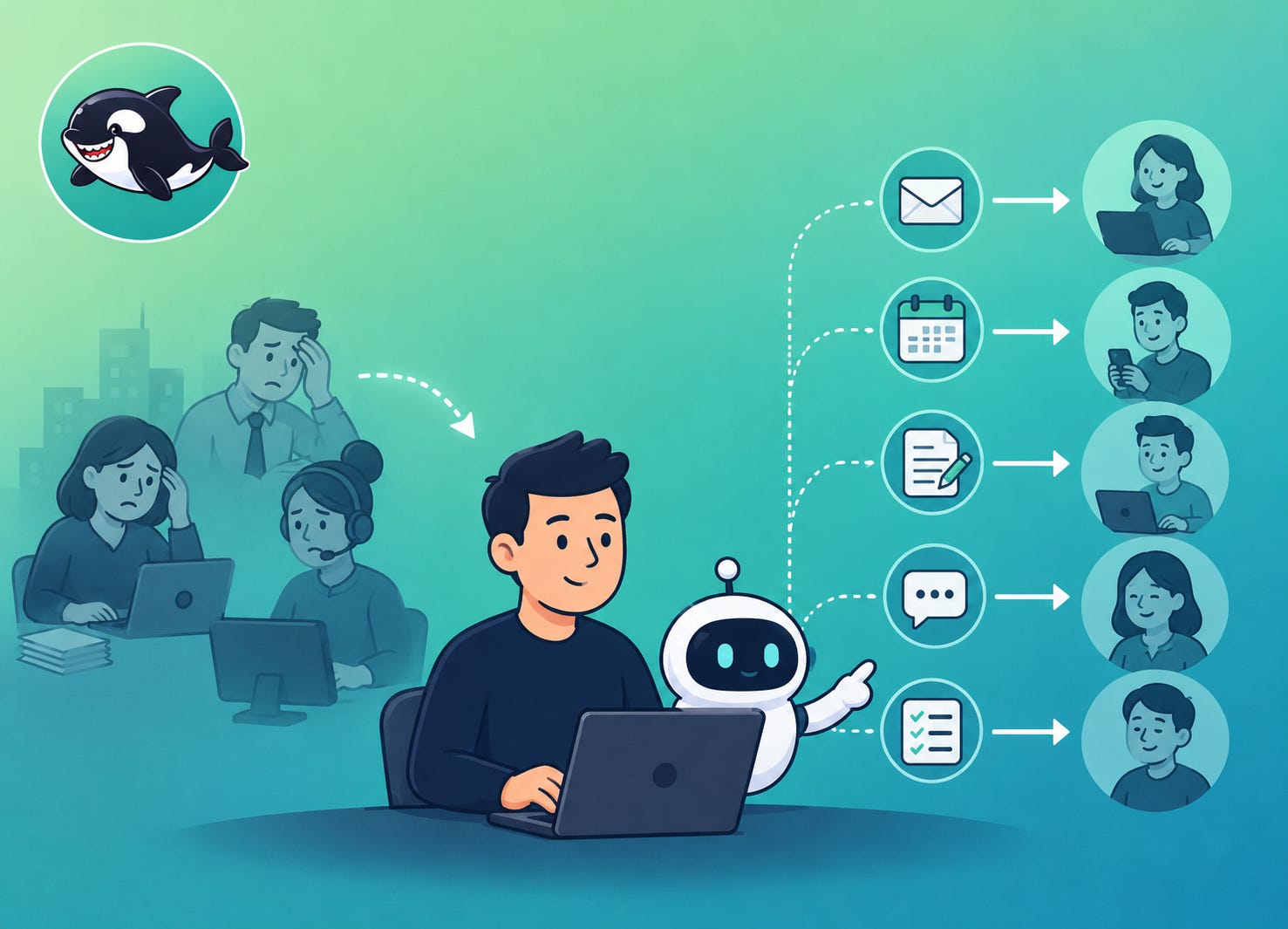
Orca replaces the orchestration work that a human executive assistant, a junior analyst, a content coordinator would otherwise do. It pulls emails, manages calendars, drafts responses, summarises transcripts, tracks tasks. It does the work that Chapter 2 describes Sarah losing. The forty-two-slide deck, the status meetings, the coordination layer that turned out to be 80 per cent of her job.
I did not build Orca to displace people. I built it because the work it does is reproducible and the technology to reproduce it exists. That is not a moral justification. It is an honest description of what happened.
The builder’s dilemma, in one paragraph: I am building the loom. I know it. I am writing a book about the cost of looms. The CEO of the company that makes the thread just went on the record saying the looms are going to put weavers out of work. And I am still building.
Amodei deserves credit for saying it. Most technology CEOs do not talk about displacement. They talk about augmentation, productivity, empowerment. The language is designed to make the transition sound like an upgrade. Amodei used the word “disrupt” and his company published the data.
The Next Rung is a book on how AI is quietly dismantling the middle of knowledge work, and what you can do about it before the market decides for you: pre-order it before it publishes in January.
But there is a gap between saying the thing and doing something about it. Anthropic published the research. It did not publish a plan for what happens to the 70 per cent of customer service work that its own technology can absorb. That is not a criticism specific to Anthropic. No AI company has published that plan. No government has either, for that matter.
The book’s argument is that we are in the quiet squeeze. Chapter 4 describes it through six vignettes of invisible displacement. The Bristol agency that did not post a job. The project manager whose Thursday meeting got halved. The freelance UX consultant whose day rate is still on his website but nobody is booking it. None of them would describe what happened to them as displacement. But the 55,000 US layoffs explicitly cited as AI-related in 2025, the Challenger figure, are just the visible tip.
Amodei said the quiet bit out loud. The question is whether anyone heard it.
I think some people did. The book is written for them. The 30 to 55 year old in an organisational-middle role who feels something is off but cannot yet name it. Amodei named it. The book maps what it means for your household, your mortgage, your positioning.
The CEO of the company whose technology I use every day is telling you what I spent two years writing. That is either reassuring or terrifying, depending on what you do next.