
In 1990, the managing director of an insurance company had a suspicion that his operation was inefficient. He didn’t know the scale. He brought in a cost accountant, dug into the numbers, and found that errors, rework, and waste were costing the business £170 million a year. Not in a rounding-error sense. In a “how is this company still operating” sense.
The group CFO launched a global review across all sixty countries where the firm ran. The findings were worse than the UK number. The CEO started an improvement programme that ran for years.
None of that £170 million had ever appeared on a financial report. It was sitting inside salary lines, inside overhead, inside the cost of everyone who had a job because the work wasn’t getting done right the first time.
The story comes from a paper by Rowan Jackson on what he calls ERW: errors, rework, and waste. He’s been working on this problem for decades. His working figure for how much of operating expenditure it consumes across industries is 20 to 45 per cent. In construction, the Get It Right Initiative (GIRI), which has done the most serious UK research on this, puts avoidable error at around 21 per cent of project turnover, and total costs including latent defects and indirect effects at up to a quarter of project spend. Rowan uses 30 per cent as a working figure once you include the waste that never gets counted. That’s roughly £10 to £25 billion a year in the UK construction sector alone.
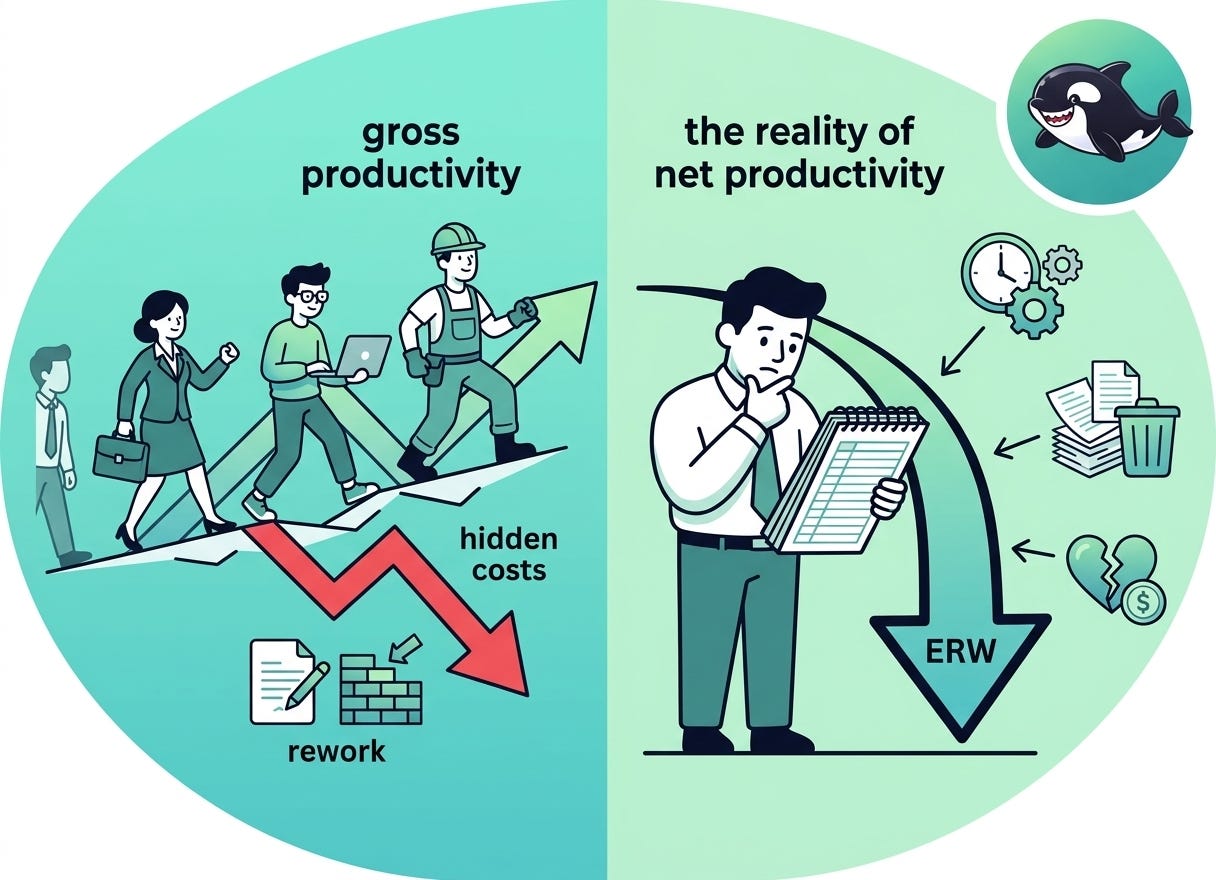
Here’s the part that matters. None of those costs appear in the P&L in a way that lets anyone see them clearly. They’re absorbed. They’re the three people doing the work of two because the system needs redundancy. They’re the fourth draft of a document because the first three were wrong. They’re the brick wall pulled down and rebuilt because it was set five centimetres out of place. They’re the customer who doesn’t come back.
If this sounds familiar, it’s because it’s the same mechanism that makes AI productivity claims so misleading. And that’s the part worth sitting with.
The Next Rung is a book on how AI is quietly dismantling the middle of knowledge work, and what you can do about it before the market decides for you: pre-order it before it publishes in January.
Why this isn’t a construction problem
The reason I’m writing about ERW in a series about AI displacement is that I kept running into a gap when I was arguing the Next Rung thesis. The gap was this: if AI delivers genuine productivity gains, displaced workers might at least benefit from cheaper goods and services as consumers, even if they can’t find work as producers. That’s the standard economist’s consolation. Output goes up, prices come down, everyone’s real income rises. The Luddites were wrong because this happened, repeatedly, for two hundred years.
The problem with applying that logic to AI is that nobody is measuring the productivity gains net of ERW. They’re measuring them gross.
A developer using an AI coding tool ships a feature in half the time. Productivity doubled. But if that feature has a bug that takes two developers a day to find and fix in production, the gross number is a lie. The fix is in a different budget line, probably in a different quarter, possibly attributed to someone else. The productivity number stays up. The ERW cost gets absorbed somewhere the accountants don’t look.
METR ran a randomised controlled trial in early 2025 on experienced open-source developers using frontier AI tools. The developers predicted the tools would make them 24 per cent faster. After using them, they reported feeling 20 per cent faster. The actual measurement, from screen recordings of the work, showed they were 19 per cent slower.
Let that sit. A 40-point gap between perceived and actual productivity, in a field where the gains are supposed to be obvious and everyone has strong priors in favour of the technology. The participants weren’t lying and they weren’t stupid. They were doing what humans do when the rework happens invisibly, gradually, at a lower cognitive register than the work itself. It disappears into the background.
And that’s in code, where the feedback loop is tight. The code either runs or it doesn’t, eventually. In knowledge work where the outputs are documents, reports, summaries, and decisions, the feedback loop is much longer. Sometimes it never closes.
Rowan’s NHS moment
Rowan told an NHS orthopaedic consultant about the 30 per cent construction figure. The consultant laughed and said the rework rate in the NHS is closer to 60 per cent.
I don’t know if 60 per cent is right. Neither does the consultant, really, because nobody is measuring it at that granularity. But think about what a number in that range would mean. NHS England’s resource spending is running at around £187 billion a year (2024-25). 30 per cent of that is £56 billion. 60 per cent is £112 billion. The UK defence budget for 2025-26 is £62.2 billion.
Put it another way. If NHS rework is anywhere near that range, the hidden cost of getting things done twice is large enough to run the country’s entire defence capability. It sits inside the budget lines nobody argues about in Parliament because nobody can point to it.
This isn’t an NHS-specific problem. Matthew Syed’s Black Box Thinking puts preventable medical accident deaths in the US at around 1,000 a day, which would be the equivalent of two fully loaded Boeing 747s crashing every morning. Aviation responds to that kind of failure rate by grounding fleets and rewriting procedures. Healthcare treats it as background noise, because the individual deaths are absorbed into individual case files, and the system-level number never makes it onto any report.
The through-line from insurance to construction to healthcare is the same. When errors and rework are invisible to the accounting system, they get baked into the cost of doing business, and the only way anyone finds them is by going looking.
AI is about to make this much worse, because AI gives you a tool that generates output at a speed that outruns your ability to verify it.
The Next Rung is a book on how AI is quietly dismantling the middle of knowledge work, and what you can do about it before the market decides for you: pre-order it before it publishes in January.
The productivity lie in plain sight
Here’s the trap. The way AI is being sold into the economy right now is through gross productivity claims. GitHub Copilot makes developers 55 per cent faster. McKinsey estimates 30 per cent of US work hours automatable by 2030. Klarna’s AI customer service handled 2.3 million conversations in 35 languages, the equivalent of 700 full-time agents.
Every one of those numbers is a gross figure. None of them is net of rework, error, or the work required to correct what the AI produced. And when you go looking for the net figure, what you find is sobering.
Klarna’s story makes this cleaner than most. The company replaced 700 customer service staff with AI in 2023. It reported aggressive cost savings. By spring 2025, customer satisfaction had dropped enough that the CEO, Sebastian Siemiatkowski, admitted publicly that “we focused too much on efficiency and cost. The result was lower quality, and that’s not sustainable.” Klarna started hiring human agents back. The company now runs a hybrid model, with AI handling routine queries and humans handling escalations and complex cases.
Notice what’s missing from Klarna’s original productivity claims and every similar announcement. The rework cost. The complaint volume. The customers who walked away. The brand damage. The eventual rehiring budget. These are real costs, but they appear in different lines of the P&L from the “AI savings” line, and often in later periods. The initial productivity claim gets made, quoted, and celebrated. The correction happens quietly, if it happens at all.
This is the ERW pattern, just applied to cognitive work instead of factory floors. And it’s doing the same thing it did in manufacturing: letting leadership celebrate gains that don’t net out, while the real costs accumulate somewhere the quarterly reporting doesn’t cover.
What the next rung argument needs
My original post on The Next Rung made the case that AI is breaking the three mechanisms that have absorbed displaced workers in every previous technological transition: new task creation, demand expansion, and skill transferability. Rowan’s ERW framework sharpens the demand-expansion argument in a way I hadn’t fully worked through.
The standard story goes: productivity gains lower prices, lower prices expand markets, expanded markets create new work. It assumes the productivity gains are real and durable, not gross numbers waiting to be eroded by rework.
If ERW runs at 20 to 45 per cent of operating expenses across the economy, and AI deployments are being sold on gross productivity claims that don’t account for it, then the demand-expansion mechanism is weaker than the optimists claim, because the actual cost reduction is smaller than reported. Some of what looks like productivity is just cost-shifting: work that used to be done by one person with a salary line is now done by an AI plus a different person doing corrections, often across different budget centres.
That matters for displacement. If the AI deployment delivers real net productivity, displaced workers at least benefit as consumers. If it delivers gross productivity that gets eaten by rework, the savings don’t materialise, the consumer doesn’t benefit, and the displaced worker has neither a job nor cheaper goods to buy.
This is the economic equivalent of a sealed box. Capital captures the announced gains. Labour loses the jobs. Consumers don’t get the price cut because the rework ate it. The only people who come out ahead are the ones selling the AI.
The Next Rung is a book on how AI is quietly dismantling the middle of knowledge work, and what you can do about it before the market decides for you: pre-order it before it publishes in January.
What to do about it
The honest version of the AI productivity conversation has to start by measuring net, not gross. Every organisation deploying AI into a workflow should be running a rework ledger alongside the productivity dashboard. How many outputs had to be corrected? How many downstream errors traced back to AI-generated content? How many hours of human review does each AI-assisted task actually consume? What was the quality score before and after, on the customer-facing side?
Rowan’s ERW work, Harrington’s process improvement methodology from the early nineties, the Toyota Production System, Danaher’s operating model, these aren’t legacy industrial frameworks. They’re the only serious methods the business world has ever developed for measuring what’s actually happening in a workflow, rather than what leadership wants to be happening. They apply to AI deployments the same way they apply to car plants.
If you’re running an AI rollout and you’re not tracking rework, you’re not running a productivity programme. You’re running a perception programme. They’re different things, and only one of them shows up on the balance sheet in the end.
The next piece in this series goes further on what that looks like in practice. For now, the point is simpler. The productivity gains you can’t measure are the ones you shouldn’t claim. And the costs that don’t appear on your financial report are the ones that will eventually eat it.
With thanks to Rowan Jackson, whose paper on Errors, Rework, and Waste (ERW) provided the framework and several of the examples in this piece, including the £170 million insurance case, the NHS consultant’s 60 per cent figure, and the broader observation that errors, rework, and waste are the silent killers of organisational performance.
Sources: Get It Right Initiative (GIRI) construction error research; METR 2025 study on developer productivity with AI tools; Moffatt v Air Canada 2024 BCCRT 149; Klarna AI customer service reversal coverage, 2025; NHS England financial directions 2025-26; UK defence budget data from House of Commons Library; Matthew Syed, Black Box Thinking; H.J. Harrington, Business Process Improvement (1991).