
The reason “it was fine last time” became the default response to technology and employment is not that economists are lazy, though some are. It is that for two hundred years, the statement was demonstrably true. Every major technological transition from 1790 onwards really was fine, eventually, for most people. The farms emptied, the factories filled. The factories hollowed, the offices filled. The offices thinned, knowledge work expanded. Living standards rose across centuries. The Luddites turned out to be wrong about the long term, even though they were right about the immediate consequence.
This consistency was not accidental. It was mechanical. Three specific things happened in every previous transition, and those three things worked together like a system. Understanding that system is understanding why this time might be different.
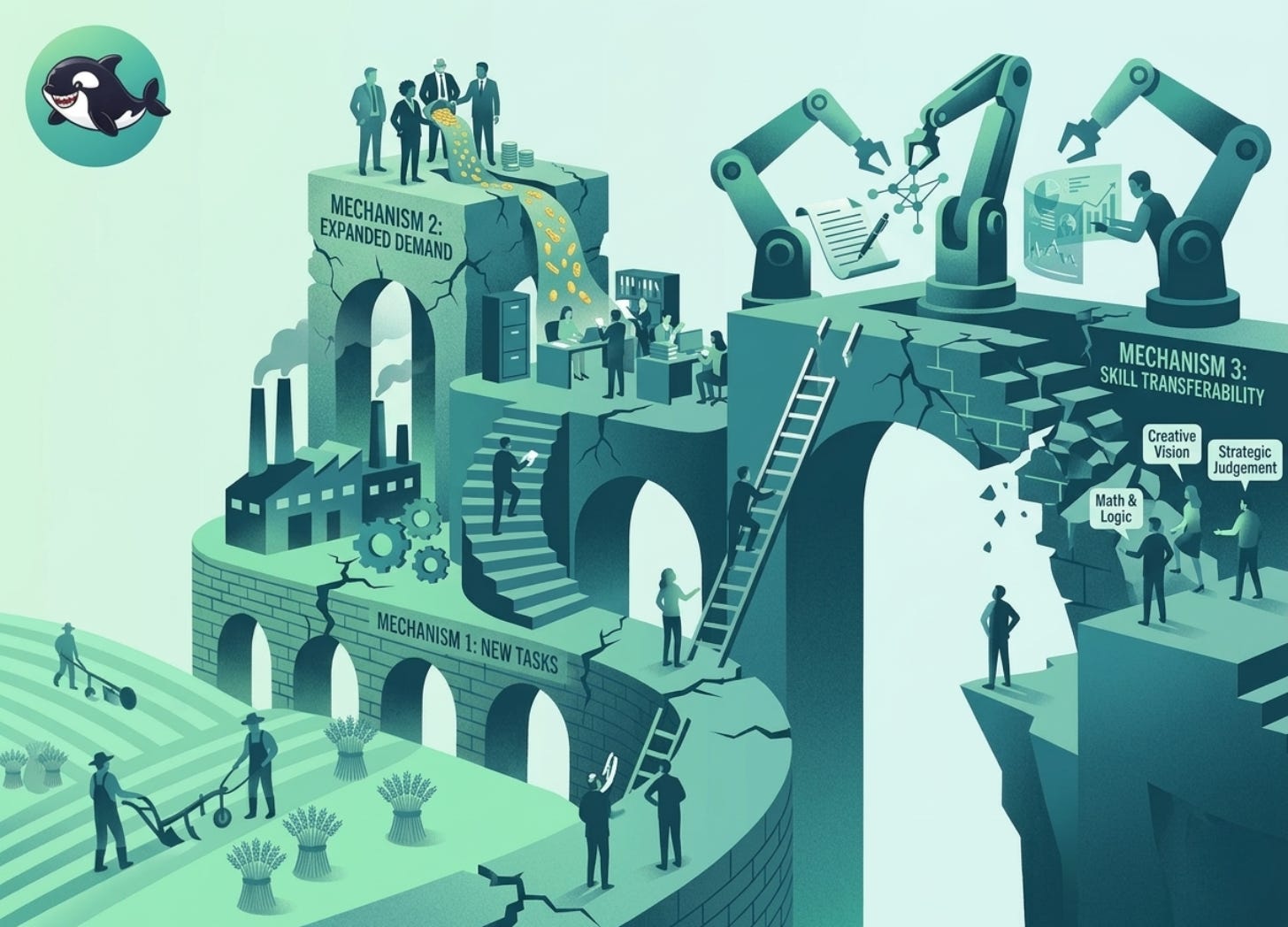
Here is the first mechanism: new technology created demand for new tasks that did not exist before.
The steam engine is the clearest example. Nobody woke up in 1769 and said, “We need an occupation: steam engine mechanic.” The occupation did not exist. But once Watt’s engine became practical, it needed people. Someone had to build them. Someone had to maintain them. Someone had to install them. Someone had to understand what could be done with them. The textile industry did not just displace hand-loom weavers. It created an entirely new layer of work around the machines: engineering, maintenance, installation, troubleshooting, parts manufacture, transport, coordination.
The steam engine destroyed one kind of job and created several others. The same pattern held through every subsequent transition. The assembly line destroyed craft skills but created flow engineers, line supervisors, scheduling coordinators, quality inspectors. The computer destroyed typing pools but created programmers, data entry specialists, systems operators, IT support. Each wave of automation generated adjacent work that required human attention. The machines could do the core task but not all the supporting work around it.
This is the first crack, and it is a visible one. AI is not like the steam engine or the assembly line or the computer. Those were narrow technologies, purpose-built for specific tasks. They automated one thing. The work around them was different work. But AI is a general-purpose labour substitute for the cognitive work that knowledge workers do across the board: reading, writing, analysing, coordinating, summarising, recommending, deciding.
The Next Rung is a book on how AI is quietly dismantling the middle of knowledge work, and what you can do about it before the market decides for you: pre-order it before it publishes in January.
When you automate reading and writing and coordinating, the adjacent work does not disappear into “something else.” It collapses into the same system. The AI reads and writes and coordinates. The human becomes redundant not just at the task but at the meta-layer of managing the task. There is no adjacent work because the work itself has been automated.
This is the critical difference. Previous transitions automated task-specific tools. This one automates general cognition.
Now, the second mechanism: productivity gains reduced costs, which expanded demand, which created more work.
This is basic economics. When factories made textiles cheaper through mechanisation, more people could afford textiles. Demand increased. To meet the increased demand, more factories were built, more textile workers were hired, more people were needed in the supply chain. The Luddites were right that mechanisation destroyed their jobs. But it destroyed them in the context of a massively expanding market. Textile production went from craft-scale to industrial-scale. Employment in textiles actually increased, even though the wage per worker dropped and working conditions were worse.
The same pattern held in every subsequent transition. Cheaper automobiles meant more automobiles sold. Cheaper information processing meant more information consumed. Cheaper computing meant more software written and more systems implemented. The productivity gains from the previous technology created expanded markets for the products of that technology.
This mechanism is holding now. McKinsey estimates that productivity gains from AI could automate thirty per cent of work hours in the US economy by 2030. That is a genuine, measurable gain. But here is the problem: the gains are not spreading.
The gains flow to whoever owns the AI system. And the AI system does not need many humans to operate it. The steam engine needed engineers and operators and maintenance workers in significant numbers. The assembly line needed supervisors, schedulers, quality checkers. The computer needed systems administrators, network engineers, helpdesk staff. Each technology created operational overhead.
AI requires a data centre, an electricity supply, and a handful of engineers. The humans it replaces do not get absorbed into operating it, because there is nothing to operate. The productivity gains stay at the top with the owners of the system.
This is the second crack. Demand expansion is real, but the employment expansion that historically followed it is not happening.
And then the third mechanism: displaced workers had transferable skills.
A farm labourer in 1790 could learn to operate a loom. It was not trivial. It required training. But it was learnable. A typist in 1980 could learn to use a word processor. The cognitive distance was manageable. You did not become a fundamentally different person. You learned a new tool, and the underlying work was still coordinating information, managing documents, organising time.
The skills that carried you through previous transitions were portable. You learned them once in childhood or early adulthood and you applied them repeatedly across different technologies. An accountant learned mathematics and logic and procedural thinking. Those skills worked with a ledger in 1920 and a spreadsheet in 1980 and a database in 2010. The tool changed. The thinking did not.
This is the third crack, and it is the most serious one, because it is not gradual. It is categorical.
The Next Rung is a book on how AI is quietly dismantling the middle of knowledge work, and what you can do about it before the market decides for you: pre-order it before it publishes in January.
The skills that survive AI automation are not refinements of existing skills. They are different in kind. They are genuine creative vision: the ability to see a solution that has not been expressed before and guide a team toward it. They are relationship management at scale: the ability to hold complex relationships with competing stakeholders and move them toward aligned outcomes. They are strategic judgment under genuine uncertainty: the ability to make decisions when the information is incomplete and irreversible, knowing you might be wrong.
These are not skills you learn in a six-month retraining programme. They are capacities that develop over years, sometimes decades, sometimes rooted in childhood experience. Some people have them latent and have never used them. Many simply do not have them, and no amount of training will install them.
Here is the historical precedent that should worry you. When coal communities were promised that miners could retrain as software developers, the programmes mostly failed. Not because miners were stupid. Many of them were quick learners with strong logical thinking. The programmes failed because the cognitive distance was too great, the geographic mismatch was severe, the age distribution was wrong. A fifty-year-old with seventeen years of industry-specific career capital was not going to start at entry level in a field where twenty-five-year-olds had a structural advantage.
The transition needed a generation. Not everyone, but most of the people whose livelihoods were built on coal mining did not successfully transition to software. They left the industry, took lower-wage work, moved away, or stayed and struggled.
That was coal to tech. One person, one place, one time.
AI displacement is the coal-to-tech problem at a hundred times the scale, compressed into a fraction of the time, happening simultaneously across every knowledge work sector.
Now, here is what matters. In every previous transition, all three mechanisms worked together. New tasks were created, so there were jobs to move into. Demand expanded, so those jobs multiplied. And displaced workers had portable skills, so they could move into those jobs in reasonable timescales. It was not comfortable. It was not always higher. But there was a rung to step to.
The question is whether all three of these mechanisms hold this time. And the honest answer is: they are not holding. They are cracking simultaneously.
New task creation is stalled because the technology is too general. Demand expansion is real but gains are not spreading. And skill transferability is broken because the skills that survive are not teachable in retraining programmes.
When all three systems crack at once, you cannot rely on the historical pattern. You cannot tell people, “it was fine last time” because the mechanism that made it fine is not present now.
This is where the position-don’t-predict framework becomes relevant. You cannot predict exactly what happens when all three absorption mechanisms fail. You can predict the direction: squeeze, compression, disruption. You cannot predict the precise magnitude or timeline. But you can position yourself for scenarios where all three are failing, and that is different work than trying to retrain into the next rung, because there might not be a next rung to retrain into.
The framework is simple. Stop trying to predict which specific job survives. Instead, identify the capabilities that survive across all scenarios, build those, and stay mobile enough to apply them in new contexts as they emerge. In a world where the old ladders are breaking, that is the only positioning that is not a gamble.
This is the argument the book develops across chapters one through four. But it is the foundation. These three mechanisms worked for two hundred years. Now they are all failing at once. That is why “it was fine last time” is not a reassurance. It is a warning.
Five questions. Two minutes. One honest answer. No email required to see your result. The follow-up analysis lands in your inbox if you subscribe.