
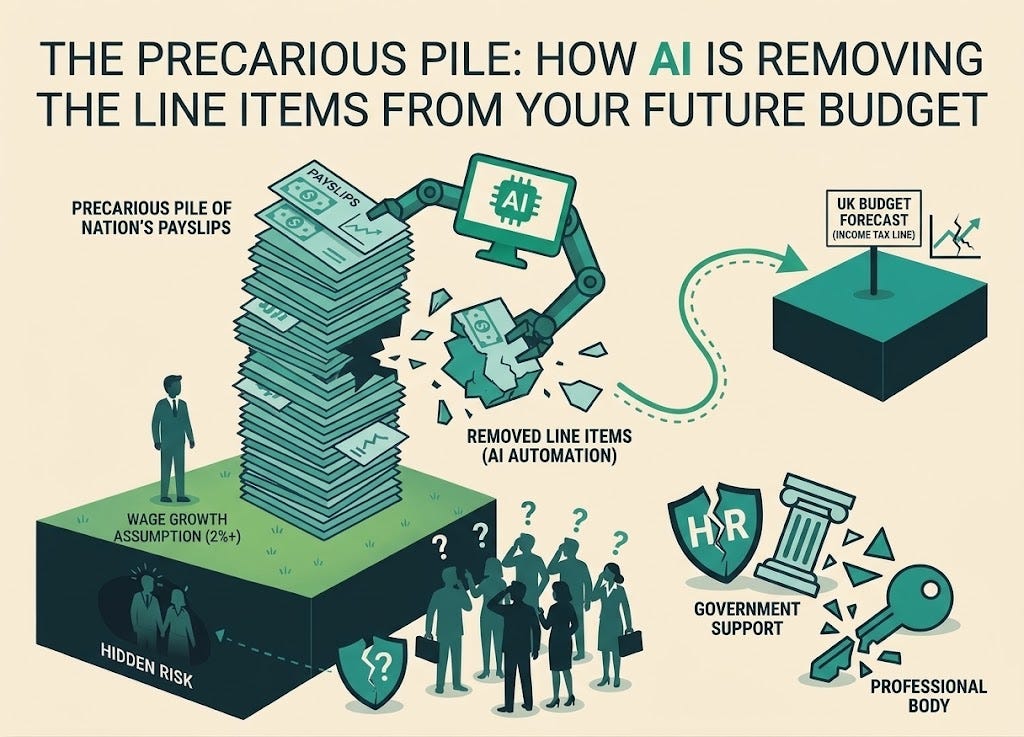
Somebody in the Treasury is more confident about your salary than you are. I mean that fairly literally. There’s a forecast that came out alongside the Budget on Wednesday 28th October and your payslip is in it, not by name obviously, but it’s in there.
It’s the income tax line. Income tax and National Insurance through PAYE, the money that’s gone before your salary even lands in the account. The Office for Budget Responsibility now has that coming in at about six hundred billion pounds a year by the end of the decade. Try and picture that as one big pile of payslips, because that’s what it is, and an awful lot of the pile comes from people on decent professional money doing coordinating work. Reporting, checking, scheduling, translating what one department wants into something the other department can do, and so on.
Anthropic published data in March on which occupations its model was already doing the work of, using how people actually use it rather than a guess, and the most exposed jobs weren’t the low-paid ones. They were the better-paid ones. The graduate ones. Put that next to the pile of payslips and you’ve got the bit of the economy the Treasury leans on hardest for income tax sitting pretty much right in the blast radius, which means that the forecast and the risk are stacked on top of each other and nobody has drawn them on the same page.
Underneath the number there’s an assumption, and I’m not having a go at the OBR for it. Wages keep going up, a bit over two per cent a year, every year out to the end of the forecast, give or take. The people in those jobs mostly stay in those jobs, the money keeps arriving. That’s what a forecast is. You assume the thing that’s been happening keeps happening, plus or minus a bit, because the alternative is making it up.
Somebody’s watching this, surely
And this is where I think a lot of people have parked the worry. Somewhere at the back of your head there’s an idea that if this gets bad, somebody’s watching it. HR will see it coming. The professional body will say something. Government will step in, because government always steps in when it’s lots of people at once. I hear a version of that most weeks, and I get it, it’s a reasonable thing to believe if you were working through 2008 and watched the state find the money to hold the banks up.
The stepping in gets planned off the forecast, though. And the forecast has you in work.
This one isn’t 2008
If it goes the way I think it goes, it won’t arrive as one big moment either. Tax receipts soften, mortgage arrears start creeping up in the same postcodes, house prices in the commuter towns wobble, all in the same quarter, because it’s the same households behind all three. The playbook everybody will reach for is 2008’s. Payment holidays, forbearance, give it a bit of time. Which works when the problem was credit and the income comes back. 2008 was a credit crisis. This one is a labour market crisis, and pausing the mortgage of somebody whose job isn’t coming back just moves the default further down the road, with interest added on.
I went through the Budget looking for that household. There’s a big AI package in it, the one that got trailed all week, and Healey stood up and promised it wouldn’t leave workers behind. So I went and found the bit that’s meant to catch the worker. It’s a research budget. Money to look at how AI changes jobs, an institute set up to think about it, and that’s the part with your name on. Nothing that turns up in a house when the income stops. They’ve funded someone to watch it happen. There’s a line for fuel duty. There’s always a line for fuel duty.
To be fair to whoever ends up having to respond, the institutions that actually lasted in this country were mostly built by frightened people in the middle of a crisis. The NHS came out of a war, nobody sat down and designed it in a good year. People got scared, properly scared, and then they built something, and it held for decades. I find that genuinely reassuring, and I also find it not reassuring in the slightest, depending on which bit of the sentence I’m looking at, because the fright comes first and it has to land on someone.
The long version of that same-quarter bit, the Treasury and the banks and the housing market together, is in chapter 7 of The Next Rung. Paperback, out 19 January with Practical Inspiration Publishing, and thenextrung.co takes pre-orders.

The Next Rung is a book on how AI is quietly dismantling the middle of knowledge work, and what you can do about it before the market decides for you: pre-order it before it publishes in January.
Go and find the measure in that Budget that would cover your household if your income dropped by a third. Page number and everything.