
Earlier this week I left a comment on someone else’s Substack. The reply I got back was the most honest sentence I’ve read about AI and jobs this year.

I want to walk through why, because the exchange contains something most public discourse on this subject is missing.
The post itself was a personal arc. A wife who watched her mechanical-engineer husband quit a stable job in 2021 to learn AI from YouTube, mocked him for two years, then converted in 2024 when he fixed a backend bug she’d been stuck on for two days in seven minutes. They now run an AI-learning newsletter together. He’s top one per cent on Upwork. Six and a half thousand hours logged.
The personal story is real. The arc is true. Plenty of people have had a version of it.
The thing that stuck with me was a different layer. The post wasn’t really about her husband. It was a case for individual reskilling as the response to AI displacement. Watch the YouTube videos. Pick up the tools. Get on the right side of history.
Which is fine, until you ask what happens at the level of the whole labour market.
The exchange
I left a comment. Generous about the personal arc, careful about the bit that doesn’t translate. The point I made was the aggregation point. One engineer pivots well and the headline writes itself. The maths underneath doesn’t get told. If AI makes the remaining engineers five times more productive, the firm doesn’t need five times the output. It needs fewer engineers. The labour market story is about the chairs that quietly disappear while a handful of people learn to build new ones.
She replied:
I think some current positions will need fewer people, yes. But new positions, workflows, and industries will appear as well, and people will shift into those areas over time. A system that works against the majority of society is not sustainable long term, and I believe even the companies building these technologies understand that too.
This is the standard optimist position, stated cleanly. New roles will appear, people will shift over time, the system can’t work against the majority indefinitely.
I came back with a question. Every previous transition had at least one absorption pillar working. New task creation, demand expansion, or skill transferability. Which one is doing the work this time?
She replied:
Actually, AI still makes obvious mistakes, so every industry needs a human in the loop. Fewer people in the old roles, sure. But the shift always creates new ones, we just can’t name them yet. So I might be too hopeful, but this is what I am thinking.
That last sentence is the most useful thing anyone has said to me about this in months.
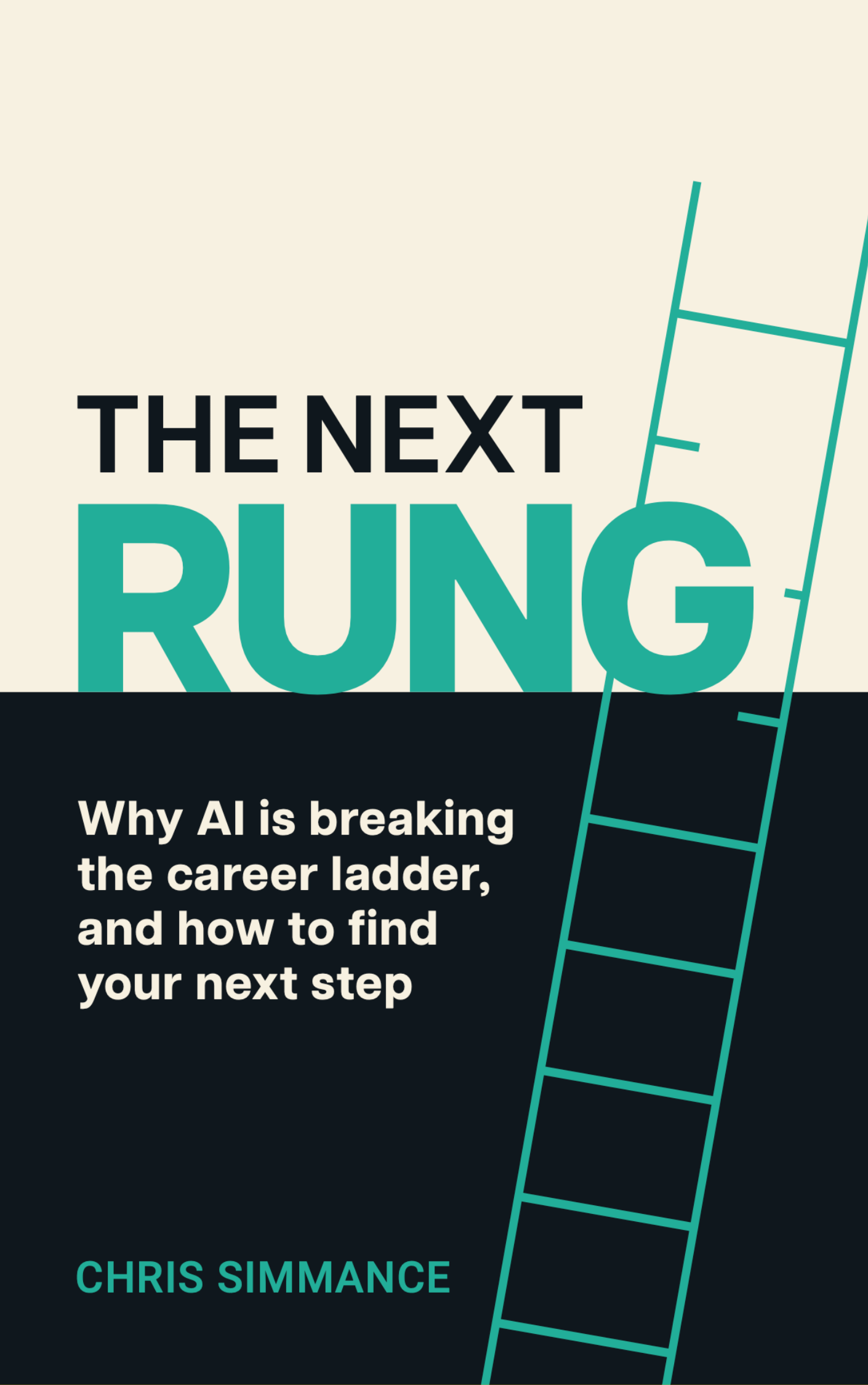
The Next Rung is a book on how AI is quietly dismantling the middle of knowledge work, and what you can do about it before the market decides for you: pre-order it before it publishes in January.
The thing nobody noticed
Here’s what’s worth noticing, and what most of the thread missed.
The second sentence concedes the case.
“Fewer people in the old roles, sure” is the displacement argument. That’s the whole first half of the book I’ve been writing for the last year. It’s the thing I expected an optimist to push back on, and they didn’t. Not because they’re inattentive. Because at this point, displacement isn’t really in dispute. The statistics are too visible. Microsoft fifteen thousand cuts alongside agent rollout. Tech sector cuts at a quarter of a million in 2025. Anthropic’s data showing programmers, customer service and paralegals at seventy-plus per cent of core tasks handled by AI.
You don’t argue with that any more. You absorb it.
What you do is move the load to the next sentence. The one that says: but the shift always creates new ones. That’s where the optimism actually lives now. Not in denying displacement. In trusting that whatever gets displaced gets replaced.
So the question becomes: what’s holding that trust up?
What’s holding the future up
Every previous economic transition came with at least one absorption mechanism doing the heavy lifting.
New task creation. The factory worker becomes the service worker becomes the knowledge worker. Each transition added new categories of paid activity, and the categories were big enough to absorb the people the old work had stopped needing.
Demand expansion. A more productive economy generates new appetites, new markets, new things to spend money on. Cheaper bread doesn’t mean fewer bakers. It means people buy other things, and the people not baking go and make those.
Skill transferability. A weaver could become a millworker. A typist could become a data entry clerk. A bookkeeper could become an analyst. The skills you already had ported, partially, into the new shape of the work.
Acemoglu and Johnson’s Power and Progress is the long view on this. The Luddites lost not because they were wrong about looms (they weren’t) but because the factory economy that came after ended up bigger than the cottage economy that came before. New tasks. New demand. Transferable skills. At least one of the three was always working.
This time, all three are breaking together.
New task creation is constrained because the same tool that absorbs the old tasks also performs most of the new ones the moment they’re defined. Demand expansion is uncertain because the productivity gains are concentrating, not distributing. Skill transferability is the worst-affected pillar of the three. The skills that survive (judgement, taste, complex relationships, genuine creative direction) take years to develop and don’t show up neatly on a course playlist.
This is the question the book exists to answer. Not whether displacement is real. We’re past that. Whether the absorption mechanism still works.
The honest answer is: not on the evidence so far.
The Next Rung is a book on how AI is quietly dismantling the middle of knowledge work, and what you can do about it before the market decides for you: pre-order it before it publishes in January.
The honest sentence
Which brings me back to her last line.
“So I might be too hopeful, but this is what I am thinking.”
I don’t think she’s a fool. I think she’s an honest person stating, out loud, the position most people are operating on. The optimism isn’t analysis. It’s a hope, plainly named as such, by someone with the self-awareness to label it.
That’s rare. Most public discourse on AI and jobs is the same hope dressed up as an argument. Tech executives have a financial reason to repeat it. Politicians have a political reason. Consultancies have a fee-shaped reason. Wrap the hope in a chart and call it a forecast.
She didn’t do that. She said: this is what I am thinking, and it might be wrong.
That’s the ground floor of the whole conversation. Most of public discourse hasn’t reached that ground floor yet.
Where this lands
I’m not writing this to win an argument with someone on Substack. I’m writing it because the position she stated is the position holding most household, corporate and policy thinking together right now. We’ll figure it out. The shift always creates new ones. We just can’t name them yet.
That’s hope. Hope is human, and hope is fine.
Hope is not a plan. It’s not a household financial strategy if you’ve got a mortgage and a knowledge-work income. It’s not a labour market policy. It’s not a corporate workforce strategy. And it’s not what you tell your kids when they ask which subjects to take.
You don’t need certainty about what comes next. You need a position that survives the optimism being wrong.
That’s what the book is about. The Next Rung is out later this year. The Substack is where I work it out in public. If that’s useful, you know what to do.
One thing to declare, by way of footnote.
I run a software business that automates the orchestration roles I’m telling you are most exposed. I am, literally, building the loom. I am also the one writing about what looms cost.
Some readers find that contradictory. I find it the only honest place to write from. The people building this should be the ones taking the cost of it seriously. Most of them aren’t.