
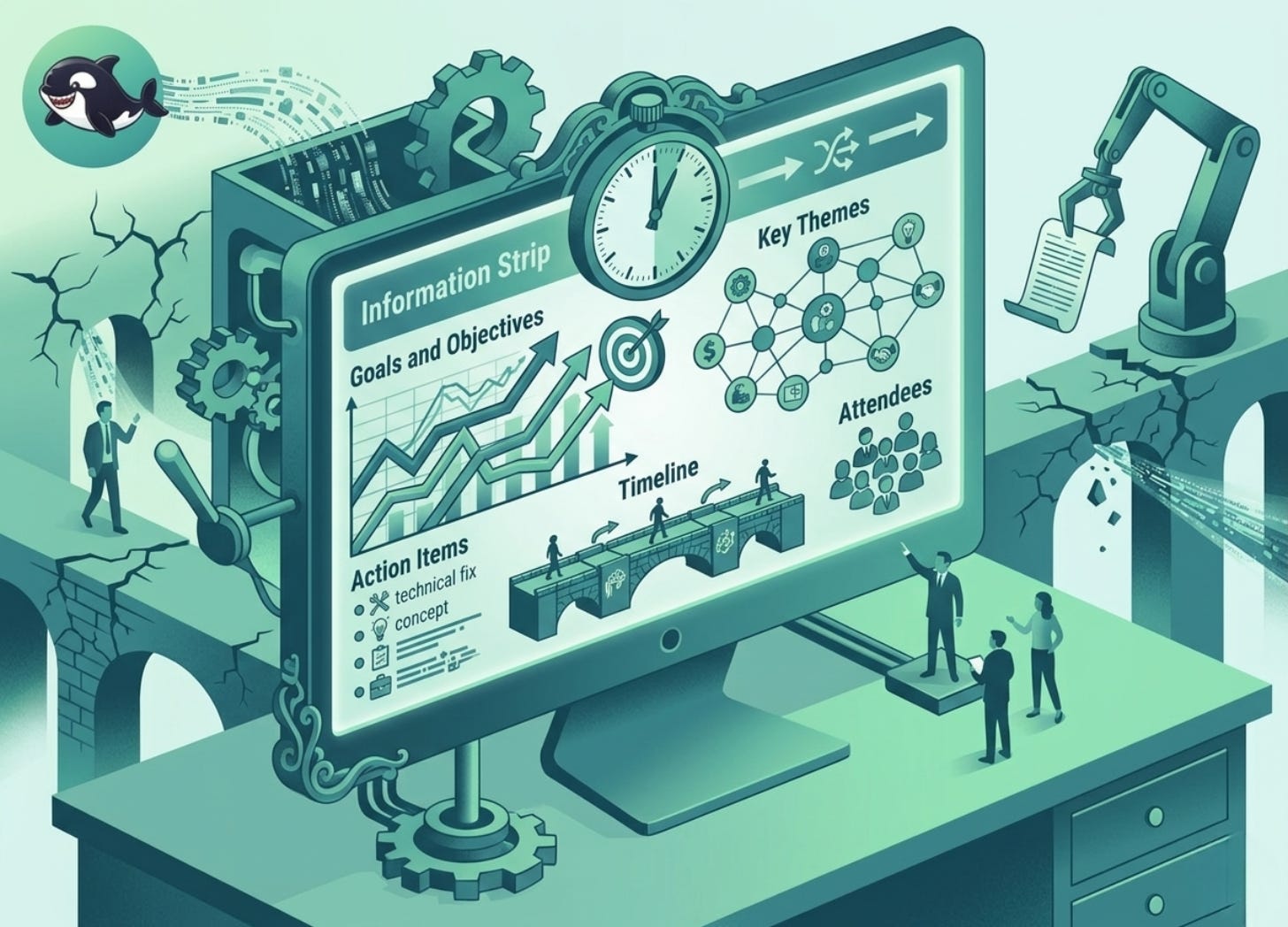
I call it the forty-minute moment, though the actual time varies between thirty and fifty minutes depending on how much we talk through the initial setup.
The demo starts with connecting Orca to someone’s calendar. This is simple: grant access, authenticate, done. Then we pick a meeting from their schedule. Usually a client meeting, sometimes an internal one. Something real. Something they actually have to prepare for, possibly in the next week. I ask them to show me, briefly, what they currently do to prepare for this specific meeting type.
They show me. Sometimes it’s thorough. They spend a day researching the client company, pulling together information from Companies House, LinkedIn, recent news, previous project outcomes, internal project notes, CRM context. Sometimes they’ve got a system. Sometimes it’s a spreadsheet. Sometimes it’s a PA or a junior who does it because the founder isn’t doing the detail work themselves. Sometimes it’s just: they know the person, they show up, they wing it.
Then I say: watch.
The Next Rung is a book on how AI is quietly dismantling the middle of knowledge work, and what you can do about it before the market decides for you: pre-order it before it publishes in January.
I connect the meeting to Orca. I add the key integration points: their email, their CRM, LinkedIn, Companies House. I point the system at the meeting they selected. I press generate.
Forty seconds later, Orca produces a brief. Not a skeleton. A brief. It has the background research on the client company, including recent funding rounds, headcount changes, sector positioning. It has the relationship history from their CRM, cross-referenced with email conversations, pulling the tone and context of the relationship. It has the prep notes on previous projects, including outcomes and blockers. It has a personal note on the client contact, built from LinkedIn and CRM warmth scoring. It’s a page and a half, long enough to be useful, short enough to read before the meeting.
The person looks at the screen. They look at me. There’s a pause. I’ve watched this pause happen ninety-seven times. The pause is consistent. It’s about four or five seconds. During that pause, they’re doing the calculation. The calculation is unconscious but unmistakable once you’ve seen it a few times. They’re working through: what I just did in forty seconds, how long would that manually take?
Someone says: “That would have taken my assistant half a day.”
Someone else: “I used to have someone doing exactly that.”
Another person: “I used to have two people doing that.”
And once, with the kind of uncomfortable honesty that arrives unexpectedly in a room where someone is trying to sell you something: “So what does Sarah do now?”
The Next Rung is a book on how AI is quietly dismantling the middle of knowledge work, and what you can do about it before the market decides for you: pre-order it before it publishes in January.
I don’t have a good answer for that question. What I have is a product that works, a business model that scales, and a knowledge that’s become harder to carry the longer I’ve been building this. The efficiency I’m selling to one person is, in aggregate, a redundancy notice for someone else. Not necessarily their Sarah. But someone’s Sarah, somewhere, in the distributed math of thousands of founders adopting the same tool, running the same calculation, making the same decision.
The interesting part comes after the demo ends. After they’ve seen what the tool does. After they’ve run the calculation in their head and confirmed that yes, this eliminates the work that used to require human labour. And they say: can I try it.
They try it. Sometimes they connect their calendar themselves. Sometimes they want to see it work on a different meeting type. Sometimes they want to test it against a difficult client situation where the preparation is actually hard. I let them. They run it. It works. It usually works. Not always perfectly, but well enough that the twenty minutes they’d spend cleaning up the AI output is less than the four hours they’d spend writing it from scratch.
That’s when the expression shifts.
The calculation they did at forty seconds was intellectual: this is more efficient. The calculation they do after running it themselves is emotional. They feel the weight lifting. The admin they’ve hated for years is suddenly handled. The meetings they used to dread, the ones that required four hours of research and prep, are now prepared in forty seconds. The inbox they’d been drowning in, reading and categorising and flagging and responding to, is now triaged. The CRM they’d been neglecting because the updates were tedious, that’s current. The content calendar that required hours of planning and coordination, that can now be scheduled in batches.
For two hundred and fifty pounds a month, they’ve bought back hours of their week.
They sign up. They’re relieved. The relief is real every time. I’ve watched this moment ninety-seven times. The weight they’ve been carrying has a weight, and suddenly it’s gone.
Then comes the part I find hardest to witness. The part that comes about ninety seconds after they sign up. They’re filling in their profile. They’re connecting more calendars, more data sources. They’re configuring their voice preferences. And then, usually about three minutes in, they pause. They look up. And they ask the question in a different tone.
Not: what will this do for me. But: what does this mean for my team.
Sometimes they’re asking it aloud. Sometimes it’s just an expression. I watched one founder fill in the profile section that asks “describe your role,” and when she got to the field for her assistant’s role, she stopped. She just looked at it. Didn’t type anything. Looked at me. Said nothing. That was the whole conversation.
Another one said: “My whole marketing coordinator role, all of it, this does all of it, doesn’t it.”
I said: “Most of it, yes. The tactical parts. Email management, calendar coordination, basic content drafting, simple analytics reports.”
He nodded. Then he said: “I need to think about something. Give me a week.”
He didn’t sign up. Or rather, he signed up after a week. But in that week he’d made the decision. The decision was: I’m going to use this, and I’m going to figure out what my coordinator actually does that this doesn’t do, and I’m going to have that conversation with her. Or I’m going to figure out what she could do if I freed her from the tactical work, and we’ll build something new out of her capability. Or I’m going to help her transition somewhere else, and I’ll feel like shit about it but I’ll do it properly.
He bought the tool because the economics didn’t give him a choice. But he’s thinking about it because he’s a human being and his coordinator is a human being and he’s not comfortable with the distance between the two truths.
That’s the forty-minute moment. Not the efficiency. That’s just arithmetic. The moment is the moment after. The moment when you’ve understood intellectually what this thing does, and you’ve felt emotionally what it means, and you’re holding both those things at the same time and they don’t align and you have to decide what you’re actually going to do about it.
The buy signal is relief, then guilt, then maths.
Relief because the tool works and you’re buying yourself time.
Guilt because you understand that your time is someone else’s absence.
Maths because you run the calculation: if I free up fifteen hours a week for my coordinator, what could she do with that. Or if I don’t free up those hours, if I just use Orca to make sure she’s redundant, what does that let me do. Build the business faster. Compete harder. Survive. The calculation doesn’t have a good answer. It has answers. None of them are comfortable.
That’s why I’m writing a book about displacement while selling tools that displace. That’s why I’m sitting in advisory sessions helping business owners restructure around AI tools, while knowing that the restructuring means redundancy somewhere. That’s the triangle I sit in. The tool, the transition, the cost of the transition. All three vertices are real. All three are true. And none of them cancel the others out.
The book is trying to describe what’s happening at kitchen tables and in business conversations and in the forty minutes after someone has seen what Orca actually does and understood what it means. The tool is completing that transition. I’m documenting it. The people on the other side of both are the ones bearing the cost.
That’s not a clean position. It’s the position I’m in.