
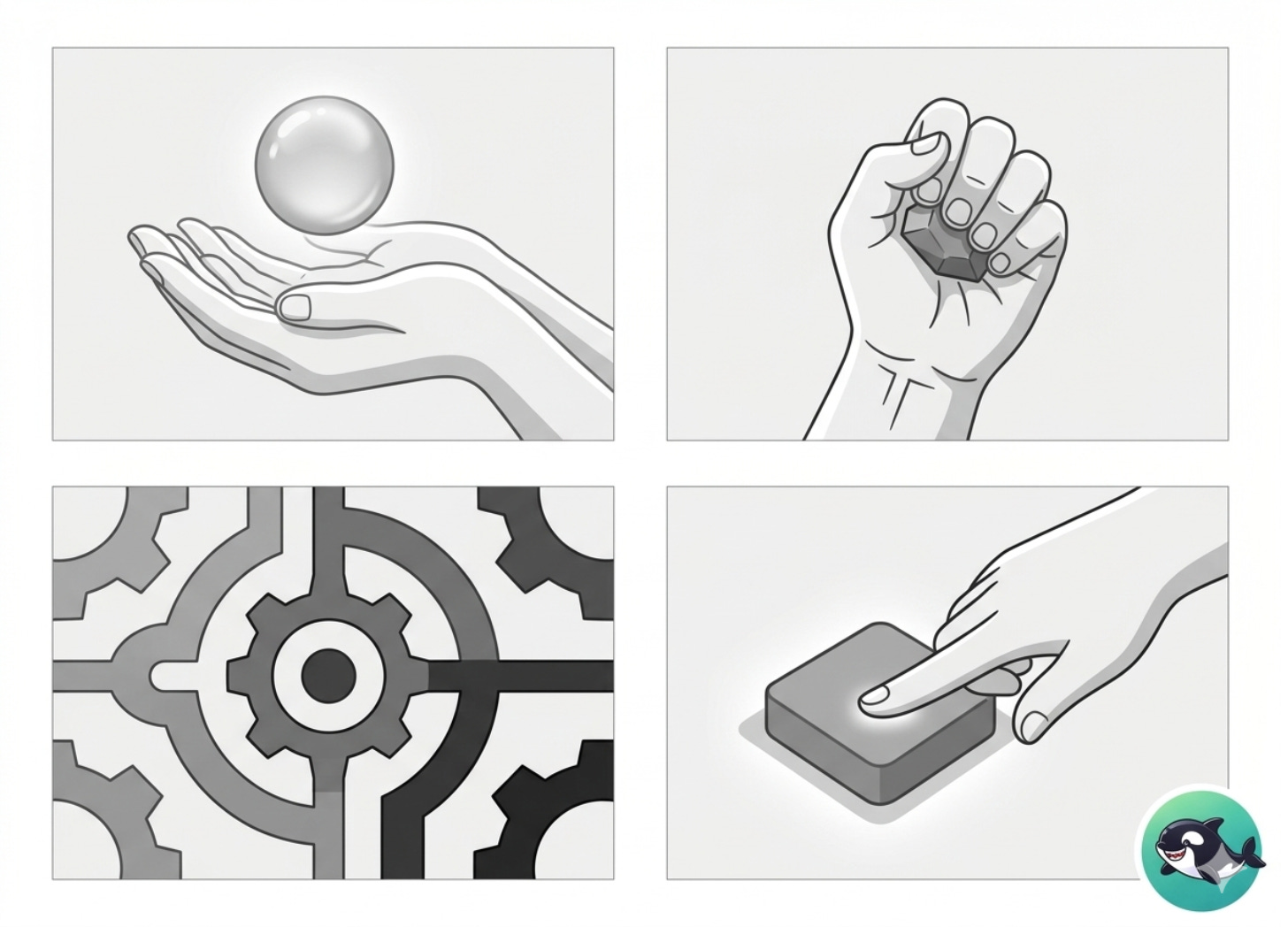
The first thing you notice when you’ve shown Orca to a hundred people is that the reactions follow three patterns. Not variations on one pattern. Three distinct sequences that almost never cross.
The second thing is that the objections, while they sound different in each conversation, sort into three archetypes with three honest answers.
The third thing is that there’s one question, usually asked quietly about halfway through, that tells you whether the person’s going to buy or not. Once you know what that question is, you can read the demo outcome almost before you get to the end.
Let me describe what I’ve seen.
The three reactions
Relief. This is the one that comes first. The person’s sitting in the demo. They watch a meeting brief generate in under a minute. They see follow-up emails draft in their voice. They watch the inbox reduce from chaos to thirty actionable items. And something in their shoulders drops.
You can actually see it happen. The weight they’ve been carrying, the thing they’ve been managing since they woke up this morning and probably yesterday and probably the day before that, has a path off. Not gone. Not solved. But there’s a direction now. Someone’s built a thing that handles the part of their job that’s been eating their day.
The relief is real and it’s immediate. Some people cry. Not dramatically. Just that thing where your eyes get wet because you’ve been living in scarcity and someone just showed you abundance.
Guilt. This comes next, usually about fifteen minutes in, when the person starts doing the maths. A PA who would cost them two or three grand a month is being replaced by a tool that costs two hundred and fifty pounds. A coordinator role that’s been taking someone eight hours a day is now taking an hour. The back-of-napkin arithmetic is obvious.
And with that arithmetic comes the uncomfortable recognition: I could have let that person go. Or I don’t need to hire that person. Or the person I’m about to hire won’t actually be necessary. The relief about time opens directly into discomfort about people.
This is where some demos stall. The person who was excited about the capability five minutes ago is now quiet. They’re working through something that’s not technical.
Maths. If the person moves past the guilt phase (which some do, some don’t), they usually land in a more calculating frame. Okay, the tool works. Okay, the economics are obvious. Okay, there’s a capability gain. What does this do to my business? What does it let me do? What new advantages do I have?
This is usually when the conversation shifts from “this is nice” to “how much does this cost me to implement, what’s the rollout, when can I start.” The person’s moved from ethical discomfort into operational pragmatism. They’ve decided to do it or they’re pricing the decision.
Here’s the important bit: relief and guilt don’t predict conversion. People can feel both and still not buy. But when someone moves to the maths phase, they usually do. The maths phase is where the ethics gets integrated into the business decision.
The Next Rung is a book on how AI is quietly dismantling the middle of knowledge work, and what you can do about it before the market decides for you: pre-order it before it publishes in January.
The three objection archetypes
The objections I hear sound different but they fall into three categories. And each one has an answer that actually addresses what’s being asked, rather than what’s being said.
The integration objection. “How much work is it to get this into our systems?” Or “does this connect with our CRM?” Or “what if we use a different email client?” This sounds like a technical question. What’s really being asked is: is this real or is this a demo? Can it actually work in my actual business, or will it turn out to be a theoretical capability?
The honest answer: integration is the difference between demo and product. Orca connects to what you actually use (Gmail, Slack, Outlook, Salesforce, HubSpot). It doesn’t require APIs. It watches your calendar, reads your emails, understands your CRM context. Setup is usually a weekend. After that, it’s running.
Show them the integration. Walk through it. Let them see that it’s not vapour.
The accuracy objection. “Will it get it right?” This isn’t really about accuracy. It’s about risk. What happens if the tool is wrong or presents bad information?
The honest answer: it’s accurate enough that it saves time. It’s not accurate enough that you stop thinking. You read the output, catch what’s misunderstood, fix it in two minutes. You’ve still saved forty minutes. The demo shows this. Show where Orca gets something slightly wrong. Show the fix. Show that the person catches it. That’s what matters. Not perfect accuracy. Accurate enough that the human layer is the final check.
The displacement objection. This is the Sarah question, but asked with a different edge. “Isn’t this going to put people out of work?” Or “aren’t you destroying jobs?” Or the version that comes from someone who’s thinking about being on the receiving end: “will I still have something to do?”
The honest answer depends on who’s asking. If they’re asking from the position of running a company, the answer is: yes, probably, you should think about what to do about that. If they’re asking from the position of being in a coordination role themselves, the answer is: probably, but not immediately, and you should start thinking now about what you want to do next.
Neither of these is comforting. But both of them are true. And I’ve found that people respect honesty about the hard part more than they respect being offered a false comfort.
The Next Rung is a book on how AI is quietly dismantling the middle of knowledge work, and what you can do about it before the market decides for you: pre-order it before it publishes in January.
The conversion question
About forty minutes into a demo, usually while we’re looking at the follow-up email generation, someone will ask a question. It’s asked quietly, often apologetically. And once I know what question gets asked, I can usually predict whether they’re buying.
The question is some version of: “So what does this actually give me back?”
Not the feature. The actual hours. The actual days. The thing they get to do instead.
A founder asking this is usually about to convert. A director asking this is usually about to convert. Even someone who’s been quiet the whole time, if they ask this question, they’re thinking about implementation. They’re mapping what they’d do with the time.
The people who don’t ask this question, who stay focused on capability and features and integration, those people often don’t buy. Or they buy and don’t use it. Because they never moved from “what can this do” to “what can I do with the time it frees up.”
The question matters because it reveals whether someone’s thinking about the tool or thinking about their life. Thinking about their life is the thing that makes someone actually adopt something.
What we’ve changed
In a hundred demos, we’ve made three changes based on what we’ve seen.
First, we spend less time on accuracy. Showing perfect output doesn’t predict adoption. Showing realistic output with human judgment does. We deliberately show where Orca gets something slightly wrong and how the user catches and fixes it in thirty seconds. People watch that and see themselves in it.
Second, we moved the pricing conversation. It used to be at the end. Now it’s upfront. Two hundred and fifty pounds a month. Not hidden. Not positioned as “investment”. Just: this costs this much. The people who flinch and leave are the people who were never going to adopt it anyway. The people who say “okay, what does it do” are usually the people who buy. It filters much better.
Third, we’ve simplified the setup conversation. We used to walk people through all the integrations, all the options, all the configuration possibilities. Now we say: connect your calendar, your email, your CRM. That’s it. We handle the rest. Want more later? We’ll add it. But the door is lower. More people walk through.
They’re just: we stopped showing what we thought was impressive and started showing what moves someone toward deciding.
The field journal part
The people who convert usually already know they need something like this. They’re drowning. Exhausted by coordination work, not excited about automation.
They usually ask about privacy and security early. People who care about that detail usually care about things in general, which predicts they’ll use the tool properly. They usually want to talk to someone else before they buy. Not impulse. Thinking it through.
The ones who don’t convert usually say “I’ll think about it” and then don’t. Without a two-week buying decision, it usually means no.
The ones who do buy usually say “What’s the first step?” Right now. In this conversation.
The difference is whether the person’s operating from scarcity or choice. Scarcity, they see the tool as a solution to a pain they’re living in. Choice, they see it as an option to evaluate. Scarcity converts. Choice doesn’t.