
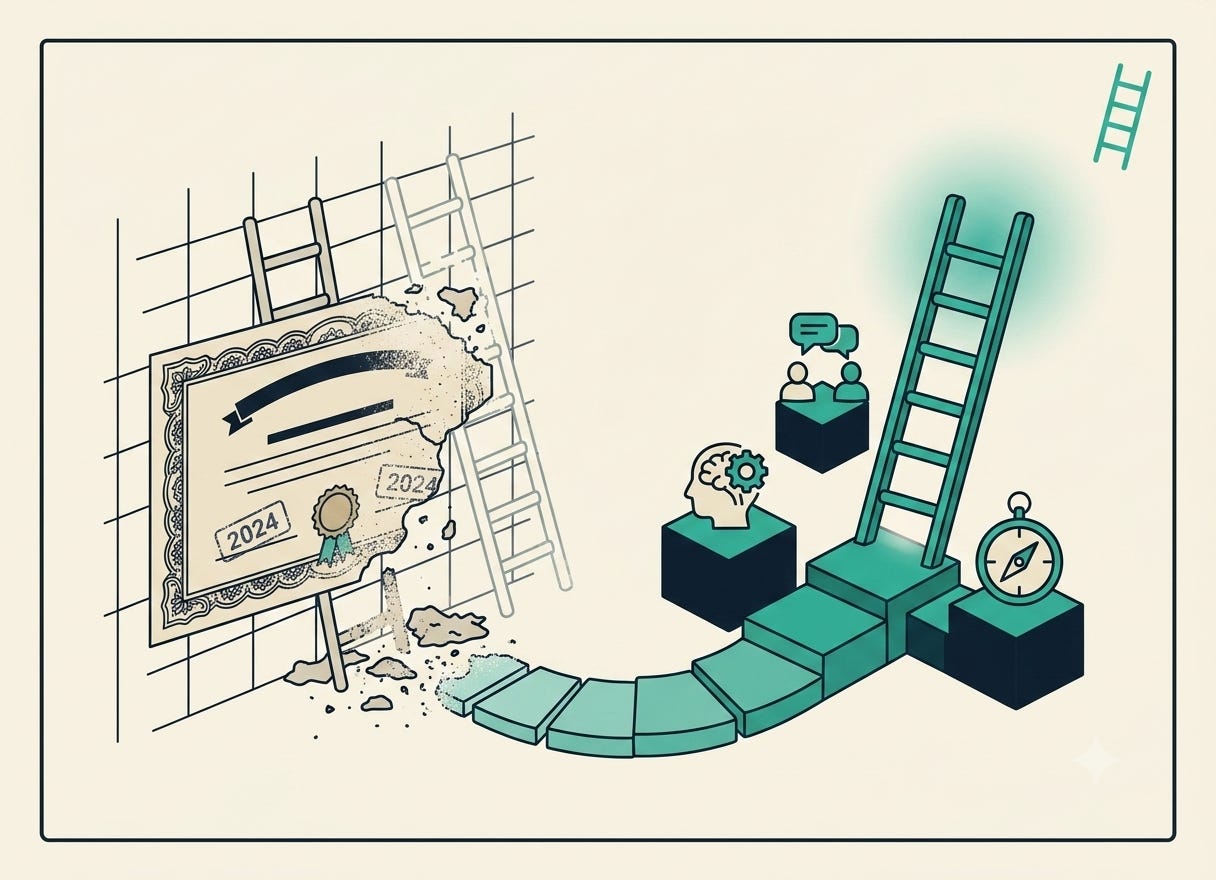
The half-life of technical skills is now under two and a half years. That estimate comes from BCG and Harvard Business Review, and it means a certificate granted once and held for life is, in a labour market moving this fast, a polite fiction.
Which is an uncomfortable thing to say to a parent, because the entire map most parents are using runs through certificates. Do well at school, get the grades, get the degree, get the job. That map worked. It worked for me, more or less, and it probably worked for you. The problem is not that the map was wrong. The problem is that the city it describes is being demolished.
Here is the mechanism, briefly. For most of the last century the exam was a convenient proxy for employability, because the economy rewarded exactly the behaviours the exam selected for. Remembering, collating, summarising, writing up. The orchestration work. And the orchestration work is exactly what AI absorbs first. When the work the exam selects for is the work the technology replaces first, the proxy breaks. Grades still measure what a written test can measure. The measured attribute has simply stopped being the best predictor of whether a student will have a career at thirty-five.
So what replaces it? I have skin in this game, I should say. I co-founded Enterprise Skills and built Skills Hub, a platform that measures the eight workplace capabilities AI does not replicate, things like decision-making, adaptability, team collaboration, leadership. Comprehension of business concepts among students using it improved by 73 per cent against traditional teaching. I have since left the business, but the thesis has not changed: the qualifications schools measure are becoming weaker signals every year, while the human capacities they do not measure are becoming priceless.
One scene from the chapter, because it shows the difference better than I can explain it. A Year 10 student scores 34 out of 100 on commercial awareness at the start of term. Below average, not alarming, the kind of score that leaves a person with an impression of themself as not-that-strong on the subject. Halfway through a supply-chain simulation, in a team of four, under time pressure, they spot a pricing margin error none of her teammates see. They say so. The team recalculates. Their score moves to 51, because they demonstrated the capability in action against a real-looking problem with other people in the way.
An exam cannot do that. It can ask her to explain what a pricing margin is. It cannot put her in a room where the margin is wrong and observe whether she notices. And that difference, between knowing and doing, is the difference employers care about most.
Chapter 13 of the book goes through the whole of this: what capability-based assessment actually looks like in a classroom (which, I should say, looks almost exactly like the classroom you were in thirty years ago), why the certificates in that system deliberately expire, the eight-minute parents’ evening where a teacher tries to put a second map on the table without telling the parent their own lived experience is wrong, and the four practical moves a parent can make now, before any of this reaches their child’s school. The first move costs nothing: at the next parents’ evening, ask what your child can do that a written test will never surface. The teacher will know. The report will not have asked.
The other three moves are in the chapter.
This is from Chapter 13 of The Next Rung, my book on what AI displacement actually looks like from inside. It’s open for pre-order now: