
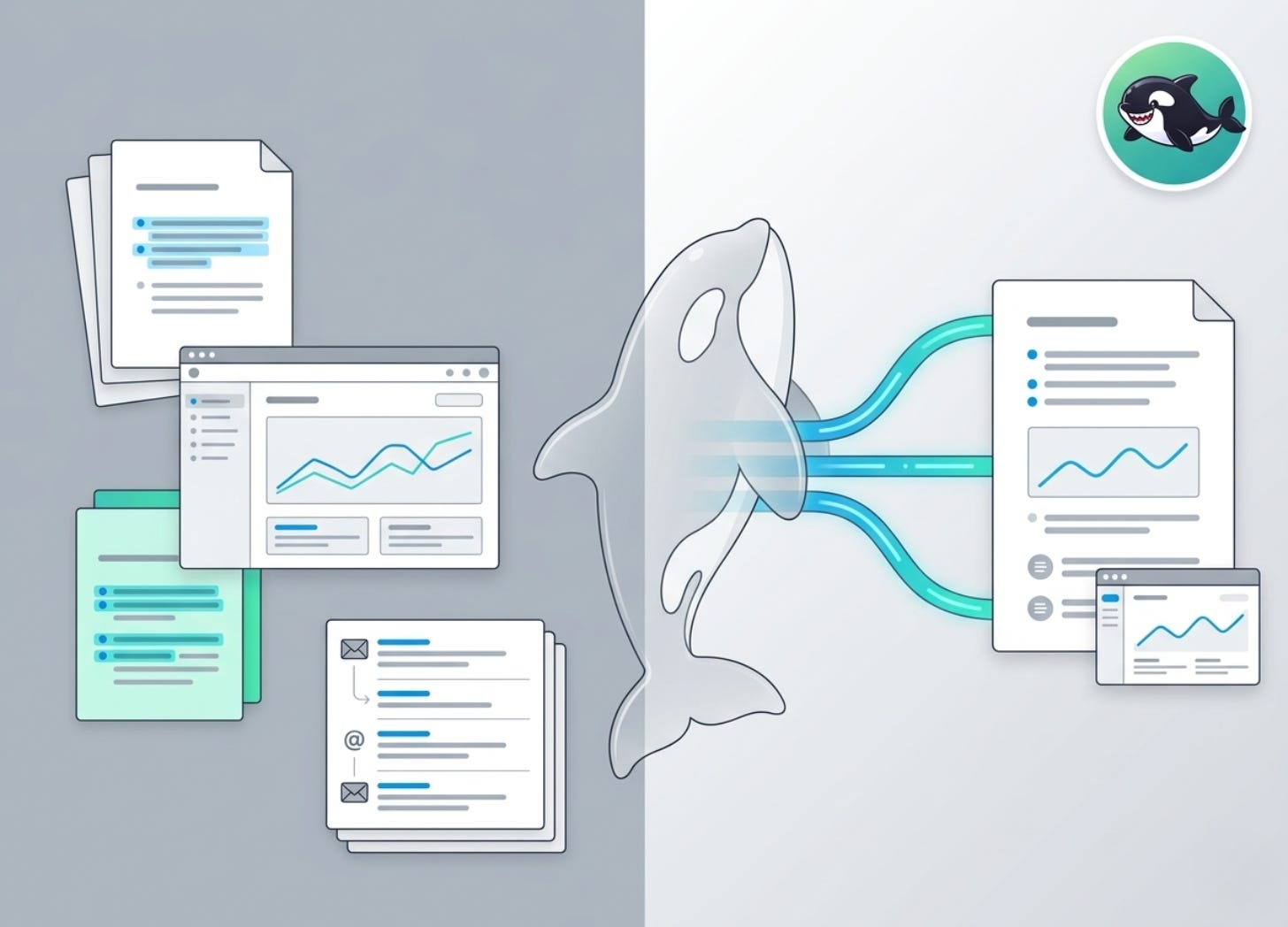
I’m writing a book that argues orchestration jobs are the first layer to fall to AI. I’m also selling a product that automates orchestration work. If you’re reading this thinking those two things shouldn’t coexist, you’re seeing the same contradiction I see. That’s the whole thing.
Let me be direct about what happened. I didn’t build Orca in ignorance of what it would do. I built it in full knowledge. I watched the labour market signal for three years. I watched hiring freezes replace hiring. Watched contractors not get renewed. Watched graduates send 200 applications for work that would have been guaranteed five years ago. Then I watched what’s left of those jobs hollow out underneath from the inside as the tools got better every quarter.
The honest position: the tools get built whether I build them or not. The market has decided that orchestration can be automated. Three or four major companies are deploying autonomous agent swarms into these roles right now. If I don’t build Orca, someone else does. If nobody builds anything, the tools exist anyway, just worse, more expensive, less transparent about what they’re doing. The choice isn’t between building and not building. It’s between building carefully, in public, with the argument about impact visible, or stepping aside while someone else builds it without that honesty.
So I built it in public. I wrote the book arguing what was coming. I’m building the tool. I’m not pretending they don’t interact. This piece is me sitting in that interaction and explaining why I think it’s the only way to be credible in this market.
The Next Rung is a book on how AI is quietly dismantling the middle of knowledge work, and what you can do about it before the market decides for you: pre-order it before it publishes in January.
What Orca actually is
Orca is a native macOS application built on Tauri 2, React 19, TypeScript, running on Supabase in the back end. It integrates with your email, your calendar, transcripts from your meetings, your tasks, your contacts. It’s sold as a managed service on Claude API. Two hundred and fifty pounds a month, personalised setup, one-to-one onboarding with me.
Here’s what it does.
Calendar integration plus CRM plus email plus LinkedIn history produces a meeting brief in under a minute. Background research. Relationship history. What they’re working on now. What they asked about last time. Commercial context from Companies House. The whole picture that used to require someone spending half a day on research and coordination work. Now it’s generated, reviewed, and ready.
Follow-up emails. You finish a meeting, Orca has watched the transcript, it knows what was agreed, it understands your voice from previous emails, and it drafts next steps in your tone. Not templated. Not generic. Actually your voice.
Inbox triage. Three hundred emails a day becomes thirty flagged items and a summary. The ones that need action now. The ones waiting on response. The ones you should probably read but don’t need to act on. The ones that are just FYI.
CRM management that doesn’t require you to manually log every interaction. Calendar events feed through automatically. Notes get attached. Warmth scoring tells you which relationships are warm and which are cold by action, not by your memory.
LinkedIn content that’s actually in your voice. Not the corporate newsletter tone. Not the motivational poster energy. The way you actually think about the things you think about.
All of this runs continuously. It doesn’t take meetings off. It doesn’t need annual leave. A solo founder with Orca has the operational output of a PA, a social media manager, a CRM administrator, a research analyst, and a junior strategist.
That’s not hyperbole. That’s what it does, measurably, for the people currently using it.
Who it’s for
Founders who can’t afford (or don’t want) an operations person but who are drowning in coordination work. Directors running consultancies and agencies where they’re the bottleneck. Anyone operating at a level where the work is mostly about knowing what’s happening, making decisions based on that knowledge, and then coordinating the outcome, but who’s currently spending two-thirds of their time just keeping the information flowing.
The clients who’ve found most value are people who were previously good enough at coordination that they could do it themselves, but who hated it. Not because they were bad at it. Because they were good enough to know it was taking up space that would be better used on thinking, strategy, relationship building, actual work that required them.
What it displaces
Here’s where the honesty matters.
Orca directly displaces the functional output of junior support roles. PAs, yes, but also research analysts, CRM administrators, social media coordinators, the people whose primary function is keeping information flowing between systems and people. Every user of Orca who’s replacing someone is contributing to the displacement this book describes.
Every demo I do, someone eventually asks the question quietly: what happens to Sarah. Not in those words usually. Usually it’s “what about my team” or “what happens to the person in this role.” This piece doesn’t answer that fully. Article three does. But the honest answer starts here: roles that are 80 per cent orchestration, 20 per cent something else, those roles are contracting. The maths is unavoidable.
Orca accelerates that contraction. It makes the contraction cheaper, easier, more technically feasible. It reduces the friction on something that was going to happen anyway.
Why this is the only credible position
If I were selling Orca while claiming it wouldn’t displace anyone, you’d be right to dismiss me. If I were selling Orca while denying that displacement was happening at all, you’d be right to think I was either lying or willfully ignorant.
Instead, I’m saying: I know what this does. I’m selling it anyway. Here’s why that’s honest instead of hypocritical.
First, the alternative to my building this isn’t no displacement. It’s worse displacement. It’s a proprietary tool sold by a company that doesn’t have to sit inside the consequences. It’s an internal capability built by a larger company that does the same work without the transparency.
Second, I’m visible. Every user can see what’s happening. Every pitch includes the full picture of what the work was and what Orca does with it. I’m not hiding the displacement inside generic language about “augmentation” and “productivity.” I’m showing it.
Third, I’m betting my credibility on the advice in the book. If the displacement thesis is wrong, if orchestration work actually absorbs people and grows, then I look foolish for building this. That’s a real downside I’m carrying. It’s not enough to offset the harm if I’m wrong, but it’s not nothing either.
Fourth, the people buying Orca are getting advice. Not just from the tool. From me, through the setup and the ongoing relationship. That advice says: use the time you’ve freed up to get better at the work that actually matters. Build the relationships deeper. Think about strategy that’s actually novel. Do the work only you can do. Don’t just offload the coordination and move on to the next layer of coordination above it.
The Next Rung is a book on how AI is quietly dismantling the middle of knowledge work, and what you can do about it before the market decides for you: pre-order it before it publishes in January.
The hardest part of a demo
I do a demo of Orca at least three times a week now. The hardest moment comes at the end.
After the brief is generated, after the follow-up email is drafted, after the inbox is triaged and the CRM is current and the LinkedIn content is posted, there’s usually a pause. The person I’m showing it to is usually a founder or a director. They’re relieved. Visibly, unmistakably relieved. The thing that’s been sitting on their shoulders, the weight of coordination work they’ve been carrying for years, has a path off.
But then they say something like: “So what does Sarah do now?” Not bitter. Usually not angry. Often with a kind of uncomfortable recognition in their voice.
Sarah in this case is whoever’s been doing the coordination work. Usually it’s someone junior, someone talented enough that they’d be good at it, often someone who went into it thinking it was the path toward strategy work, and who’s now realised it’s the path toward being made redundant.
I answer the question. I give them the honest version. And I watch them work through the moral mathematics of it. Want the tool, want the time back, want their business to run better, and also want Sarah to have a job. Those things don’t coexist anymore. The tool makes it impossible to have both.
That’s the moment where building this in public, with the argument about impact visible, matters. Because I’m not pretending the maths is different. I’m showing it. And the conversation that happens next, about what Sarah could do instead, about how to handle the transition, about what work actually requires a human, that conversation is the one that should happen, and almost never does.