
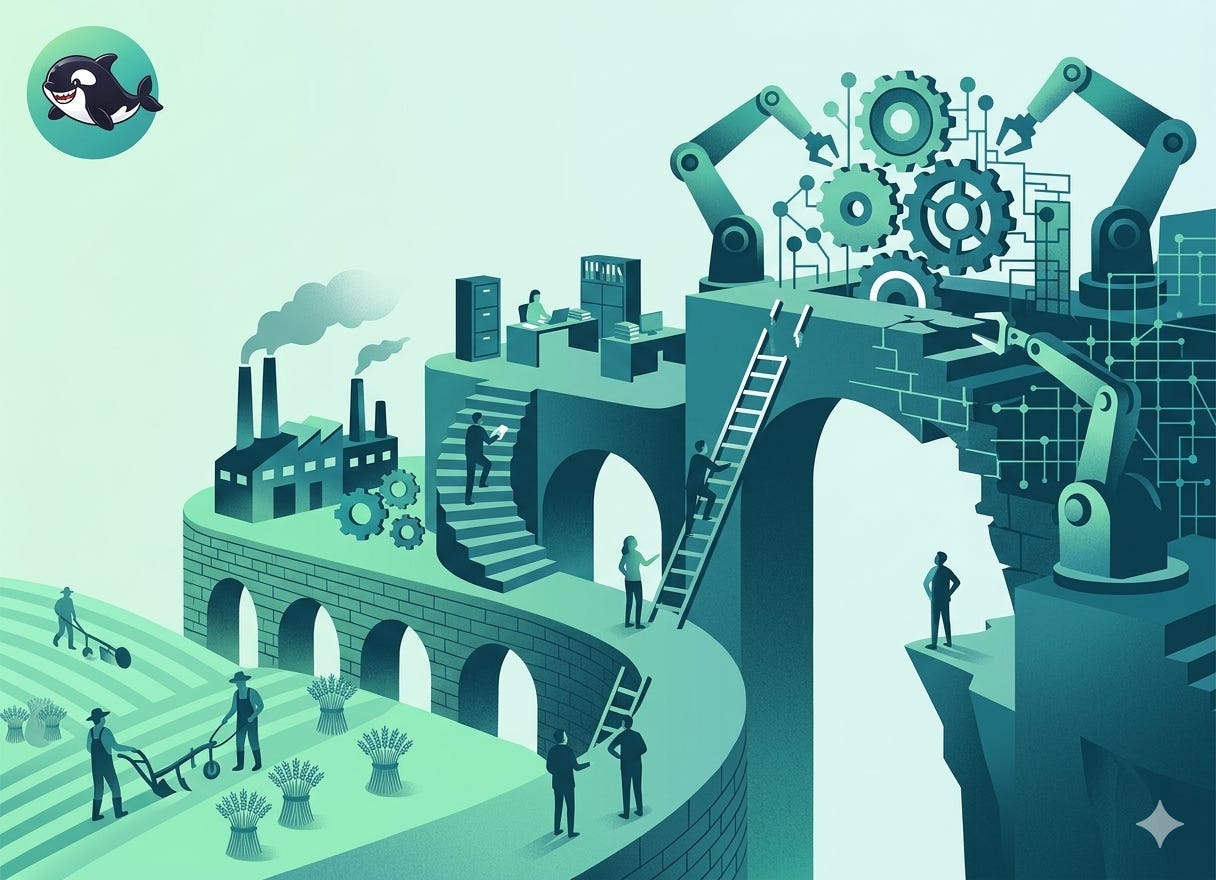
In 1790, ninety per cent of Americans worked on farms. Today it’s less than two per cent. Nobody rioted over that transition. Nobody needed to. The factories were hiring.
Every previous technological revolution had somewhere for displaced workers to go. Agricultural workers moved to factories because factories actually needed bodies. Factory workers moved to offices because the service economy needed organisers, coordinators, managers. Office workers moved into knowledge work because the professional class was expanding and needed people to do the cognitive grunt work. There was always a next rung on the ladder. Not comfortable, not always higher, but a rung.
The pattern ran so consistently that economists gave it a name: the Luddite Fallacy. The Luddites themselves, in 1811, were textile workers who smashed stocking frames because the new machinery was destroying their livelihoods. They turned out to be right about the immediate consequences and wrong about the long-term ones. The machines did destroy their jobs. But mechanised textiles grew enormously, employed far more people than before (in different roles, at different wages), and kicked off an expansion that eventually raised living standards for nearly everyone. For two hundred years, the Luddites were wrong. Technology destroyed jobs in one place and created them somewhere else, usually somewhere better.
Which is why, when anyone worries about technology and employment, the standard response has been: it was fine last time.
The Next Rung is a book on how AI is quietly dismantling the middle of knowledge work, and what you can do about it before the market decides for you: pre-order it before it publishes in January.
Here’s the thing that actually matters about why it was fine last time. The mechanism wasn’t magic. It was mechanical. Three specific things happened in every previous transition, and all three of them are cracking now.
First, new technology created demand for new tasks. Someone had to build the machines, operate them, maintain them, sell what they produced, transport it, market it, finance it, insure it. Each wave of automation generated a cascade of adjacent human work that hadn’t existed before. The steam engine freed humans from doing the work horses did. It still needed people to operate, maintain, and build around it.
Second, productivity gains reduced costs, which increased demand, which created more work. When factories made clothing cheaper, more people bought clothing. When computers made information cheaper, more people consumed information. Cheaper output meant bigger markets meant more jobs. The gains spread through the economy because the new industries needed workers, and workers with income became consumers.
Third, displaced workers had transferable skills. A farm labourer could learn to operate a loom. A typist could learn to use a word processor. The cognitive distance between the old job and the new one was manageable. You didn’t become a fundamentally different person. You learned a new tool.
These three things, new task creation, demand expansion, and skill transferability, held up every transition from agriculture to industry to services to knowledge work. The question is whether all three hold this time.
Here’s what’s actually happening: they’re all cracking at once.
The Next Rung is a book on how AI is quietly dismantling the middle of knowledge work, and what you can do about it before the market decides for you: pre-order it before it publishes in January.
New task creation is cracking because AI is not a narrow technology. It’s not a substitute for one thing. It’s a general substitute for the cognitive work that knowledge workers do across the board: reading, writing, analysing, coordinating, summarising, recommending, deciding. When you automate a narrow task, adjacent tasks remain for humans. When you automate the general cognitive toolkit, the question of what adjacent tasks remain becomes much harder to answer.
Demand expansion is holding, but the gains aren’t spreading. AI does create productivity. McKinsey estimates that thirty per cent of work hours in the US economy could be automated by 2030. But productivity gains don’t distribute themselves. They flow to whoever owns the AI systems, and the AI systems don’t need many humans to operate. The steam engine needed operators. The assembly line needed workers. The AI system needs a data centre, an electricity supply, and a handful of engineers. The humans it replaces don’t get absorbed into operating it, because there’s nothing to operate.
And skill transferability is visibly broken. The skills that survive AI automation are different in kind, not just in degree. They’re things like genuine creative vision, complex relationship management, strategic judgment under genuine uncertainty. These aren’t skills you learn in a six-month retraining programme. They’re capacities that develop over years, sometimes decades, sometimes from childhood. Some people have them latent and never used them. Many simply don’t.
The historical comparison here is instructive. When coal communities were promised that miners could retrain as software developers, the programmes mostly failed. Not because miners were stupid. But because the cognitive distance was too great, the geographic mismatch was severe, and a fifty-year-old with seventeen years of industry-specific career capital wasn’t going to start at entry level in a field where twenty-five-year-olds had a structural advantage. The transition needed a generation.
AI displacement is the coal-to-tech problem at a hundred times the scale, compressed into a fraction of the time.
The adoption curve for AI is faster than anything in the history of technology. ChatGPT reached one hundred million users in two months. The telephone took seventy-five years. By August 2025, over half of American adults were using generative AI tools. Previous transitions gave labour markets decades to adjust. AI gave them roughly five years, from mainstream availability in 2023 to restructuring necessity by 2028.
The honest position is directional confidence with precise uncertainty. The direction is clear: AI is automating cognitive work at a speed and scale that breaks the historical pattern of job absorption. The precision is absent: we don’t know whether the net displacement will be ten per cent of knowledge work or fifty per cent. But we know it’s happening.
And it’s happening quietly. Not in headlines yet. In hiring freezes instead of layoffs. In contractors who don’t get renewed. In graduates who apply to two hundred jobs and get three interviews. In ground that moves so slowly you can tell yourself it’s not moving at all.
Until it is.
Which brings us to the part that actually matters: when all three absorption mechanisms are breaking simultaneously, you can’t rely on “it was fine last time” to be right again. The next rung was fine last time because it existed. The question isn’t whether the next rung exists. The question is whether anyone’s built one, and whether displaced workers can reach it. Right now, the answer to both is no. And the time to change that answer is measured in years, not decades.